The question asks to identify an alkaline earth metal from the given options. This requires knowledge of the classification of elements in the periodic table, specifically the groups to which different types of metals belong.
Correct Option: A) Magnesium is an alkaline earth metal, belonging to Group 2 of the periodic table.
To determine the minimum score Zareen needs, we first calculate Pragya's total score. Then, we find Zareen's current total score. To match Pragya's performance, Zareen's final average must be at least Pragya's average. We need to find the minimum score Zareen must achieve in one of the remaining tests, assuming she scores the minimum possible (0) in the other two, to reach Pragya's total score.
Pragya's average score in 15 tests is 24 marks.
\[ \text{Pragya's total score} = \text{Average score} \times \text{Number of tests} \] \[ = 24 \times 15 = 360 \text{ marks} \]Zareen's average score in 12 tests is 23 marks.
\[ \text{Zareen's current total score} = \text{Average score} \times \text{Number of tests} \] \[ = 23 \times 12 = 276 \text{ marks} \]To match Pragya's performance, Zareen must also achieve a total score of at least 360 marks over 15 tests.
Zareen has 3 tests remaining. To find the minimum score she needs in any one of these tests to still have a chance to match Pragya's performance, we assume she scores the lowest possible marks (0) in the other two remaining tests. This means the entire deficit of 84 marks must be covered by a single test.
Since each test is out of 30 marks, a score of 84 marks in one test is impossible. This implies that Zareen needs to distribute these marks across the remaining tests.
The question asks for "at least how much does Zareen have to score in any one of the remaining 3 tests to still have a chance to match Pragya’s performance". This implies we are looking for a scenario where she can still achieve the target. If she scores 0 in two tests, she needs 84 in one, which is impossible.
Let's re-interpret the question: "at least how much does Zareen have to score in any one of the remaining 3 tests" means what is the minimum score required in one test, given that she can score optimally in the other two tests (up to 30 marks each).
Let the scores in the remaining three tests be \(T_1, T_2, T_3\). We need \(T_1 + T_2 + T_3 = 84\). Each \(T_i \le 30\).
To minimize one score, say \(T_1\), we must maximize the other two scores, \(T_2\) and \(T_3\).
Maximum possible score for \(T_2 = 30\).
Maximum possible score for \(T_3 = 30\).
So, the maximum sum of two tests is \(30 + 30 = 60\).
Then, the minimum score for \(T_1\) would be:
\[ T_1 = 84 - (T_2 + T_3)_{\text{max}} \] \[ T_1 = 84 - 60 = 24 \text{ marks} \]So, Zareen must score at least 24 marks in one of the remaining tests, assuming she scores 30 in the other two, to achieve a total of 360 marks.
Correct Option: A) 24
It was Monday on 5th February 2018. What was the day of the week on 5th February 2009?
To find the day of the week on a past date, we need to calculate the number of odd days (remainder when the total number of days is divided by 7) between the given date and the target date. We will count the number of normal years and leap years between 2009 and 2018, calculate the total odd days, and then subtract these odd days from the given day.
Correct Option: C) Thursday
This is an alphanumeric series question. We need to analyze the pattern for both the numerical and alphabetical parts separately to find the next term.
The numbers in the series are \(2, 8, 26\).
Let's look at the differences or a multiplicative pattern:
Following this pattern, the next number should be:
\[ 26 \times 3 + 2 = 78 + 2 = 80 \]The letters in the series are \(S, V, Y\).
Let's find their positions in the English alphabet (A=1, B=2, ...):
Now let's look at the difference in positions:
Following this pattern, the next letter should be 3 positions after Y.
Y is the \(25^{\text{th}}\) letter. Counting 3 letters forward from Y:
So, the next letter is B.
The next number is \(80\).
The next letter is \(B\).
Therefore, the next term in the series is \(80B\).
C) 80B — This matches our calculated next term by following the patterns for both the numerical and alphabetical parts of the series.
The question asks to identify the author of the book 'I Do What I Do', published in 2017. This requires knowledge of prominent authors and their works, particularly those related to economics and public policy in India.
Correct Option: A) Raghuram Rajan is the author of the book 'I Do What I Do: On Reform, Rhetoric and Resolve', which was published in 2017. The book is a collection of his speeches and essays from his time as the Governor of the Reserve Bank of India.
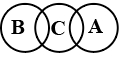
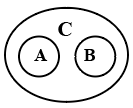
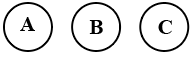
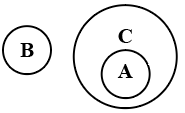
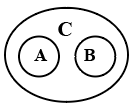
Which of the following correctly represents the relationship between:
A) Light
B) Heat
C) Sun
To determine the correct relationship between Light (A), Heat (B), and Sun (C), we must understand how these elements are interconnected. The Sun is the source of both light and heat.
Correct Option: B) The diagram correctly shows A and B as subsets within C, indicating that both light and heat come from the Sun.
The question asks to identify the first metalloid in the modern periodic table. This requires knowledge of the classification of elements and their positions in the periodic table.
B) B (Boron) is the first metalloid in the modern periodic table, located in Period 2 with atomic number 5.
This is a direction and distance problem. We need to track Niki's movements step-by-step and then calculate the shortest distance from her final position to her starting point. We can visualize her path or use coordinate geometry.
Alternatively, we can visualize the movements:
Notice that BC and DE are equal in length and opposite in direction, meaning Niki's north-south displacement cancels out. Her net movement is only in the east-west direction.
So, she is 4 km from her starting point towards the west.
C) 4 km - Based on the step-by-step calculation, Niki is 4 km away from her starting point.
The question asks for the state where the Sunderbans Tiger Reserve is located. This is a direct factual question related to Indian geography and wildlife conservation. Knowledge of the location of major national parks and tiger reserves in India is essential for competitive exams.
Correct Option: C) The Sunderbans Tiger Reserve is a renowned tiger reserve and a UNESCO World Heritage Site located in the Sunderbans delta in the state of West Bengal, India. It is famous for its unique mangrove ecosystem and its population of Royal Bengal Tigers.
Which figure follows next in the below series?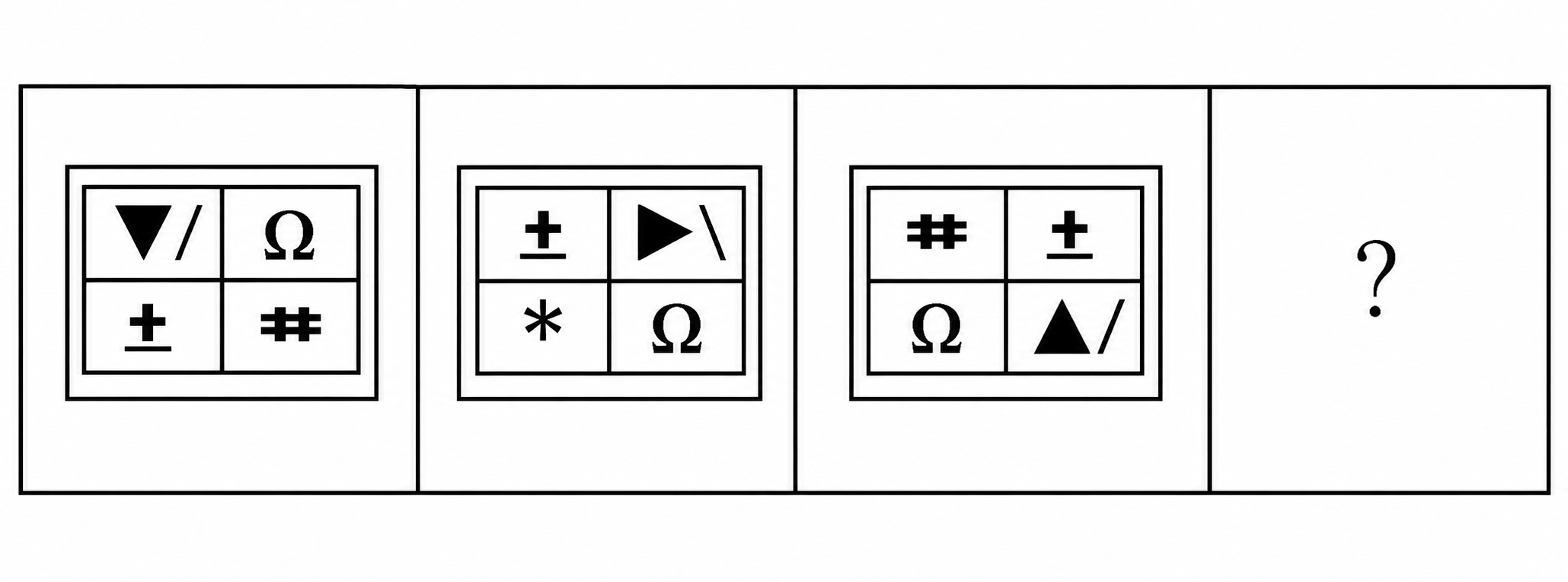
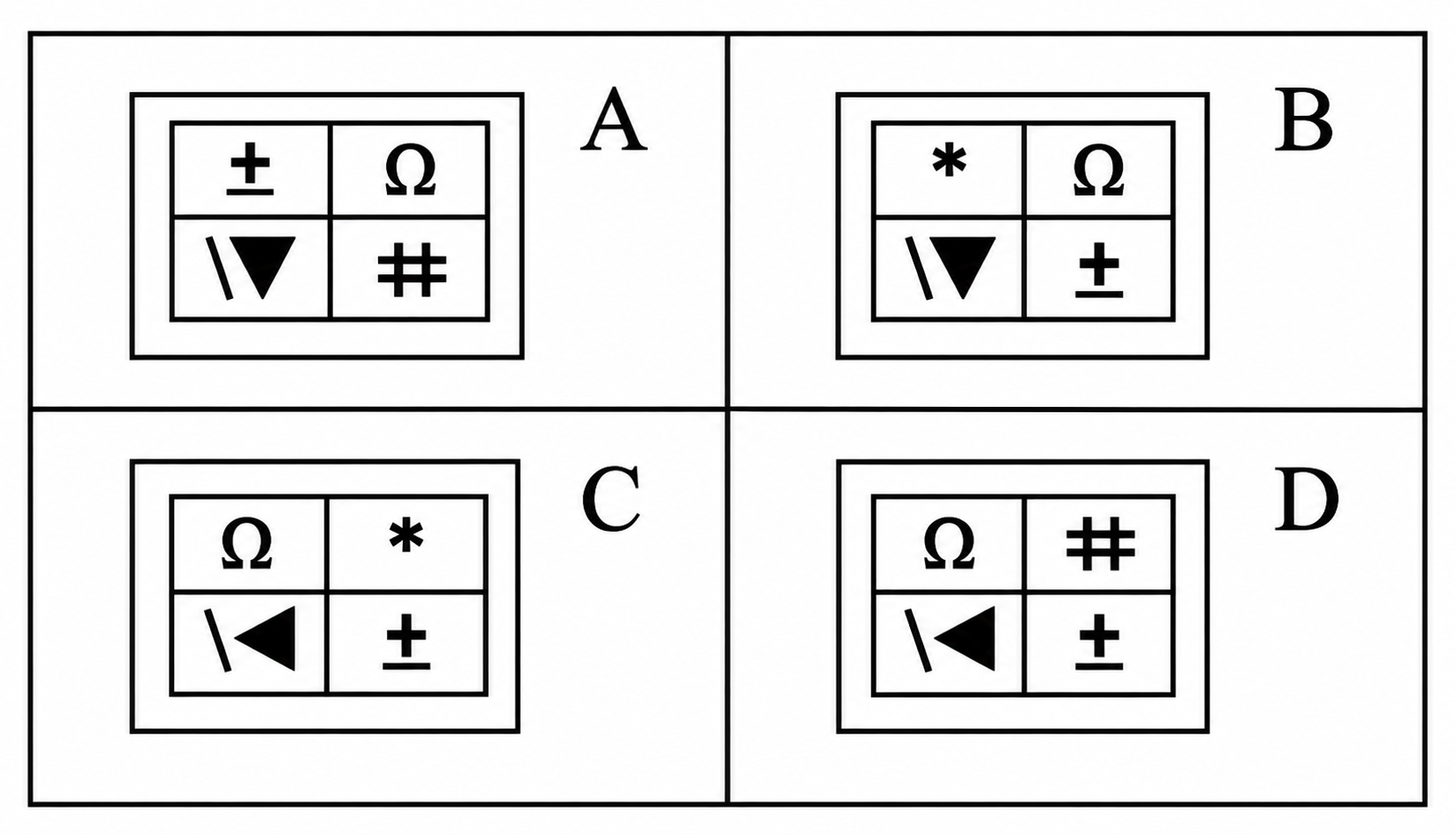
The problem involves identifying the pattern in the sequence of figures and determining which option logically follows the given series.
Correct Option: A) The symbols have rotated clockwise to match the pattern.