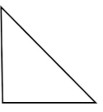
110 ÷ [53 − {43 − (37 − 136 ÷ \( \overline{17 \times 2} \))}] =?
The question asks us to identify the relationship between the first pair of words and then apply the same relationship to the third word to find the missing fourth word. This is a word analogy problem.
Correct Option: A) Change — "Change" is a direct synonym for "Modify". Both words refer to making something different from what it was before, often with an intention of improvement or adaptation. This relationship is parallel to "Repair" and "Edit", which also denote making corrections or improvements.
Select the mirror image of the figure given below.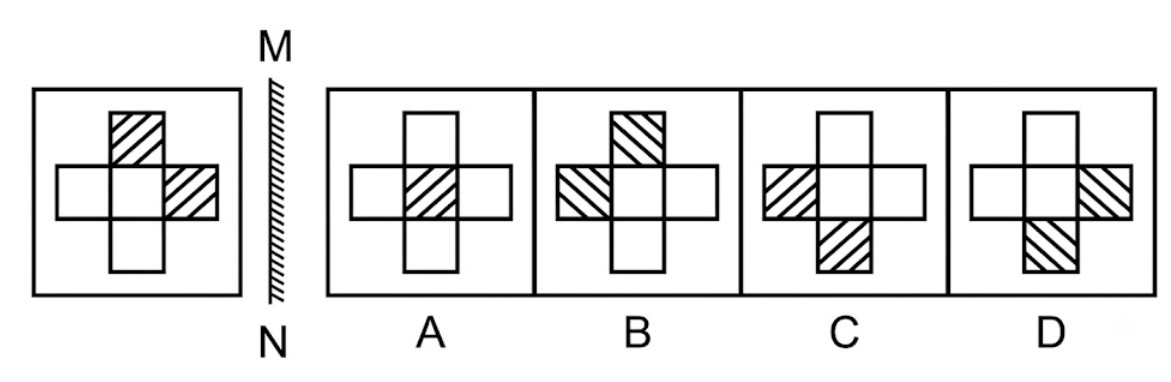
To find the mirror image of a figure, we need to reflect the elements across the mirror line, which in this case is labeled as MN. The mirror image will have the same shape and size but reversed orientation.
Correct Option: A) The shaded area is correctly positioned on the left arm, matching the mirror image.
A worker takes a 15 kg piece from the ground and puts it on his head, 1.0 m above the ground. Calculate the work done by him on the goods. (g = 10 m s-2)
To calculate the work done by the worker on the goods, we need to determine the change in the potential energy of the goods. Work done against gravity is equal to the change in gravitational potential energy. The formula for work done against gravity is \(W = mgh\), where \(m\) is the mass, \(g\) is the acceleration due to gravity, and \(h\) is the vertical height.
Identify the given values:
Recall the formula for work done against gravity:
The work done (\(W\)) by the worker on the goods to lift them against gravity is given by the formula for potential energy:
\[W = mgh\]Substitute the values into the formula:
\[W = (15 \text{ kg}) \times (10 \text{ m s}^{-2}) \times (1.0 \text{ m})\]Calculate the work done:
\[W = 150 \text{ J}\]B) 150 J is the correct answer. The calculation \(W = mgh = 15 \text{ kg} \times 10 \text{ m s}^{-2} \times 1.0 \text{ m} = 150 \text{ J}\) directly yields this value.
A) 155 J — This value is incorrect. It might result from an arithmetic error or using a slightly different value for \(g\) (e.g., \(g \approx 10.33 \text{ m s}^{-2}\)) or a miscalculation of mass or height.
C) 140 J — This value is incorrect. It might result from an arithmetic error or using a different value for \(g\) (e.g., \(g \approx 9.33 \text{ m s}^{-2}\)) or a miscalculation of mass or height.
D) 100 N — This option is incorrect for two reasons. Firstly, the unit for work done is Joules (J), not Newtons (N). Newtons is the unit for force. Secondly, the numerical value is also incorrect for the work done.
The question asks to identify the true statement(s) regarding properties of matter. We need to evaluate each statement (A and B) based on the definitions of physical properties like hardness and shape, and how they apply to different states of matter (solids, liquids, and gases).
Statement A defines hardness as the property of matter to allow volume reduction under high pressure, and states that this property is shown by gases. This definition is incorrect. Hardness is typically defined as the resistance of a material to deformation, indentation, or scratching. The property described as "allowing volume reduction under high pressure" is compressibility. While gases are highly compressible, the statement incorrectly labels this property as "hardness." Therefore, statement A is false.
Statement B defines shape as the property of a substance that flows easily and allows it to change its shape under external force, and states that this property is exhibited by both liquids and gases. This definition is also incorrect. The ability to flow easily and change shape under external force is characteristic of fluids (liquids and gases). However, the term "shape" itself refers to the external form or outline of an object. Liquids and gases do not have a fixed shape; they take the shape of their container. The statement incorrectly defines "shape" as the property of flowing and changing shape. While liquids and gases do flow and change shape, the property described is fluidity or lack of fixed shape, not "shape" as a property in itself in this context. Therefore, statement B is false.
Since both statements A and B are false, the correct option is the one that states both are false.
A) Both A and B are false.
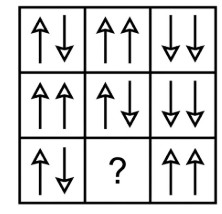
From the given alternatives, select the figure which can be substituted for the question mark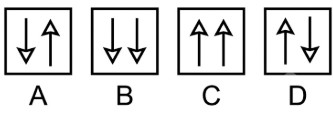
The problem involves identifying a pattern in the given grid of arrows and selecting the option that correctly fits the missing space marked with a question mark.
Correct Option: A) Option A fits the pattern as it has arrows pointing down, which is required for the second cell of the third row.
Which alphanumeric set follows the given series?
S-81, ?, O-49, M-36, K-25
The problem presents a series of alphanumeric sets, and we need to find the missing set. We should analyze the pattern for both the alphabetical and numerical parts of the series separately.
C) Q-64 — This option correctly follows both the alphabetical and numerical patterns identified.
The liquefaction and boiling temperatures of a compound are directly related to the strength of the intermolecular forces present. Stronger intermolecular forces require more energy to overcome, leading to higher boiling and liquefaction points. We need to compare the types and strengths of intermolecular forces in the given compounds.
A) Acetic Acid has the strongest intermolecular forces due to the formation of stable hydrogen-bonded dimers. This requires significantly more energy to overcome during phase transitions, leading to the highest liquefaction and boiling temperatures among the given compounds.
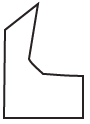
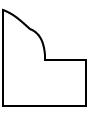
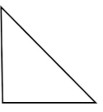
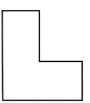
Consider the following figure (X), figures a, b, c, and d the figure that can be formed by the pieces of figure (X)-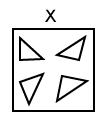
The problem involves assembling a set of given shapes into a complete figure. We need to identify which option correctly forms the figure using the pieces provided.
Correct Option: C) The pieces fit together seamlessly to form a complete figure.
The problem asks for the number of employees working in company A, given the total population and percentages of people working in different companies or not working. We need to first find the total number of people who are employed, then calculate the number of people working in company A based on the given percentages, accounting for those who work in both companies.
Calculate the number of people who are employed:
The total population is 400. It is given that 20% of the population does not work.
\[ \text{Population not working} = 20\% \text{ of } 400 = \frac{20}{100} \times 400 = 80 \]\[ \text{Total employed population} = \text{Total population} - \text{Population not working} \]\[ \text{Total employed population} = 400 - 80 = 320 \]Calculate the percentage of employed people who work in company A only, company B only, and both:
Let \( N_A \) be the percentage of employees working in company A, \( N_B \) be the percentage of employees working in company B, and \( N_{A \cap B} \) be the percentage of employees working in both companies.
Given:
The percentage of employees working in company A only is:
\[ \text{Only A} = N_A - N_{A \cap B} = 45\% - 10\% = 35\% \]Calculate the total percentage of unique employees:
The percentage of employees working in company B only is:
\[ \text{Only B} = N_B - N_{A \cap B} = 45\% - 10\% = 35\% \]The total percentage of employees working in at least one company is:
\[ \text{Total unique employees (percentage)} = \text{Only A} + \text{Only B} + N_{A \cap B} \]\[ \text{Total unique employees (percentage)} = 35\% + 35\% + 10\% = 80\% \]This 80% represents the proportion of the employed population that works in company A, company B, or both. This is a crucial distinction. The percentages given (45%, 45%, 10%) are percentages of the employed population, not the total population.
Calculate the number of employees working in company A:
The question asks for the total number of employees working in company A. This includes those who work only in A and those who work in both A and B.
The percentage of employed people working in company A is given as 45%.
\[ \text{Number of employees in Company A} = 45\% \text{ of Total employed population} \]\[ \text{Number of employees in Company A} = \frac{45}{100} \times 320 \]\[ \text{Number of employees in Company A} = 45 \times 3.2 \]\[ \text{Number of employees in Company A} = 144 \]Correct Option: D) 144