
The question asks to identify the lead actor in the 2017 movie "Hindi Medium". This requires knowledge of popular Indian cinema and the cast of specific films.
The movie "Hindi Medium" is a well-known Bollywood film that addresses the issue of language barriers and the education system. The central character, Raj Batra, was portrayed by the acclaimed actor Irrfan Khan.
C) Irrfan Khan played the lead role of Raj Batra in the movie "Hindi Medium" (2017). The film was a critical and commercial success, and Irrfan Khan's performance was widely praised.
This is a direction sense problem. We need to determine the final direction A is looking at after turning his head. We start with his initial facing direction and then apply the turn.
To visualize this, imagine a compass:
Correct Option: A) South
The question asks for the meaning of 'p' in the pH scale. The pH scale is a measure of the hydrogen ion concentration in a solution. Understanding the etymology and scientific convention behind the 'p' is key to answering this question.
D) Potenz, which means power in German. This is the correct origin and meaning of 'p' in pH, referring to the German word "Potenz" for power or potential.
Consider the following question and decide which of the statements is/are sufficient to answer the question.
Question: Find the value of Z from the statements.
Statement: I) A + Z = 19
II) Z + P = 12
Only statement II is sufficient.
Neither statement I nor II is sufficient
Either statement I or II is sufficient.
Only statement I is sufficient.
This is a data sufficiency question. We need to determine if the given statements provide enough information to find the unique value of 'Z'. We will analyze each statement individually and then combine them if necessary.
Statement I gives the equation: \(A + Z = 19\).
From this equation, we can express Z as \(Z = 19 - A\). Since the value of 'A' is unknown, 'Z' can take infinitely many values depending on 'A'. For example, if \(A=1\), then \(Z=18\); if \(A=5\), then \(Z=14\), and so on. Therefore, Statement I alone is not sufficient to find a unique value for Z.
Statement II gives the equation: \(Z + P = 12\).
From this equation, we can express Z as \(Z = 12 - P\). Since the value of 'P' is unknown, 'Z' can take infinitely many values depending on 'P'. For example, if \(P=1\), then \(Z=11\); if \(P=2\), then \(Z=10\), and so on. Therefore, Statement II alone is not sufficient to find a unique value for Z.
Combining both statements, we have a system of two equations:
We have three unknown variables (A, Z, P) and only two equations. We can express Z in terms of A from the first equation and in terms of P from the second, but we cannot find a unique numerical value for Z. For example, we can have:
Since Z can still take multiple values, even when both statements are combined, they are not sufficient to find a unique value for Z.
Correct Option: B) Neither statement I nor II is sufficient
This is a syllogism question. We need to analyze the given statements and determine which conclusions logically follow. We can use Venn diagrams to visualize the relationships between the categories (jaguars, cheetahs, leopards).
Analyze Statement 1: "Some jaguars are cheetahs."
This means there is an overlap between the set of jaguars and the set of cheetahs. Let's denote Jaguars as J and Cheetahs as C.
Possible Venn Diagram 1: A region where J and C intersect.
Analyze Statement 2: "Some cheetahs are leopards."
This means there is an overlap between the set of cheetahs and the set of leopards. Let's denote Leopards as L.
Possible Venn Diagram 2: A region where C and L intersect.
Combine the statements and consider possible scenarios for Jaguars and Leopards.
Since "Some jaguars are cheetahs" and "Some cheetahs are leopards", there are two main possibilities regarding the relationship between Jaguars and Leopards:
Possibility 1: No overlap between Jaguars and Leopards.
It's possible that the cheetahs that are jaguars are distinct from the cheetahs that are leopards, and there is no direct overlap between jaguars and leopards. In this case, "No leopard is jaguar" (Conclusion 1) would be true.
Example: If J = {A, B}, C = {B, D}, L = {D, E}. Here, B is a jaguar and a cheetah, D is a cheetah and a leopard. No jaguar is a leopard.
Possibility 2: Some overlap between Jaguars and Leopards.
It's also possible that some cheetahs are both jaguars and leopards, or that the overlap between jaguars and cheetahs extends to leopards. In this case, "Some jaguars are leopards" (Conclusion 2) would be true.
Example: If J = {A, B}, C = {B, D}, L = {B, D, E}. Here, B is a jaguar, a cheetah, and a leopard. So, some jaguars are leopards.
Evaluate the conclusions based on these possibilities.
Conclusion 1: "No leopard is jaguar." This is true in Possibility 1 but false in Possibility 2.
Conclusion 2: "Some jaguars are leopards." This is false in Possibility 1 but true in Possibility 2.
Determine the logical relationship between the conclusions.
Since both conclusions cannot be true simultaneously (if some jaguars are leopards, then it's not true that no leopard is jaguar, and vice-versa), and one of them must be true (as shown by the possibilities), they form a complementary pair. This is a case of 'Either/Or'.
As explained in step 5, based on the given statements, the relationship between jaguars and leopards is uncertain. They might not overlap at all, or they might overlap. Therefore, either "No leopard is jaguar" or "Some jaguars are leopards" must be true, but not both at the same time. This is a classic 'Either/Or' scenario in syllogisms.
A) Only conclusion 1 follows. — This is incorrect because conclusion 1 ("No leopard is jaguar") is not necessarily true. There's a possibility that some jaguars are leopards.
B) Both conclusions 1 and 2 follow. — This is incorrect because conclusions 1 and 2 are contradictory. If some jaguars are leopards, then it cannot be true that no leopard is jaguar, and vice versa.
D) Only conclusion 2 follows. — This is incorrect because conclusion 2 ("Some jaguars are leopards") is not necessarily true. There's a possibility that no leopard is a jaguar.
The question asks to identify the novel by George Saunders that won the 2017 Man Booker Award for Fiction. This requires knowledge of contemporary literary awards and their recipients.
George Saunders, an American writer, won the Man Booker Prize (now known as the Booker Prize) in 2017 for his novel Lincoln in the Bardo.
A) Lincoln in the Bardo — This is the correct title of the novel by George Saunders that won the 2017 Man Booker Award for Fiction. It is a historical novel that takes place in a graveyard over the course of one night in 1862, as Abraham Lincoln grieves the death of his son, Willie.
The question asks to identify the metal for which Mayurbhanj mines are known. This requires knowledge of the major mineral resources found in specific regions of India, particularly Odisha.
Correct Option: C) Iron-ore. The Mayurbhanj district in Odisha is a significant producer of high-grade iron ore, particularly from mines like Badampahar.
Which answer figure will replace the question mark (?) given in the question figure.
Question Figures: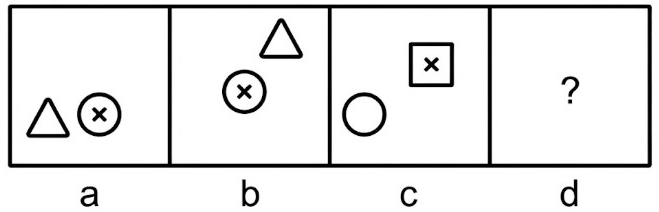
Answer Figures: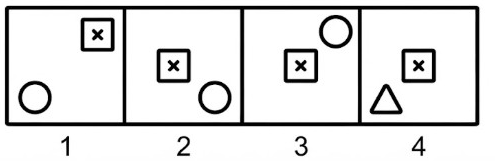
To solve this question, we need to identify the pattern or sequence in the given figures and apply it to find the missing figure.
Correct Option: B) 3
The velocity of a wave is 'v', frequency 'f', and wavelength 'λ' is ______?
v = \( \frac{1}{f\lambda} \)
v = \( \frac{f}{\lambda} \)
v = fλ
v = \( \frac{\lambda}{f} \)
This question asks for the fundamental relationship between the velocity, frequency, and wavelength of a wave. This is a standard formula in wave physics.
C) v = fλ is the correct relationship, as derived from the definitions of velocity, frequency, and wavelength.
The question asks about the substances responsible for the characteristic thickening of cell walls at the corners of collenchyma cells. This is a direct recall question from plant anatomy, specifically related to the composition of different plant cell walls.
A) Cellulose and Pectin: Collenchyma cell walls are characterized by uneven thickening, primarily at the corners, due to the deposition of cellulose, hemicellulose, and pectin. Pectin is particularly abundant and contributes significantly to the plasticity and flexibility of these walls, allowing for growth while providing support.