To find the equivalent resistance of resistors connected in parallel, we use the formula for parallel resistances. The reciprocal of the equivalent resistance is the sum of the reciprocals of individual resistances.
Identify the given resistances:
Recall the formula for equivalent resistance (\(R_{eq}\)) when resistors are connected in parallel:
\[ \frac{1}{R_{eq}} = \frac{1}{R_1} + \frac{1}{R_2} + \frac{1}{R_3} \]Substitute the given values into the formula:
\[ \frac{1}{R_{eq}} = \frac{1}{9} + \frac{1}{4} + \frac{1}{12} \]Find a common denominator for the fractions. The least common multiple (LCM) of 9, 4, and 12 is 36.
\[ \frac{1}{R_{eq}} = \frac{4}{36} + \frac{9}{36} + \frac{3}{36} \]Add the fractions:
\[ \frac{1}{R_{eq}} = \frac{4 + 9 + 3}{36} = \frac{16}{36} \]Simplify the fraction:
\[ \frac{1}{R_{eq}} = \frac{4}{9} \]To find \(R_{eq}\), take the reciprocal of the result:
\[ R_{eq} = \frac{9}{4} = 2.25 \, \Omega \]B) The equivalent resistance is \(2.25 \, \Omega\).
The problem asks us to find the next number in the given series: 2, 5, 9, 19. We need to identify the pattern or rule governing the sequence.
The question asks to identify the state or union territory where Anantnag city is located. This requires general knowledge of Indian geography.
Correct Option: B) Anantnag is a major city and district in the Union Territory of Jammu and Kashmir. It is located in the Kashmir Valley and is known for its historical and cultural significance, as well as being a gateway to many tourist destinations in the region.
This problem involves setting up and solving a system of linear equations based on the given age relationships. We will assign variables to the present ages of Ankita and Anu and then translate the given conditions into algebraic equations. Finally, we will solve these equations to find their present ages.
Define variables for present ages:
Let Ankita's present age be \(A\) years.
Let Anu's present age be \(U\) years.
Formulate the first equation from the first condition:
"Ankita is two years younger than Anu."
This means Anu is two years older than Ankita.
\[ U = A + 2 \quad \text{(Equation 1)} \]
Formulate the second equation from the second condition:
"After four years from today, Anu's age will be two times of Ankita's age three years ago."
Anu's age after four years from today: \(U + 4\)
Ankita's age three years ago: \(A - 3\)
According to the problem statement:
\[ U + 4 = 2 \times (A - 3) \quad \text{(Equation 2)} \]
Solve the system of equations:
Substitute Equation 1 into Equation 2:
\[ (A + 2) + 4 = 2(A - 3) \]
Simplify the equation:
\[ A + 6 = 2A - 6 \]
Subtract \(A\) from both sides:
\[ 6 = A - 6 \]
Add 6 to both sides:
\[ A = 12 \]
Find Anu's present age:
Substitute \(A = 12\) into Equation 1:
\[ U = 12 + 2 \]
\[ U = 14 \]
State the present ages:
Ankita's present age is 12 years.
Anu's present age is 14 years.
Correct Option: C) 12 years and 14 years
To solve this problem, we need to use the divisibility rule for 3. A number is divisible by 3 if the sum of its digits is divisible by 3. We will find the possible values of 'x' that satisfy this condition and then sum them up.
Correct Option: B) 15
The problem presents a series of alphanumeric terms. To find the next term, we need to identify the pattern for each component: the first number, the first letter, the second number, and the second letter.
Let's break down the given terms: 3X24C and 5V22E.
Combining these patterns, the next term in the series is 7T20G.
D) 7T20G is the correct option as it follows all the identified patterns for numbers and letters.
This problem involves calculating the rate of work done by a tap and a leak. We will determine the filling rate of the tap, the effective filling rate when the leak is present, and then use these to find the emptying rate of the leak alone. Finally, we can calculate the time taken to empty the full tank due to the leak.
Calculate the filling rate of the tap:
The tap fills the tank in 10 hours. So, in one hour, the tap fills \(\frac{1}{10}\) of the tank.
\[\text{Tap filling rate} = \frac{1}{10} \text{ tank/hour}\]Calculate the effective filling rate with the leak:
With the leak, it takes 11 hours to fill the tank. So, in one hour, the effective filling (tap - leak) is \(\frac{1}{11}\) of the tank.
\[\text{Effective filling rate} = \frac{1}{11} \text{ tank/hour}\]Calculate the emptying rate of the leak:
The effective filling rate is the tap's filling rate minus the leak's emptying rate.
\[\text{Effective filling rate} = \text{Tap filling rate} - \text{Leak emptying rate}\]Rearranging to find the leak's emptying rate:
\[\text{Leak emptying rate} = \text{Tap filling rate} - \text{Effective filling rate}\] \[\text{Leak emptying rate} = \frac{1}{10} - \frac{1}{11}\]To subtract these fractions, find a common denominator, which is 110:
\[\text{Leak emptying rate} = \frac{11}{110} - \frac{10}{110}\] \[\text{Leak emptying rate} = \frac{1}{110} \text{ tank/hour}\]Calculate the time taken to empty the tank due to the leak:
If the leak empties \(\frac{1}{110}\) of the tank in one hour, then to empty the entire tank (which is 1 unit), it will take the reciprocal of this rate.
\[\text{Time to empty} = \frac{1}{\text{Leak emptying rate}}\] \[\text{Time to empty} = \frac{1}{\frac{1}{110}} \text{ hours}\] \[\text{Time to empty} = 110 \text{ hours}\]Correct Option: D) 110
The question asks to identify the village and state where the second project of the Swajal Scheme was launched by the Ministry of Drinking Water and Sanitation in 2018. This requires specific knowledge about government schemes and their implementation locations.
Correct Option: B) Bhikampura, Karauli, Rajasthan
The question asks to identify the host country for the 2023 Rugby World Cup. This requires knowledge of major international sporting events and their host nations.
Correct Option: B) France hosted the 2023 Rugby World Cup.
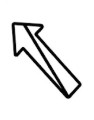
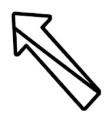
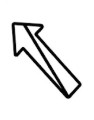
If a mirror is placed to the left of the figure, indicate the appropriate mirror image of the given figure.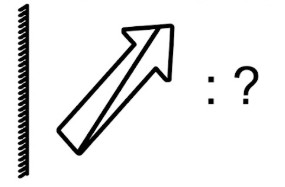
To determine the mirror image of a given figure, we need to visualize how the figure would appear if reflected across a vertical mirror placed to its left.
Correct Option: A) The arrow in Option A points upwards and to the left, which is the correct mirror image of the original figure.