
The question asks to identify the statement that is NOT true about Nichrome. We need to evaluate each option based on the known properties and applications of Nichrome.
Based on the analysis, statement C is the one that is not true about Nichrome's characteristic properties for its common applications.
C) Temperature affects its resistance at high levels. This statement is not true. Nichrome is valued precisely because its resistance changes relatively little with temperature, allowing for stable and predictable heating. While resistance generally increases with temperature for most conductors, Nichrome's coefficient of resistance is low enough to make it suitable for high-temperature applications without drastic changes in its electrical properties.
The question asks about the location where the British established the first printing press in India in 1778. This is a factual question related to the history of printing in India during the British colonial period.
D) Calcutta. The first printing press under British administration was established in Calcutta in 1778, which led to the publication of India's first newspaper, Hicky's Bengal Gazette, in 1780.
The question asks to identify a gymnosperm from the given options. To answer this, one needs to understand the classification of plants, specifically distinguishing between gymnosperms, angiosperms, ferns, and mosses.
Correct Option: B) Pine is a classic example of a gymnosperm. It produces cones and its seeds are not enclosed within a fruit.
Superman is flying over the home krypton. Krypton is spherical in shape. It is in Pune city, which is situated on the equator. It is now facing towards the North Pole. He crosses the equator and flies to his left and reaches Mumbai, which is just opposite the equator of Pune city. He decides to fly to the South Pole, but he stops in Delhi on half way. What are the measurements of the following angles, considering the center of the krypton as a reference point?
This problem involves visualizing positions on a sphere (Krypton) and calculating the angular separation between these points from the center. We need to understand geographical concepts like the equator, North Pole, South Pole, and relative directions (left/right) on a spherical surface.
Correct Option: C) 135, 180, 45
What is the number of triangles in the following figure?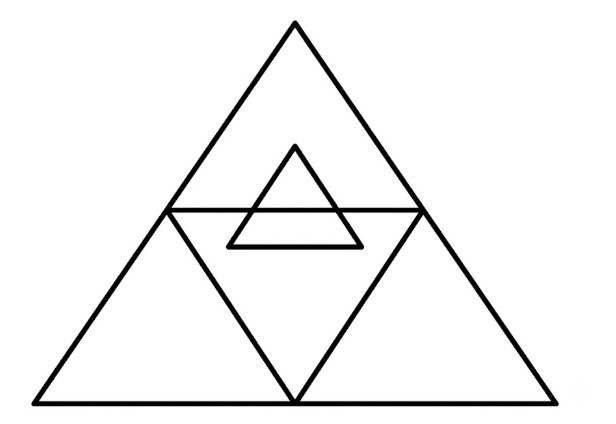
To determine the number of triangles in the given figure, we need to identify all possible triangles formed by the intersecting lines.
Correct Option: A) 9
The question asks to identify the odd one out among the given options. This typically involves finding a common characteristic shared by three options and identifying the one that does not share that characteristic. In this case, the options are names of rivers. We need to determine their geographical context or origin.
Correct Option: D) Yamuna is the correct answer because it is a part of the Ganga River System, while the other three rivers (Sutlej, Ravi, Chenab) are part of the Indus River System.
This problem can be solved using the concept of work and time. We will calculate the individual work rates, then consider the work done by Esther alone in the last few days and the work done by both together for the initial period.
Calculate individual daily work rates:
Raksha can do a work in 27 days. So, Raksha's 1-day work is:
\[ \text{Raksha's 1-day work} = \frac{1}{27} \]Esther can do a work in 45 days. So, Esther's 1-day work is:
\[ \text{Esther's 1-day work} = \frac{1}{45} \]Calculate combined daily work rate:
When they work together, their combined 1-day work is:
\[ \text{Combined 1-day work} = \frac{1}{27} + \frac{1}{45} \]To add these fractions, find a common denominator, which is the LCM of 27 and 45. LCM(27, 45) = 135.
\[ \text{Combined 1-day work} = \frac{5}{135} + \frac{3}{135} = \frac{8}{135} \]Determine work done in the last 9 days:
Raksha leaves 9 days before the work is over. This means Esther works alone for the last 9 days.
Work done by Esther in the last 9 days:
\[ \text{Work by Esther in last 9 days} = 9 \times \frac{1}{45} = \frac{9}{45} = \frac{1}{5} \]Calculate remaining work:
The total work is 1. Work remaining after Esther works alone for 9 days is:
\[ \text{Remaining work} = 1 - \frac{1}{5} = \frac{4}{5} \]Calculate days both worked together:
This remaining work (\(\frac{4}{5}\)) was done by both Raksha and Esther working together.
Let \(D\) be the number of days they worked together.
\[ D \times \text{Combined 1-day work} = \text{Remaining work} \]So,
\[ D \times \frac{8}{135} = \frac{4}{5} \]Solving for \(D\):
\[ D = \frac{4}{5} \times \frac{135}{8} = \frac{4 \times 135}{5 \times 8} = \frac{540}{40} = 13.5 \text{ days} \]Calculate total days Esther worked:
Esther worked for \(13.5\) days with Raksha and \(9\) days alone.
Total days Esther worked = \(13.5 + 9 = 22.5\) days.
Correct Option: D) 22.5
______ is a passive form of phytochrome.
The question asks to identify the passive form of phytochrome. Phytochrome is a photoreceptor pigment in plants that exists in two interconvertible forms: a red-light absorbing form (Pr) and a far-red light absorbing form (Pfr). These forms are distinguished by the wavelength of light they absorb most effectively and their physiological activity.
C) P660 — This represents the Pr (phytochrome red) form, which absorbs red light most effectively at a wavelength of approximately 660 nm. This form is the passive or inactive state of phytochrome.
To find the next term in the given series, we need to identify the pattern in both the numerical and alphabetical components of each term.
The numbers in the given series are 5, 7, 9, 11.
The numerical sequence is an arithmetic progression with a common difference of 2. Therefore, the next number will be \(11 + 2 = 13\).
The letters in the given series are E, G, I, K.
Let's find their positions in the English alphabet:
The alphabetical sequence also follows a pattern where each letter is 2 positions ahead of the previous one (E + 2 = G, G + 2 = I, I + 2 = K). Therefore, the next letter will be 2 positions after K.
The next number is 13 and the next letter is M. Combining these, the next term in the series is 13M.
C) 13M — This option correctly identifies both the numerical (13) and alphabetical (M) components based on the established patterns.
This problem involves understanding directions and relative motion. When two people are moving in opposite directions, if one's direction is known, the other's direction will be exactly opposite to it. We need to identify the direction opposite to North-East.
Correct Option: A) South-West is the direction opposite to North-East.