
The question asks us to find a word that shares the same relationship with 'Sedate' as 'Empty' shares with 'Vacant'. This is an analogy question, so we need to identify the type of relationship between the first pair of words and apply that same relationship to the third word to find the fourth.
Correct Option: D) Calm
'Calm' means not showing or feeling nervousness, anger, or other strong emotions. It is a direct synonym for 'Sedate', as both words convey a sense of peacefulness and composure.
How many right-angled triangles exist in the picture below?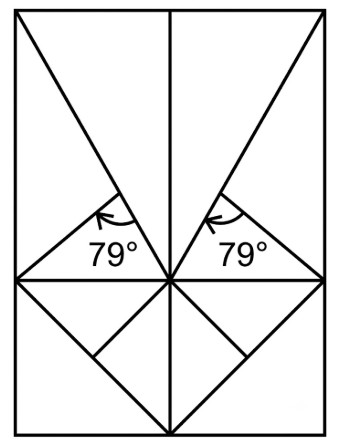
To determine the number of right-angled triangles in the given diagram, we need to identify all triangles that have one angle measuring 90 degrees.
Correct Option: A) 12
The question asks about the direction of flow of the Narmada and Tapi rivers. To answer this, one needs to recall the general geography of peninsular India and the drainage patterns of its major rivers.
Correct Option: C) West
The Narmada and Tapi rivers are two of the few major rivers in peninsular India that flow westward. They originate in central India and flow through rift valleys before emptying into the Arabian Sea.
What will be the mirror image of the given image if the mirror is on MN?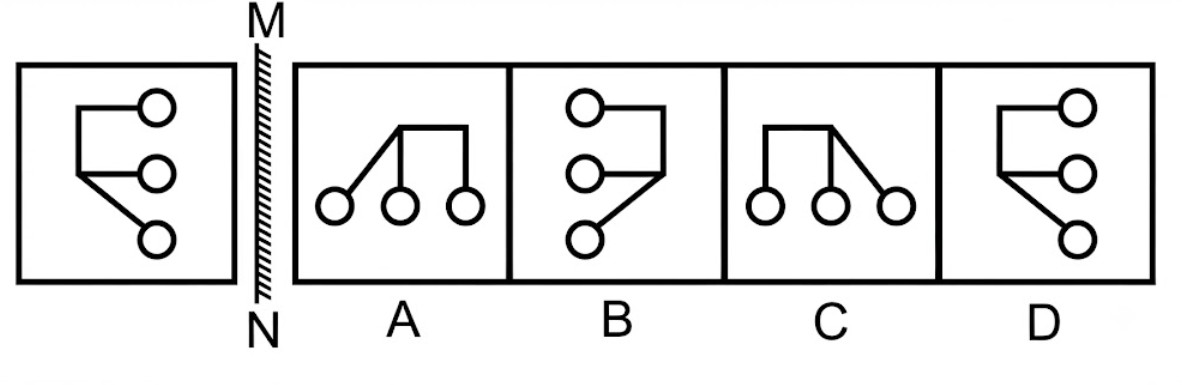
To find the mirror image of a given figure, we need to reflect the elements across the specified mirror line. The mirror image will have the same shape but reversed orientation.
Correct Option: C) Option C correctly represents the mirror image with reversed orientation.
The question asks to identify the state for which the Sangai deer is the state animal. This requires knowledge of state symbols in India, specifically state animals.
The Sangai deer (Rucervus eldii eldii) is a subspecies of Eld's deer found only in Manipur, India. It is a critically endangered species and is known for its distinctive antlers and its habitat in the floating phumdis (heterogeneous mass of vegetation, soil, and organic matter at various stages of decomposition) of Keibul Lamjao National Park, the world's only floating national park. It is officially recognized as the state animal of Manipur.
Correct Option: A) Manipur is the correct answer because the Sangai deer is the state animal of Manipur.
This question tests logical reasoning, specifically the ability to identify implicit assumptions in a given statement. An implicit assumption is something that is not directly stated but must be true for the statement to make sense or be logically coherent. We need to analyze the statement and each assumption to see if it is necessarily implied.
C) Only assumption I is implicit.
This problem involves the conservation of energy with the presence of non-conservative forces (friction). We will use the work-energy theorem, which states that the total work done on an object is equal to the change in its kinetic energy. Here, the initial kinetic energy of the block is converted into elastic potential energy of the spring and work done against friction.
The initial kinetic energy of the block is transformed into elastic potential energy stored in the spring and work done against friction as the block slides and compresses the spring. When the block comes to rest, its final kinetic energy is zero.
The work-energy theorem states that the net work done on an object equals its change in kinetic energy:
\[ W_{\text{net}} = \Delta KE \]\[ W_{\text{spring}} + W_{\text{friction}} = KE_{\text{final}} - KE_{\text{initial}} \]Let \(x\) be the compression of the spring. The work done by the spring (which is negative as it opposes motion) is:
\[ W_{\text{spring}} = -\frac{1}{2}kx^2 \]The work done by friction (which is also negative as it opposes motion over distance \(x\)) is:\[ W_{\text{friction}} = -f_k x \]Since the final kinetic energy \(KE_{\text{final}}\) is 0 (the block comes to rest), the equation becomes:
\[ -\frac{1}{2}kx^2 - f_k x = 0 - KE_{\text{initial}} \]\[ -\frac{1}{2}kx^2 - f_k x = -16 \text{ J} \]\[ \frac{1}{2}kx^2 + f_k x - 16 = 0 \]Using the quadratic formula \(x = \frac{-b \pm \sqrt{b^2 - 4ac}}{2a}\), where \(a=5000\), \(b=15\), \(c=-16\):
\[ x = \frac{-15 \pm \sqrt{(15)^2 - 4(5000)(-16)}}{2(5000)} \]\[ x = \frac{-15 \pm \sqrt{225 + 320000}}{10000} \]\[ x = \frac{-15 \pm \sqrt{320225}}{10000} \]\[ x = \frac{-15 \pm 565.88}{10000} \]We take the positive root since compression \(x\) must be a positive value:\[ x = \frac{-15 + 565.88}{10000} \]\[ x = \frac{550.88}{10000} \]\[ x \approx 0.055088 \text{ m} \]The question describes a scenario where the elements in a compound (carbon dioxide) always combine in a fixed mass ratio, regardless of the sample. This directly relates to one of the fundamental laws of chemical combination. We need to identify which law states this principle.
Correct Option: B) Constant Proportion
To find the next number in the series, we need to identify the pattern or relationship between consecutive numbers. We will calculate the difference between adjacent terms to determine if there's a constant difference or a progressive change.
A) 47 — The pattern shows a consistent subtraction of 8 from each preceding number. Following this rule, \(55 - 8 = 47\).
Consider the following question and decide which of the statements is/are sufficient to answer the question.
Question:
Find the value of x, if Statement:
1) \( \frac{1}{x} + \frac{1}{9} = \frac{1}{27} \)
2) a2 + p2 = q2
Neither 1 nor 2 is sufficient.
Only 2 is sufficient.
Only 1 is sufficient.
Either 1 or 2 is sufficient.
We need to determine which of the given statements is sufficient to find the value of \(x\). We will analyze each statement independently to see if it allows us to solve for \(x\).
Analyze Statement 1:
The statement is given as: \[\frac{1}{x} + \frac{1}{9} = \frac{1}{27}\]
To find the value of \(x\), we can rearrange the equation:
\[ \frac{1}{x} = \frac{1}{27} - \frac{1}{9} \]To subtract the fractions on the right side, find a common denominator, which is 27:
\[ \frac{1}{x} = \frac{1}{27} - \frac{3}{27} \] \[ \frac{1}{x} = \frac{1 - 3}{27} \] \[ \frac{1}{x} = \frac{-2}{27} \]Now, take the reciprocal of both sides to find \(x\):
\[ x = \frac{27}{-2} \] \[ x = -\frac{27}{2} \]Since we were able to find a unique value for \(x\) using Statement 1, Statement 1 alone is sufficient.
Analyze Statement 2:
The statement is given as: \( a^2 + p^2 = q^2 \)
This is a general algebraic or geometric (Pythagorean theorem) relationship between variables \(a\), \(p\), and \(q\). This statement does not contain the variable \(x\) at all. Therefore, it provides no information about \(x\) and cannot be used to find its value.
Thus, Statement 2 alone is not sufficient.
Conclusion:
Statement 1 alone is sufficient to find the value of \(x\), while Statement 2 alone is not sufficient.
Correct Option: C) Only 1 is sufficient.