
The question asks about the historical administrative status of Meghalaya before it became a separate state. This requires knowledge of the reorganisation of states in Northeast India.
C) Assam. Meghalaya was initially formed as an autonomous state within Assam in 1970 and subsequently became a full-fledged state in 1972.
To find the percentage increase in the number of bacteria at the end of 3 hours, we need to calculate the number of bacteria after each hour, considering the given percentage changes. Then, we will compare the final number with the initial number to determine the overall percentage increase.
Initial number of bacteria:
\[ N_0 = 5,00,000 \]After the first hour (4% decrease):
The number of bacteria decreases by 4%. So, the remaining percentage is \(100\% - 4\% = 96\%\) or \(0.96\).
\[ N_1 = N_0 \times (1 - 0.04) = 5,00,000 \times 0.96 = 4,80,000 \]After the second hour (5% increase):
The number of bacteria increases by 5% from \(N_1\). So, the new percentage is \(100\% + 5\% = 105\%\) or \(1.05\).
\[ N_2 = N_1 \times (1 + 0.05) = 4,80,000 \times 1.05 = 5,04,000 \]After the third hour (10% increase):
The number of bacteria increases by 10% from \(N_2\). So, the new percentage is \(100\% + 10\% = 110\%\) or \(1.10\).
\[ N_3 = N_2 \times (1 + 0.10) = 5,04,000 \times 1.10 = 5,54,400 \]Calculate the total increase in the number of bacteria:
\[ \text{Increase} = N_3 - N_0 = 5,54,400 - 5,00,000 = 54,400 \]Calculate the percentage increase:
\[ \text{Percentage Increase} = \frac{\text{Increase}}{\text{Initial Number}} \times 100 \] \[ \text{Percentage Increase} = \frac{54,400}{5,00,000} \times 100 \] \[ \text{Percentage Increase} = 0.1088 \times 100 = 10.88\% \]B) The percentage increase in the number of bacteria at the end of 3 hours is 10.88%.
What is the total number of squares in the following figure.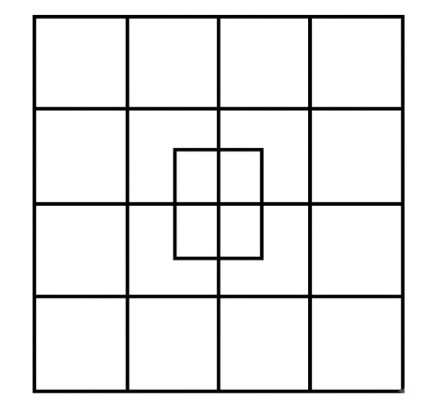
To find the total number of squares in the given figure, we need to count all possible squares of different sizes formed by the grid lines.
Adding these up, we have:
Total squares = \(16 + 9 + 4 + 1 + 2 = 32\).
However, upon recounting the additional squares formed by the inner rectangle, we find there are actually 3 additional squares, leading to a total of 35 squares.
Correct Option: A) 35
On an average Meenu uses 15% of her monthly salary for shopping, going to restaurants and malls. The remaining 40% goes towards household expenses, and 45% goes to her savings. If in a month, she spends Rs. 40,000 on the house, what is her annual income?
Rs. 10,20,000
Rs. 14,00,000
Rs. 12,00,000
Rs. 10,00,000
The problem asks for Meenu's annual income based on her monthly spending habits. We are given the percentage of her monthly salary allocated to different categories and the actual amount spent on household expenses in a month. We will first find her monthly salary and then calculate her annual income.
Meenu spends Rs. 40,000 on household expenses in a month.
From the given distribution, 40% of her monthly salary goes towards household expenses.
So, we can write the equation:
\[ 40\% \times (\text{Monthly Salary}) = \text{Rs. } 40,000 \]Let \(\text{MS}\) be the Monthly Salary.
\[ 0.40 \times \text{MS} = 40,000 \]\[ \text{MS} = \frac{40,000}{0.40} \]\[ \text{MS} = \frac{40,000}{\frac{40}{100}} \]\[ \text{MS} = \frac{40,000 \times 100}{40} \]\[ \text{MS} = 1,000 \times 100 \]\[ \text{MS} = \text{Rs. } 1,00,000 \]There are 12 months in a year. So, the annual income is 12 times the monthly salary.
\[ \text{Annual Income} = \text{Monthly Salary} \times 12 \]\[ \text{Annual Income} = 1,00,000 \times 12 \]\[ \text{Annual Income} = \text{Rs. } 12,00,000 \]Correct Option: C) Rs. 12,00,000
To solve this problem, we need to determine the individual work rates of Jeevan and Jyoti, and then calculate the combined work rate of all three (Jeevan, Jyoti, and Panu) to find Panu's work rate. The payment for the work is distributed based on the amount of work done by each person.
Since the total work is 1 (or \(\frac{8}{8}\)), the remaining work must have been done by Panu.
\[ \text{Work done by Panu in 3 days} = 1 - \frac{7}{8} = \frac{1}{8} \]The total amount for the work is Rs. 3,200. The earnings are proportional to the work done.
\[ \text{Panu's earning} = \text{Total amount} \times \text{Fraction of work done by Panu} \] \[ \text{Panu's earning} = 3200 \times \frac{1}{8} = \text{Rs. } 400 \]Correct Option: A) Rs. 400
Which alphanumeric term will be next in the given series?
10D, 13E, 16F, 19G,?
To find the next term in the series, we need to identify the pattern in the numbers and the letters separately. We will analyze the numerical sequence and the alphabetical sequence independently.
The numbers in the given series are 10, 13, 16, 19.
The pattern for the numbers is an addition of 3 to the previous number. So, the next number will be \(19 + 3 = 22\).
The letters in the given series are D, E, F, G.
The pattern for the letters is that they are consecutive letters in alphabetical order. So, the next letter after G will be H.
The next number is 22 and the next letter is H. Therefore, the next alphanumeric term in the series is 22H.
Correct Option: A) 22H
The question asks about the origin of the name "India." This is a historical and geographical fact related to ancient civilizations and their interactions with the Indian subcontinent. The name is historically linked to a major river in the region.
Correct Option: A) The name India is derived from the Indus river. The ancient Persians and Greeks referred to the land east of the Indus River as "India," a name derived from "Sindhu," the Sanskrit name for the Indus River.
What does that symbol represent?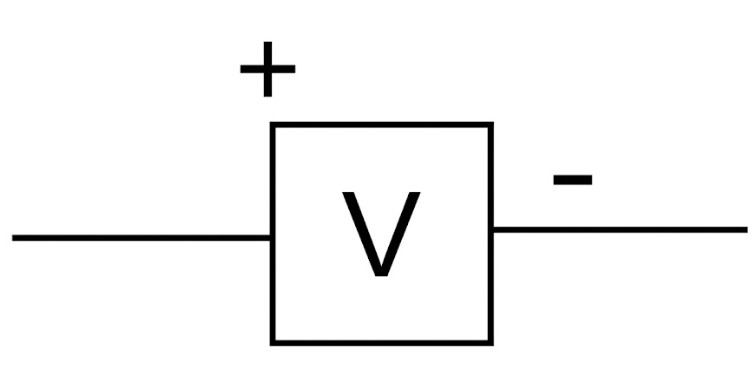
unconnected wire crossing
a voltmeter
Variable Resistance or Current Controller
a resistance of resistance R
The diagram provided in the question shows a symbol that is commonly used in electrical circuit diagrams. Understanding the standard symbols used in these diagrams is crucial for identifying the correct component.
Correct Option: B) a voltmeter
What is the new repo rate announced by the Reserve Bank of India (RBI) on 1st August 2018?
This question tests knowledge of monetary policy decisions made by the Reserve Bank of India (RBI), specifically the repo rate. Candidates need to recall the repo rate announced on a specific date.
Correct Option: A) 6.5%
This is a problem involving work, time, and the number of people. We can use the concept of "Man-Days-Work" or the formula \(M_1 D_1 W_2 = M_2 D_2 W_1\), where \(M\) is the number of people, \(D\) is the number of days, and \(W\) is the amount of work. Alternatively, we can calculate the work rate per person per day.
The total work units are \(40,000\) bulbs. The total man-days for this work are \(45 \text{ people} \times 12 \text{ days} = 540 \text{ man-days}\).
So, the work rate per man-day is:
\[ \text{Work Rate} = \frac{\text{Total Work}}{\text{Total Man-Days}} = \frac{40,000 \text{ bulbs}}{540 \text{ man-days}} \]We need to make \(100,000\) bulbs. Using the work rate calculated above:
\[ \text{Total Man-Days for } W_2 = \frac{W_2}{\text{Work Rate}} = \frac{100,000 \text{ bulbs}}{\frac{40,000 \text{ bulbs}}{540 \text{ man-days}}} \]\[ \text{Total Man-Days for } W_2 = \frac{100,000}{40,000} \times 540 = \frac{10}{4} \times 540 = 2.5 \times 540 = 1350 \text{ man-days} \]We need to complete \(1350\) man-days of work in \(9\) days. Let \(M_2\) be the number of people required.
\[ M_2 \times D_2 = \text{Total Man-Days for } W_2 \]\[ M_2 \times 9 = 1350 \]\[ M_2 = \frac{1350}{9} = 150 \text{ people} \]The initial number of people was 45. The new number of people required is 150.
\[ \text{Additional People} = M_2 - M_1 = 150 - 45 = 105 \text{ people} \]B) 105