The question asks about the origin of the term "Chinaman style" in cricket bowling. This is a factual question related to cricket history and terminology. To answer it correctly, one needs to know the specific bowler after whom this style was named.
D) a West Indian bowler of Chinese origin. The term "Chinaman" in cricket bowling is named after Ellis Achong, a West Indian cricketer of Chinese descent, who first bowled this type of delivery in Test cricket.
Select the figure from the options that when placed in the blank space will complete the pattern.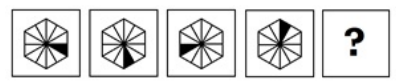
The problem involves identifying the pattern of shaded segments in a hexagonal figure and selecting the option that continues this pattern.
Correct Option: B) The shaded segment is at the top, continuing the pattern.
This question tests knowledge of standard units of digital information storage. Specifically, it asks for the conversion of gigabytes (GB) to megabytes (MB). Understanding the prefixes used in computer science (kilo, mega, giga, tera) is crucial.
A) 1000 megabytes. This is the widely accepted and commonly used conversion for 1 gigabyte in terms of megabytes, especially in a general context.
The question asks to identify the ruler responsible for the construction of the Konark Sun Temple. This requires knowledge of Indian history, specifically the patronage of major architectural marvels.
D) King Narasimhadeva I
The Konark Sun Temple, a UNESCO World Heritage Site, was built in the 13th century CE by King Narasimhadeva I of the Eastern Ganga Dynasty. It is dedicated to the Sun God Surya and is renowned for its intricate stone carvings and unique architectural design, resembling a colossal chariot with twelve pairs of wheels pulled by seven horses.
The question asks about the share of the Government of India (GOI) in NABARD as of April 2019. This is a factual question related to the ownership structure of a major financial institution in India. Recalling the changes in NABARD's shareholding structure is key to answering this.
Correct Option: C) 100%
As of April 2019, the Government of India acquired the entire stake of the Reserve Bank of India in NABARD, making its share 100%. This move was aimed at making NABARD a fully government-owned entity.
Which bank recently (in April 2019) became the 3rd largest bank of India after the merger with two other banks?
Bank of Baroda
Punjab National Bank
State Bank of India
Indian bank
The question asks to identify which bank became India's third-largest after a merger in April 2019. This requires knowledge of significant banking mergers that occurred around that time.
A) Bank of Baroda — After the merger of Dena Bank and Vijaya Bank with Bank of Baroda, which became effective on April 1, 2019, Bank of Baroda became the third-largest public sector bank in India. This aligns with the question's timeframe and criteria.
Convert \( \frac{8}{9} \) into a decimal number.
To convert a fraction into a decimal number, we perform division. The numerator is divided by the denominator. If the division results in a repeating pattern, we denote it using an ellipsis (...).
Set up the long division:
\[ \begin{array}{r} 0.\text{888...} \\ 9 \overline{\) 8.000} \\ -7 \text{ 2} \\ \hline 80 \\ -7 \text{ 2} \\ \hline 80 \\ -7 \text{ 2} \\ \hline 8 \end{array} \]
First step of division: 8 divided by 9 is 0 with a remainder of 8. We add a decimal point and a zero to 8, making it 8.0.
Second step of division: Now, we divide 80 by 9. \( 9 \times 8 = 72 \). So, we write 8 after the decimal point. The remainder is \( 80 - 72 = 8 \).
Third step of division: Bring down another zero, making it 80 again. Divide 80 by 9, which again gives 8 with a remainder of 8.
Identify the pattern: This pattern of getting 8 as the quotient and 8 as the remainder will repeat indefinitely. Therefore, the decimal representation of \( \frac{8}{9} \) is 0.888...
B) 0.888... is the correct decimal representation of \( \frac{8}{9} \), as the digit 8 repeats infinitely after the decimal point.
The question asks to identify the person who first conceived the idea of the Indian National Army (INA). This requires knowledge of the historical origins and key figures involved in the formation of the INA during World War II.
A) Mohan Singh first conceived the idea of the Indian National Army and played a crucial role in its initial formation from Indian prisoners of war in Southeast Asia.
To find the width of the rectangle, we will use the formula for the perimeter of a rectangle. The perimeter is given, and the length is known, allowing us to solve for the unknown width.
The perimeter \(P\) of a rectangle with length \(L\) and width \(W\) is given by:
\[ P = 2(L + W) \]We are given:
Substitute these values into the perimeter formula:
\[ 100 = 2(29 + W) \]First, divide both sides of the equation by 2:
\[ \frac{100}{2} = 29 + W \]\[ 50 = 29 + W \]B) 21 m — The calculation shows that the width of the rectangle is 21 m.
The question asks to identify the community for which the President of India had the power to nominate two members to the Lok Sabha, a provision that was later abolished. This requires knowledge of specific constitutional provisions related to parliamentary representation.
C) Anglo-Indian: Article 331 of the Indian Constitution empowered the President to nominate up to two members from the Anglo-Indian community to the Lok Sabha if he felt they were not adequately represented. This provision was discontinued by the 104th Constitutional Amendment Act, 2019, which came into effect in January 2020.