The question asks to identify the country that conducted the world's first underwater cabinet meeting to draw attention to climate change. This is a factual question related to environmental diplomacy and international efforts to combat climate change, specifically focusing on vulnerable island nations.
This event garnered significant international media attention and served as a powerful visual statement about the existential threat faced by the Maldives and similar nations.
Correct Option: A) Maldives
If sin x - 5cos x = 2\(\sqrt{6}\) cos x, then the value of cot x is:
2\(\sqrt{6}\)
5 + 2\(\sqrt{6}\)
1
5 - 2\(\sqrt{6}\)
The problem asks us to find the value of \(\cot x\) given an equation involving \(\sin x\) and \(\cos x\). We will manipulate the given equation algebraically to isolate a term that can be directly converted into \(\cot x\).
Start with the given equation:
\[ \sin x - 5\cos x = 2\sqrt{6} \cos x \]Rearrange the terms to group \(\cos x\) terms together:
\[ \sin x = 5\cos x + 2\sqrt{6} \cos x \]Factor out \(\cos x\) from the terms on the right side:
\[ \sin x = (5 + 2\sqrt{6}) \cos x \]To find \(\cot x\), which is defined as \(\frac{\cos x}{\sin x}\), we need to divide both sides by \(\sin x\) and \((5 + 2\sqrt{6})\). First, divide both sides by \(\cos x\):
\[ \frac{\sin x}{\cos x} = 5 + 2\sqrt{6} \]Recognize that \(\frac{\sin x}{\cos x}\) is \(\tan x\):
\[ \tan x = 5 + 2\sqrt{6} \]Since \(\cot x = \frac{1}{\tan x}\), we can find \(\cot x\) by taking the reciprocal of \(\tan x\):
\[ \cot x = \frac{1}{5 + 2\sqrt{6}} \]To rationalize the denominator, multiply the numerator and denominator by the conjugate of the denominator, which is \((5 - 2\sqrt{6})\):
\[ \cot x = \frac{1}{5 + 2\sqrt{6}} \times \frac{5 - 2\sqrt{6}}{5 - 2\sqrt{6}} \]Apply the difference of squares formula \((a+b)(a-b) = a^2 - b^2\) in the denominator:
\[ \cot x = \frac{5 - 2\sqrt{6}}{5^2 - (2\sqrt{6})^2} \]\[ \cot x = \frac{5 - 2\sqrt{6}}{25 - (4 \times 6)} \]\[ \cot x = \frac{5 - 2\sqrt{6}}{25 - 24} \]\[ \cot x = \frac{5 - 2\sqrt{6}}{1} \]\[ \cot x = 5 - 2\sqrt{6} \]Correct Option: D) \(5 - 2\sqrt{6}\)
Telangana became the _____ state of India in 2014.
This question tests knowledge about the formation of Indian states and their chronological order. Specifically, it asks for the ordinal position of Telangana among Indian states when it was formed in 2014.
Correct Option: D) 29 th — Telangana was officially formed on June 2, 2014, by bifurcating Andhra Pradesh. At the time of its formation, India had 28 states. With the addition of Telangana, the total number of states became 29. Later, in 2019, Jammu and Kashmir was reorganized into two Union Territories, reducing the number of states back to 28, but at the time of Telangana's formation, it was indeed the 29th state.
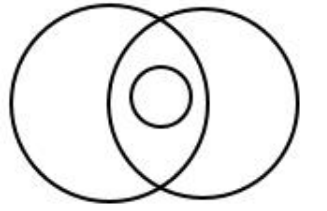
Select the Venn diagram that best represents the relationship between the given set of classes.
Eagle, Predator, Bird
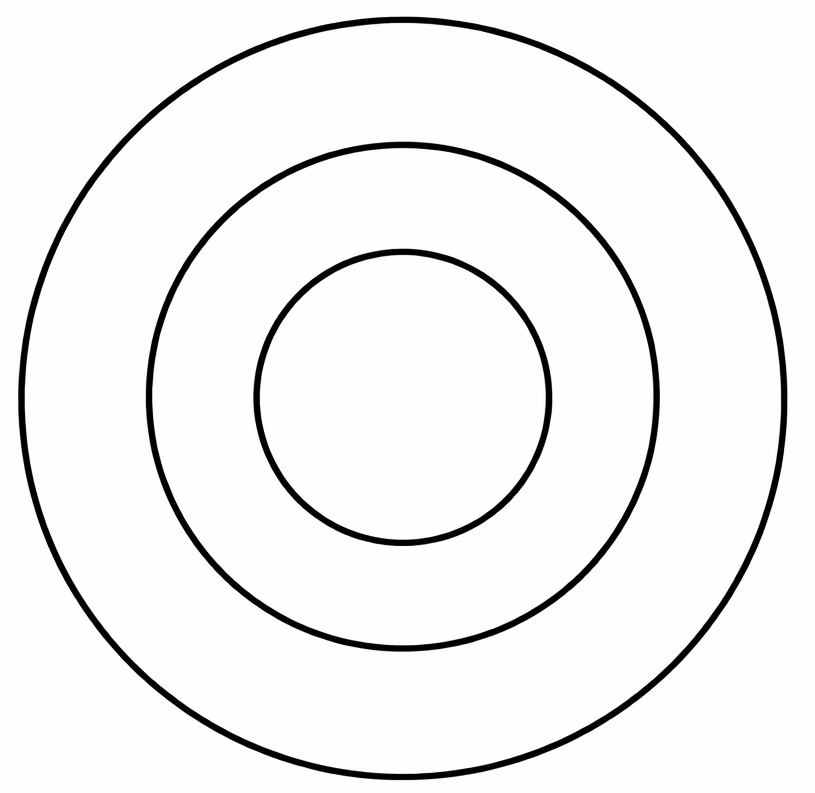
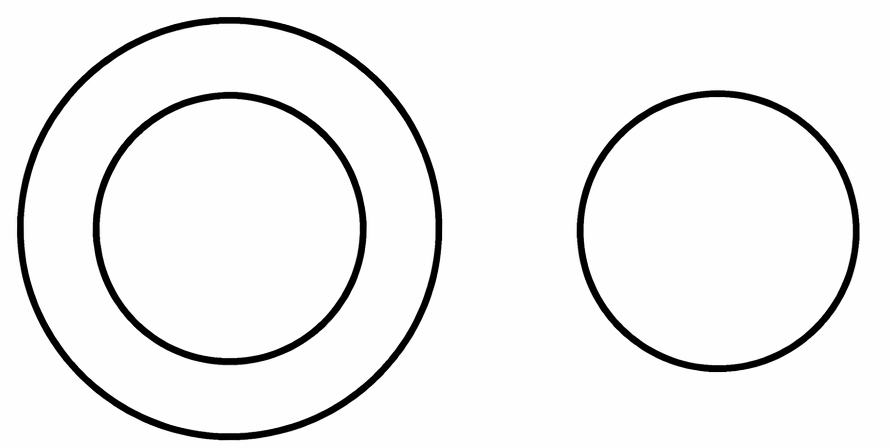
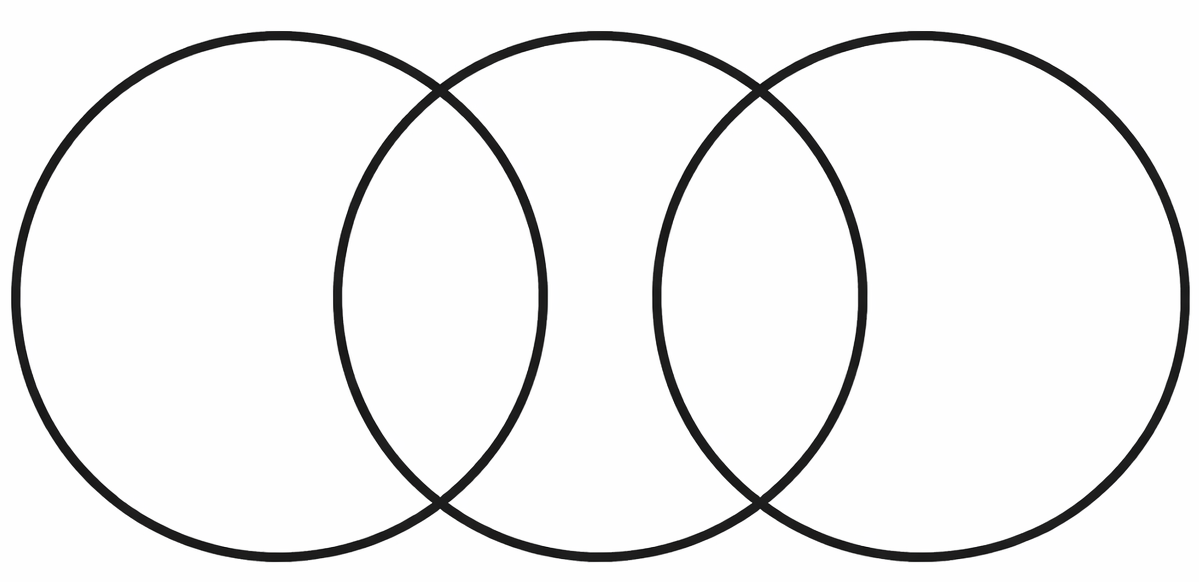
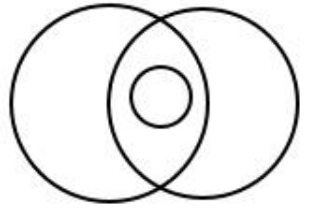
To solve this problem, we need to understand the hierarchical relationship between the classes 'Eagle', 'Predator', and 'Bird'. An eagle is a type of bird, and it is also a predator. Therefore, the correct Venn diagram should show 'Eagle' as a subset of both 'Bird' and 'Predator'.
Correct Option: D) The diagram shows 'Eagle' as a subset within the intersection of 'Bird' and 'Predator', accurately representing the relationships.
The question asks for the specific local name of "slash and burn" agriculture practiced in the Andaman and Nicobar Islands. This type of agriculture, also known as shifting cultivation, has various regional names across India and the world. Identifying the correct local term requires knowledge of these geographical variations.
Correct Option: D) Dipa is the local name for slash and burn agriculture practiced in the Andaman and Nicobar Islands.
The question asks to identify the correctly matched pair of a Mughal ruler and a foreign traveler who visited India during their reign. This requires knowledge of the timelines of prominent Mughal emperors and the foreign visitors to their courts.
Correct Option: A) Aurangzeb - Manucci. Niccolao Manucci, an Italian traveler, visited India during the reign of Aurangzeb and documented his experiences in "Storia do Mogor." He arrived in India in 1653 and remained there for a significant period, covering Aurangzeb's rule (1658-1707).
The question asks to identify the international border that the Radcliffe Line represents. This requires knowledge of historical geography related to the partition of British India.
C) India and Pakistan — The Radcliffe Line was drawn in 1947 to divide British India into India and Pakistan. It demarcated the borders between West Pakistan and India, and East Pakistan (which later became Bangladesh) and India.
The question asks to identify the region considered the "nerve centre of Indian nationalism" during the first decade of the 20th century. This period (1900-1910) was marked by significant political developments, including the Swadeshi movement and the partition of Bengal, which intensified nationalist sentiments.
D) Bengal was indeed the nerve centre of Indian nationalism during the first decade of the 20th century. The Partition of Bengal in 1905 by Lord Curzon sparked the Swadeshi and Boycott movements, which were initially concentrated in Bengal but soon spread to other parts of India. Calcutta (now Kolkata), the capital of British India until 1911, was a major intellectual and political hub, fostering a strong sense of nationalism among its educated populace and leaders.
We are given the selling price of 18 toys and the total loss incurred, which is equal to the cost price of 4 toys. We need to find the cost price of each toy. We can set up an equation relating the total selling price, total cost price, and the loss.
Let the cost price of one toy be \( \text{CP} \).
Then, the cost price of 18 toys is \( 18 \times \text{CP} \).
The problem states that the loss is equal to the cost price of 4 toys.
So, \( \text{Loss} = 4 \times \text{CP} \).
We know the formula for loss:
\( \text{Loss} = \text{Total Cost Price} - \text{Total Selling Price} \)
Substitute the given values and expressions into the loss formula:
\[ 4 \times \text{CP} = (18 \times \text{CP}) - \text{₹}980 \]
Rearrange the equation to solve for \( \text{CP} \):
\[ \text{₹}980 = (18 \times \text{CP}) - (4 \times \text{CP}) \]
\[ \text{₹}980 = 14 \times \text{CP} \]
Now, calculate the value of \( \text{CP} \):
\[ \text{CP} = \frac{\text{₹}980}{14} \]
\[ \text{CP} = \text{₹}70 \]
D) ₹70 is the correct answer. The cost price of each toy is ₹70.
Study the given pattern carefully and select the number that can replace the question mark (?) in it. 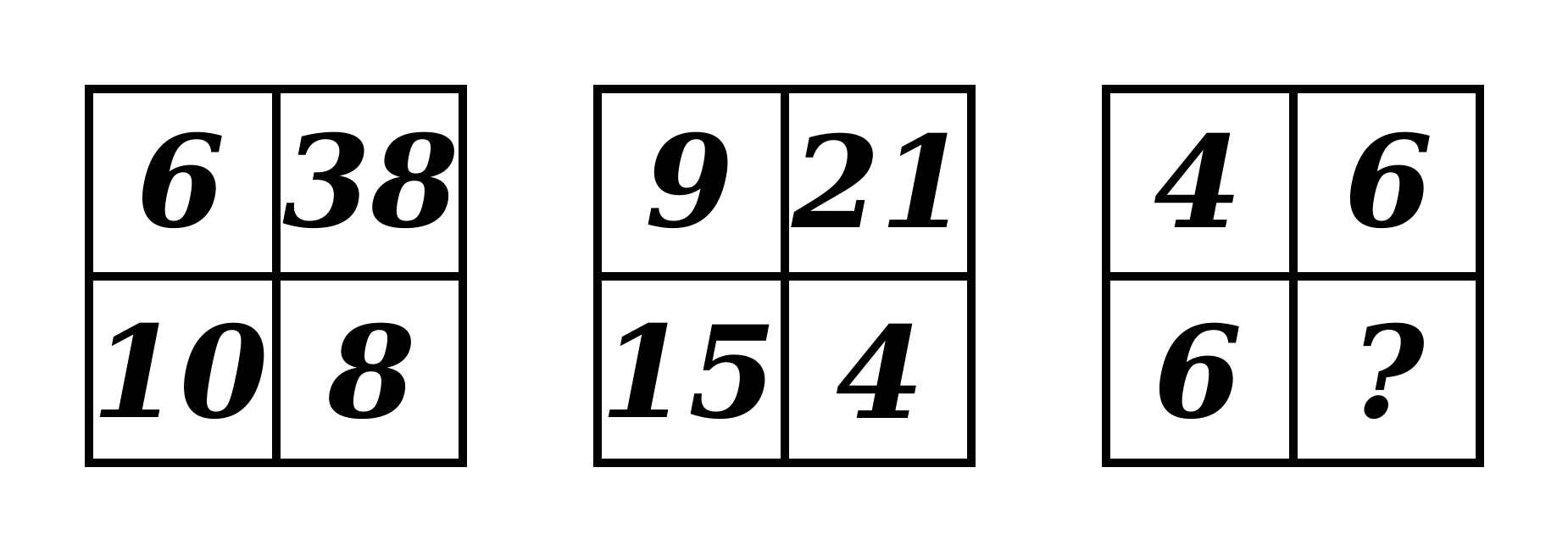
To solve this pattern, we need to identify the relationship between the numbers in each box and apply the same logic to find the missing number.
Correct Option: B) 3