
Select the option that is best represented by the following Venn diagram 
Year, Month, Weather
Wheat, Crop, Cereal
Criminal, Thief, Police
Doctors, Nurses, Hospital
The Venn diagram consists of three concentric circles, which represent a hierarchical relationship where each inner circle is a subset of the outer circles.
Correct Option: B) Wheat, Crop, Cereal
The question asks about the electoral college for the Vice-President of India. To answer this, one needs to recall the constitutional provisions regarding the election of the Vice-President.
Correct Option: D) members of both houses of parliament
This option correctly identifies the electoral college for the Vice-President as comprising members from both the Lok Sabha and the Rajya Sabha, as stipulated by Article 66(1) of the Indian Constitution.
The question asks about the committee whose recommendations led to the establishment of the National Stock Exchange (NSE) in India. This is a factual question related to the history of financial market reforms in India.
Correct Option: C) The Pherwani Committee (also known as the High-Powered Study Group on Establishment of New Stock Exchanges) recommended the establishment of the National Stock Exchange (NSE) in India. The NSE was incorporated in 1992 based on these recommendations to provide a modern, efficient, and transparent trading platform.
Who shot dead Rand, the commissioner of Police, Poona due to failure to check plagues towards the end of 19th century in India?
Veer Savarkar
Vasudev B. Phadke
Damodar Chapekar
Bhagat Singh
The question asks to identify the individual responsible for the assassination of W.C. Rand, the Commissioner of Police, Poona, towards the end of the 19th century. This event is a significant historical incident related to the Indian independence movement and the plague epidemic management by the British.
C) Damodar Chapekar — Damodar Hari Chapekar, along with his brothers Balkrishna Hari Chapekar and Vasudeo Hari Chapekar, assassinated W.C. Rand, the Chairman of the Special Plague Committee in Poona, and Lieutenant Ayerst on 22 June 1897. This act was a protest against the oppressive and insensitive measures implemented by the British authorities during the plague epidemic in Poona.
Four figures (1 to 4) have been given, out of which three are alike and one is different. Select the odd one.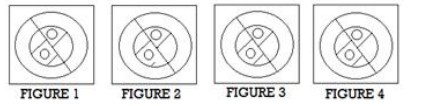
To solve this problem, we need to identify the figure that is different from the others. This usually involves recognizing patterns or features that are consistent in three figures but not in one.
Thus, Figure 2 is the odd one out due to the orientation of the diagonal line and the alignment of the smaller circles.
Correct Option: C) Figure 2
The question asks to identify which of the given countries is NOT a member of ASEAN. To answer this, one needs to know the member states of ASEAN.
B) India — India is not a member of ASEAN. It is a dialogue partner and an important regional player, but not a full member state of the Association of Southeast Asian Nations.
The question asks to identify the Article of the Indian Constitution that deals with the formation of new states and alteration of boundaries. This falls under Part I of the Constitution, which pertains to the Union and its Territory. We need to recall the specific provisions of Articles 1, 2, 3, and 10 to determine the correct answer.
A) Article 3 — Article 3 of the Indian Constitution grants Parliament the power to form new states, increase or diminish the area of any state, alter the boundaries of any state, and alter the name of any state. This directly addresses the details mentioned in the question.
The non-terminating repeating decimal among the following fractions is:
\( \frac{13}{4} \)
\( \frac{7}{5} \)
\( \frac{3}{40} \)
\( \frac{100}{111} \)
A fraction represents a terminating decimal if its denominator, when expressed in its simplest form, has only prime factors of 2 and/or 5. If the denominator contains any other prime factor, the decimal representation will be non-terminating and repeating (recurring).
Let's examine option D: \( \frac{100}{111} \)
Therefore, \( \frac{100}{111} \) is the non-terminating repeating decimal.
The question asks to identify the steel plant established during India's Second Five Year Plan (1956-61) with German collaboration. This requires knowledge of India's industrial development history, specifically the foreign collaborations for major steel plants.
Correct Option: B) Rourkela Steel Plant was set up during the Second Five Year Plan (1956-61) with the collaboration of West Germany. It was one of the first integrated steel plants in the public sector in India.
The question asks about the leader of the Dharasana Salt Works raid after Mahatma Gandhi's arrest during the Civil Disobedience Movement. This requires knowledge of key figures and events during the Indian freedom struggle, specifically the Salt Satyagraha.
Correct Option: D) Abbas Tyabji was chosen by Mahatma Gandhi to lead the march to raid the Dharasana Salt Works after Gandhi's arrest. He led the march until his own arrest.