
When individuals work together, their earnings are typically proportional to the amount of work they do or, equivalently, to their efficiency (rate of work). To find the share of B, we first need to determine the individual work rates of A, B, and C, then find the ratio of their efficiencies, and finally distribute the total earnings according to this ratio.
Calculate individual work rates:
If A can complete a job in 15 days, A's one day's work is \(\frac{1}{15}\) of the job.
If B can complete a job in 20 days, B's one day's work is \(\frac{1}{20}\) of the job.
If C can complete a job in 30 days, C's one day's work is \(\frac{1}{30}\) of the job.
Determine the ratio of their efficiencies (work rates):
The ratio of their efficiencies is the ratio of their one day's work:
\[ \text{A} : \text{B} : \text{C} = \frac{1}{15} : \frac{1}{20} : \frac{1}{30} \]Find a common denominator to simplify the ratio:
The least common multiple (LCM) of 15, 20, and 30 is 60.
Multiply each fraction by 60:
\[ \text{A} : \text{B} : \text{C} = \left(\frac{1}{15} \times 60\right) : \left(\frac{1}{20} \times 60\right) : \left(\frac{1}{30} \times 60\right) \]\[ \text{A} : \text{B} : \text{C} = 4 : 3 : 2 \]Calculate the total parts in the ratio:
Total parts \( = 4 + 3 + 2 = 9 \)
Calculate B's share:
The total earnings are ₹270. B's share is 3 parts out of the total 9 parts.
\[ \text{B's share} = \frac{\text{B's ratio part}}{\text{Total ratio parts}} \times \text{Total earnings} \]\[ \text{B's share} = \frac{3}{9} \times 270 \]\[ \text{B's share} = \frac{1}{3} \times 270 \]\[ \text{B's share} = \text{₹}90 \]A) ₹90 is the correct share for B, calculated based on the ratio of their efficiencies.
The question asks for the location of the UNESCO World Heritage site, Kandariya Mahadev Temple. This requires knowledge of prominent historical and architectural sites in India.
Correct Option: C) The Kandariya Mahadev Temple is one of the largest and most ornate temples in the Khajuraho Group of Monuments, a UNESCO World Heritage site located in the Chhatarpur district of Madhya Pradesh, India. These temples are famous for their Nagara-style architecture and erotic sculptures.
Three different positions of the same dice are shown. Select number that will be on the face opposite to the one having 4.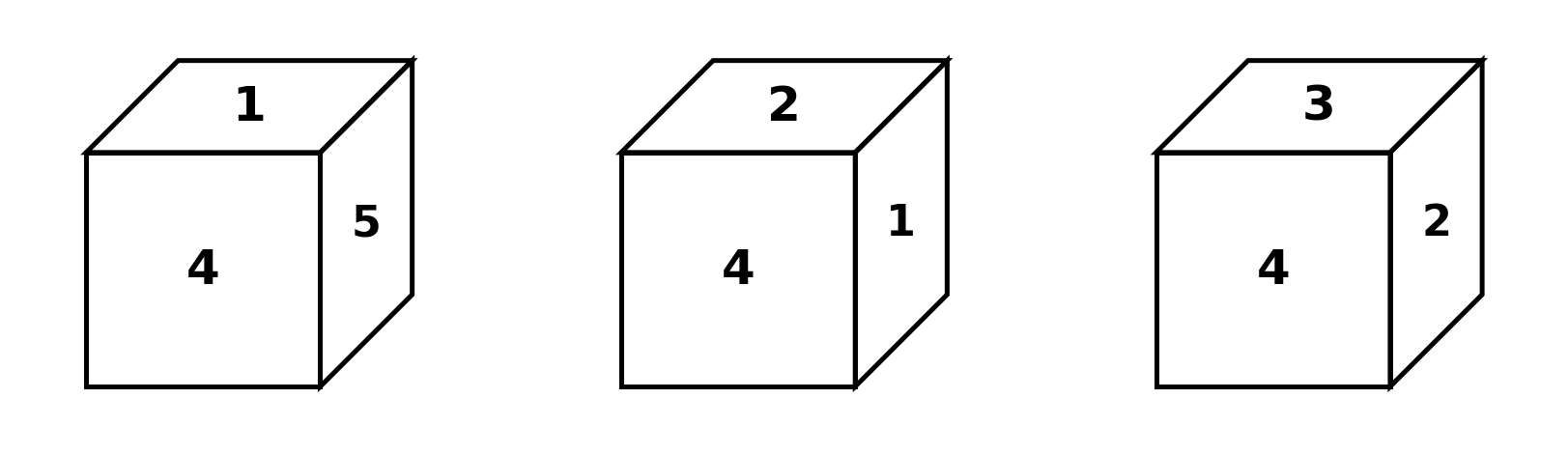
To determine the number on the face opposite to the one with 4, we need to analyze the positions shown in the diagrams and identify the relationships between the visible faces.
Correct Option: A) 6
The question asks for the headquarters of the Nuclear Power Corporation of India Limited (NPCIL). This is a factual question requiring knowledge of the organizational structure of key public sector undertakings in India.
Correct Option: B) Mumbai is the correct answer because the Nuclear Power Corporation of India Limited (NPCIL) has its headquarters situated in Mumbai, Maharashtra.
The question asks to identify the author of the ancient Sanskrit book "Ashtadhyayi". This requires knowledge of prominent ancient Indian scholars and their literary contributions, particularly in the field of grammar and linguistics.
Correct Option: D) Panini is the renowned ancient Indian grammarian who authored the "Ashtadhyayi", a seminal text on Sanskrit grammar.
The question asks to identify the activity that does NOT contribute to the greenhouse effect. The greenhouse effect is primarily caused by the emission of greenhouse gases (GHGs) into the atmosphere, which trap heat and warm the planet. We need to evaluate each option based on whether it releases significant GHGs.
Correct Option: D) Use of solar car for transport. Solar cars utilize renewable energy (solar power) and do not directly emit greenhouse gases during operation, thus not contributing to the greenhouse effect.
To find the length of the platform, we first need to determine the length of the train. We can do this by using the information given about the train crossing a post. Once the train's length is known, we can use the information about it crossing the platform to calculate the platform's length.
The speed of the train is given in km/h. To work with seconds and meters, we convert it to m/s.
\[ \text{Speed} = 96 \text{ km/h} = 96 \times \frac{5}{18} \text{ m/s} \] \[ \text{Speed} = \frac{480}{18} \text{ m/s} = \frac{80}{3} \text{ m/s} \]When a train crosses a post, the distance covered is equal to the length of the train. We are given the time taken to cross the post.
\[ \text{Length of train} = \text{Speed} \times \text{Time} \] \[ \text{Length of train} = \frac{80}{3} \text{ m/s} \times 12 \text{ s} \] \[ \text{Length of train} = 80 \times 4 \text{ m} = 320 \text{ m} \]When a train crosses a platform, the total distance covered is the sum of the length of the train and the length of the platform. We know the speed of the train and the time taken to cross the platform.
\[ \text{Distance covered} = \text{Length of train} + \text{Length of platform} \] \[ \text{Distance covered} = \text{Speed} \times \text{Time} \]So,
\[ \text{Length of train} + \text{Length of platform} = \text{Speed} \times \text{Time} \] \[ 320 \text{ m} + \text{Length of platform} = \frac{80}{3} \text{ m/s} \times 30 \text{ s} \] \[ 320 \text{ m} + \text{Length of platform} = 80 \times 10 \text{ m} \] \[ 320 \text{ m} + \text{Length of platform} = 800 \text{ m} \] \[ \text{Length of platform} = 800 \text{ m} - 320 \text{ m} \] \[ \text{Length of platform} = 480 \text{ m} \]Correct Option: D) 480 m
This problem involves calculating the quantities of milk and water in a mixture and then determining how much water needs to be added to change the ratio to a desired value. We will first find the initial amounts of milk and water, then set up an equation to find the amount of water to be added.
The total volume of the mixture is 120 litres.
The initial ratio of milk to water is 2 : 1.
This means for every 3 parts of the mixture, 2 parts are milk and 1 part is water.
Initial quantity of milk:
\[ \text{Milk} = \frac{2}{2+1} \times 120 \text{ litres} = \frac{2}{3} \times 120 \text{ litres} = 80 \text{ litres} \]Initial quantity of water:
\[ \text{Water} = \frac{1}{2+1} \times 120 \text{ litres} = \frac{1}{3} \times 120 \text{ litres} = 40 \text{ litres} \]Let \(x\) be the amount of water (in litres) that needs to be added to the mixture.
The quantity of milk remains unchanged: 80 litres.
The new quantity of water will be: \((40 + x)\) litres.
The new desired ratio of milk to water is 1 : 2.
So, we can write the equation:
\[ \frac{\text{Milk}}{\text{Water}} = \frac{80}{40 + x} = \frac{1}{2} \]Cross-multiply the equation:
\[ 80 \times 2 = 1 \times (40 + x) \]\[ 160 = 40 + x \]Subtract 40 from both sides to find \(x\):
\[ x = 160 - 40 \]\[ x = 120 \text{ litres} \]Therefore, 120 litres of water need to be added.
B) 120 litres is the correct answer. Adding 120 litres of water to the initial 40 litres results in 160 litres of water. The milk remains 80 litres. The new ratio is \(80 : 160\), which simplifies to \(1 : 2\), as required.
Select the letter that can replace the question mark (?). 
The problem involves identifying a pattern in a sequence of letters. We need to determine the letter that logically follows the given sequence.
Correct Option: C) O
To find the Least Common Multiple (LCM) of a set of numbers, we can use the prime factorization method. This involves finding the prime factors of each number, then taking the highest power of each prime factor that appears in any of the factorizations and multiplying them together.
Thus, the LCM of 144, 180, and 384 is 5760.
A) 5760 is the correct LCM calculated by finding the prime factorization of each number and taking the highest power of each prime factor.