
Four figures have been given, out of which three are alike in some manner and one is different. Select the odd one.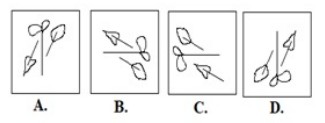
To solve this problem, we need to identify the pattern or characteristic that makes three of the figures similar and distinguishes one as different.
Correct Option: A) Figure A is different due to its lack of symmetry.
The question asks to identify the city among the given options where a subsidiary regional headquarters of the United Nations is NOT located. This requires knowledge of the main UN office locations outside of its primary headquarters in New York.
D) Rome — While Rome hosts several important UN agencies, such as the Food and Agriculture Organization (FAO), the World Food Programme (WFP), and the International Fund for Agricultural Development (IFAD), it is not considered one of the four main subsidiary regional headquarters of the United Nations. These agencies are specialized agencies, not comprehensive regional headquarters like Geneva, Vienna, or Nairobi.
The question asks to identify the musical instrument associated with the renowned musician Ustad Bismillah Khan. This requires knowledge of famous Indian classical musicians and their primary instruments.
Correct Option: B) Shehnai
Ustad Bismillah Khan (1916-2006) was an Indian musician credited with popularizing the Shehnai, a reeded wind instrument, to the extent that it became a well-known concert instrument. He performed on numerous national and international stages, including the first Independence Day ceremony in 1947 at the Red Fort, and was awarded the Bharat Ratna in 2001.
Which of the following fractions does NOT lie between \( \frac{7}{18} \) and \( \frac{3}{5} \)?
\( \frac{2}{5} \)
\( \frac{1}{2} \)
\( \frac{5}{12} \)
\( \frac{1}{3} \)
To determine which fraction does NOT lie between \( \frac{7}{18} \) and \( \frac{3}{5} \), we can convert all fractions to decimals or find a common denominator. Converting to decimals is often simpler for comparison.
\[ \frac{7}{18} \approx 0.3888... \]
\[ \frac{3}{5} = 0.6 \]
So, we are looking for a fraction that is NOT between \( 0.3888... \) and \( 0.6 \).
D) \( \frac{1}{3} \)
Convert to decimal:
\[ \frac{1}{3} \approx 0.3333... \]
Comparing this with the range:
Since \( 0.3333... \) is less than \( 0.3888... \), it does NOT lie between \( \frac{7}{18} \) and \( \frac{3}{5} \). Therefore, option D is the correct answer.
Convert to decimal:
\[ \frac{2}{5} = 0.4 \]
Comparing this with the range:
Since \( 0.4 \) is between \( 0.3888... \) and \( 0.6 \), this option is incorrect.
Convert to decimal:
\[ \frac{1}{2} = 0.5 \]
Comparing this with the range:
Since \( 0.5 \) is between \( 0.3888... \) and \( 0.6 \), this option is incorrect.
Convert to decimal:
\[ \frac{5}{12} \approx 0.4166... \]
Comparing this with the range:
Since \( 0.4166... \) is between \( 0.3888... \) and \( 0.6 \), this option is incorrect.
To determine which event happened first, we need to recall the chronological order of the major movements and incidents during the Indian freedom struggle. We will list the dates for each option provided and then compare them.
Comparing the dates:
From this comparison, it is clear that the Jallianwala Bagh Massacre took place earliest.
Correct Option: A) The Jallianwala Bagh Massacre occurred on April 13, 1919, making it the earliest event among the given options.
To find the value closest to zero, we need to calculate the value of each option and then compare them. The option with the smallest absolute value will be the closest to zero.
D) \( (0.09)^{2} \) is equal to \( 0.0081 \), which is the smallest value among all options and therefore closest to zero.
The question asks for the year when Mahatma Gandhi called for a Satyagraha against the Rowlatt Act. This requires knowledge of key events in India's freedom struggle and their timelines.
Correct Option: B) 1919 — The Rowlatt Act was passed in March 1919, and Mahatma Gandhi launched the Satyagraha against it in the same year. This movement led to widespread protests and civil unrest across India.
The question asks to identify the country that shares a border with India's Sundarbans National Park, specifically where the Sundarbans Reserve Forest is located. This requires knowledge of the geographical location of the Sundarbans and its international boundaries.
Correct Option: A) The Sundarbans National Park in India is geographically contiguous with the Sundarbans Reserve Forest, which is located in Bangladesh. They form a single ecosystem across the international border.
The question asks to identify the first batsman in the history of One Day International (ODI) cricket to score three double centuries. This is a factual question related to cricket records.
B) Rohit Sharma — Rohit Sharma is indeed the first and only cricketer to date (as of the knowledge cutoff) to have scored three double centuries in One Day Internationals.
The question asks to identify which software among the given options is NOT open source. To answer this, we need to understand the definition of open-source software and then evaluate each option based on whether its source code is freely available for use, modification, and distribution.
Correct Option: C) Microsoft Office is a proprietary software, meaning its source code is not publicly available, and it requires a license for use. Therefore, it is NOT an open-source software.