We are given the sum and difference of the LCM and HCF of two numbers, as well as the sum of the two numbers. We need to find the two numbers. We will use the properties of LCM and HCF, specifically the relationship between the product of two numbers and the product of their LCM and HCF, and solve a system of equations.
Let the two numbers be \(a\) and \(b\).
Let \(\text{LCM}\) be \(L\) and \(\text{HCF}\) be \(H\).
From the problem statement, we have:
Sum of LCM and HCF: \(L + H = 682\) (Equation 1)
Difference of LCM and HCF: \(L - H = 638\) (Equation 2)
Add Equation 1 and Equation 2:
\[ (L + H) + (L - H) = 682 + 638 \ 2L = 1320 \ L = \frac{1320}{2} \ L = 660 \]Substitute the value of \(L\) into Equation 1:
\[ 660 + H = 682 \ H = 682 - 660 \ H = 22 \]We know that for any two numbers \(a\) and \(b\), the product of the numbers is equal to the product of their LCM and HCF:
\[ a \times b = L \times H \ a \times b = 660 \times 22 \ a \times b = 14520 \]We are also given the sum of the two numbers:
\[ a + b = 286 \]Now we have a system of two equations with two variables \(a\) and \(b\):
\(a + b = 286\)
\(a \times b = 14520\)
We can find \(a\) and \(b\) by forming a quadratic equation. Consider a quadratic equation whose roots are \(a\) and \(b\):
\[ x^2 - (a+b)x + ab = 0 \ x^2 - 286x + 14520 = 0 \]Solve the quadratic equation using the quadratic formula \(x = \frac{-B \pm \sqrt{B^2 - 4AC}}{2A}\) or by factorization. Let's try factorization:
We need two numbers that sum to 286 and multiply to 14520. Let's test the options.
Alternatively, we can express one variable in terms of the other:
\[ a = 286 - b \]Substitute this into the product equation:
\[ (286 - b)b = 14520 \ 286b - b^2 = 14520 \ b^2 - 286b + 14520 = 0 \]Using the quadratic formula:
\[ b = \frac{-(-286) \pm \sqrt{(-286)^2 - 4(1)(14520)}}{2(1)} \ b = \frac{286 \pm \sqrt{81796 - 58080}}{2} \ b = \frac{286 \pm \sqrt{23716}}{2} \]Calculate the square root of 23716:
\[ \sqrt{23716} = 154 \]Now find the two possible values for \(b\):
\[ b_1 = \frac{286 + 154}{2} = \frac{440}{2} = 220 \]If \(b = 220\), then \(a = 286 - 220 = 66\).
And
\[ b_2 = \frac{286 - 154}{2} = \frac{132}{2} = 66 \]If \(b = 66\), then \(a = 286 - 66 = 220\).
So the two numbers are 220 and 66.
Correct Option: B) 220 and 66
The question asks about the symbolic representation of the 'Make in India' initiative. This requires knowledge of the official logo and its design elements.
Correct Option: B) The 'Make in India' symbol is a lion made of cogs. These cogs represent manufacturing, industry, and innovation, which are the core principles of the initiative.
The question asks to identify which of the given options is NOT a Kharif crop. To answer this, we need to know the classification of crops based on seasons in India, specifically distinguishing between Kharif and Rabi crops.
D) Wheat is a Rabi crop, sown in winter and harvested in spring. Therefore, it is the exception among the given choices, which are primarily Kharif crops.
The problem asks us to identify a hidden pattern or relationship between the numbers in each row and then apply that pattern to find the missing number. We will analyze the given rows to deduce the rule.
D) 33 is the correct answer because it follows the established pattern where the second number minus the third number equals the first number in the row.
To find the gain percentage, we first need to determine the cost price (CP) and selling price (SP) of a single banana or a common number of bananas. Then, we can calculate the profit and express it as a percentage of the cost price.
Ram bought 5 bananas for ₹20.
\[ \text{CP of 1 banana} = \frac{\text{Total Cost}}{\text{Number of Bananas}} = \frac{\text{₹}20}{5} = \text{₹}4 \]Ram sold 3 bananas for ₹15.
\[ \text{SP of 1 banana} = \frac{\text{Total Selling Price}}{\text{Number of Bananas}} = \frac{\text{₹}15}{3} = \text{₹}5 \]Profit is the difference between the selling price and the cost price.
\[ \text{Profit per banana} = \text{SP} - \text{CP} = \text{₹}5 - \text{₹}4 = \text{₹}1 \]The gain percentage is calculated using the formula:
\[ \text{Gain Percentage} = \left( \frac{\text{Profit}}{\text{CP}} \right) \times 100\% \]\[ \text{Gain Percentage} = \left( \frac{\text{₹}1}{\text{₹}4} \right) \times 100\% = 0.25 \times 100\% = 25\% \]The number of bananas bought is 5, and the number of bananas sold is 3. The Least Common Multiple (LCM) of 5 and 3 is 15.
If 5 bananas cost ₹20, then 1 banana costs ₹4.
CP of 15 bananas = \(15 \times \text{₹}4 = \text{₹}60\)
If 3 bananas sell for ₹15, then 1 banana sells for ₹5.
SP of 15 bananas = \(15 \times \text{₹}5 = \text{₹}75\)
Profit = SP - CP = ₹75 - ₹60 = ₹15
Both methods yield the same result.
A) 25% is the correct gain percentage.
The question asks about the seasonal association of the Kajri folk dance. To answer this, one needs to recall the cultural context and traditional timing of this particular folk dance form.
Correct Option: A) Monsoon
The question asks to identify the component that is NOT a part of a neuron. To answer this, we need to recall the basic structure of a neuron and differentiate its components from other biological structures.
B) Cone — Cones are photoreceptor cells found in the retina of the eye, responsible for color vision. They are specialized cells of the visual system but are not a structural component of a typical neuron.
To solve this problem, we will assume a base income for Y. Then, we will calculate X's income based on the given percentage reduction. Finally, we will determine the percentage by which Y's income is more than X's income.
Assume Y's income: Let Y's income be \(100\).
Calculate X's income: X's income is 40% less than Y's income.
\[ \text{X's income} = \text{Y's income} - (40\% \text{ of Y's income}) \] \[ \text{X's income} = 100 - \left(\frac{40}{100} \times 100\right) \] \[ \text{X's income} = 100 - 40 = 60 \]So, X's income is \(60\).
Calculate the difference in income: The difference between Y's income and X's income is:
\[ \text{Difference} = \text{Y's income} - \text{X's income} = 100 - 60 = 40 \]Calculate the percentage by which Y's income is more than X's income: This percentage is calculated with respect to X's income.
\[ \text{Percentage more} = \left(\frac{\text{Difference}}{\text{X's income}}\right) \times 100\% \] \[ \text{Percentage more} = \left(\frac{40}{60}\right) \times 100\% \] \[ \text{Percentage more} = \left(\frac{2}{3}\right) \times 100\% \] \[ \text{Percentage more} = 0.6666... \times 100\% \] \[ \text{Percentage more} \approx 66.67\% \]Correct Option: D) 66.67%
To find the median of a given set of data, we first need to arrange the data in ascending or descending order. Then, we determine if the number of data points is odd or even. If odd, the median is the middle value. If even, the median is the average of the two middle values.
Therefore, the median of the given data is 54.
C) 54 is the correct median calculated by arranging the data and finding the average of the two middle values.
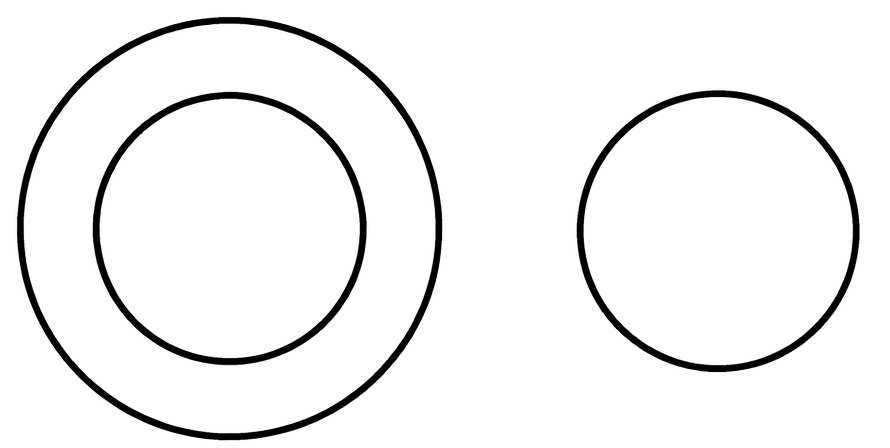
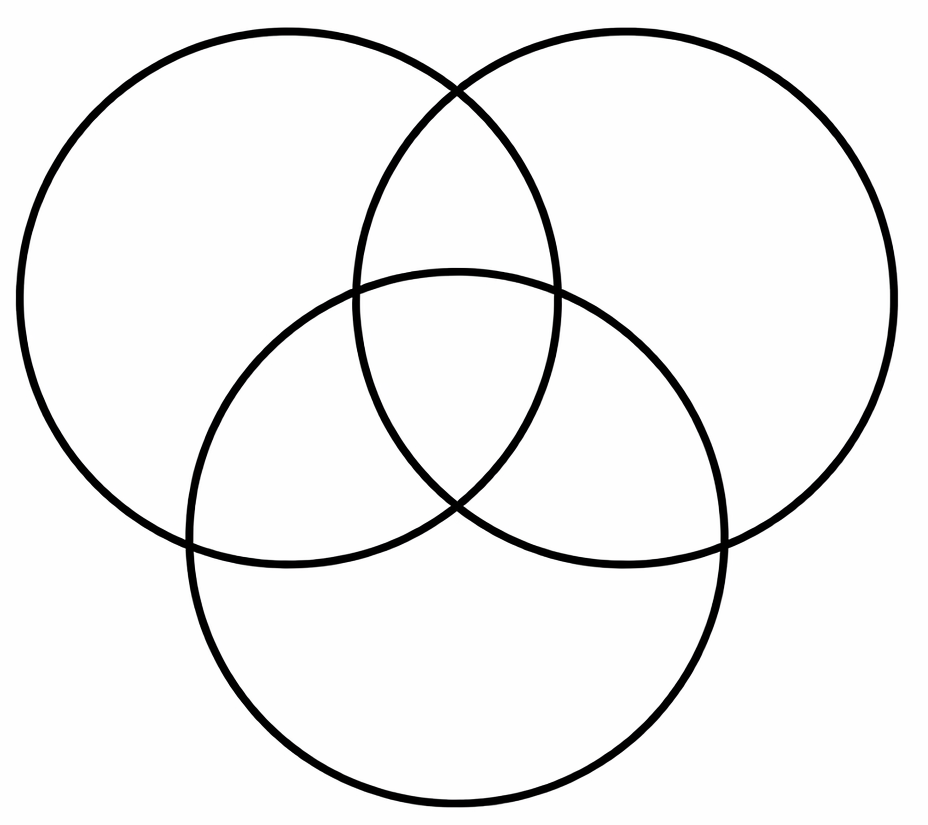
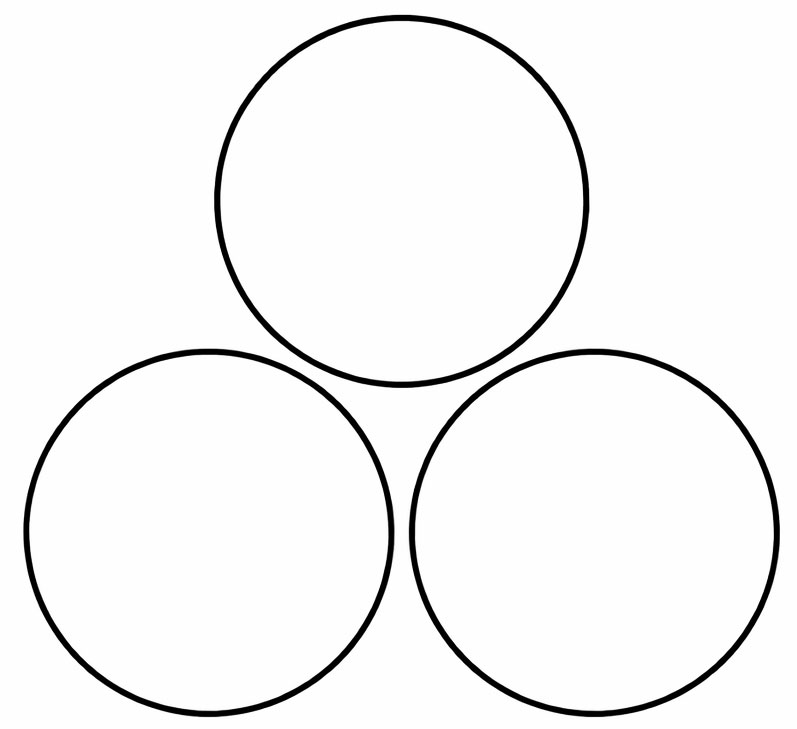
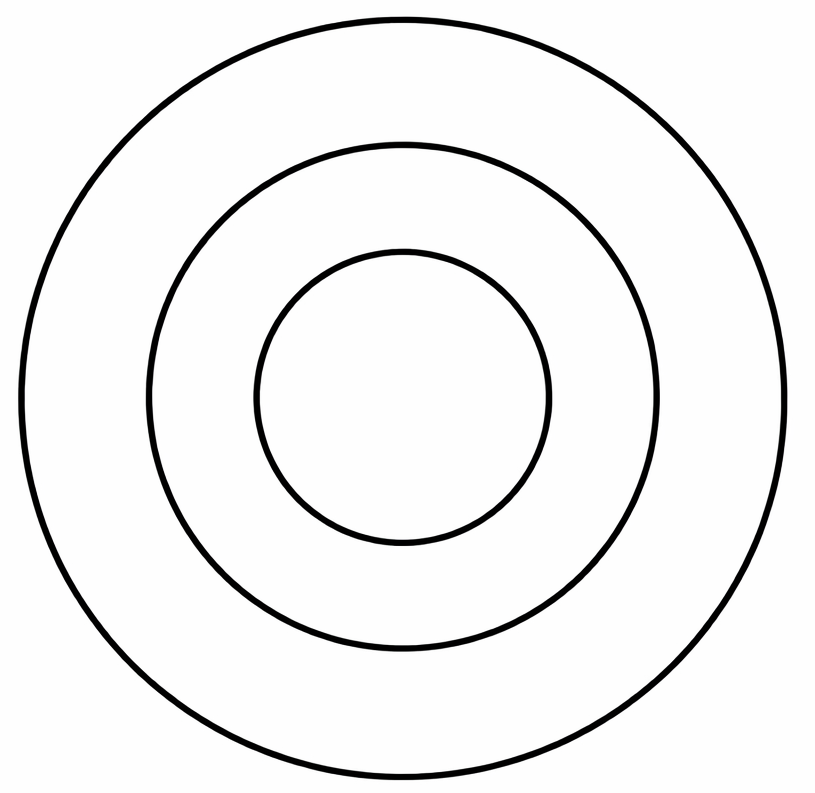
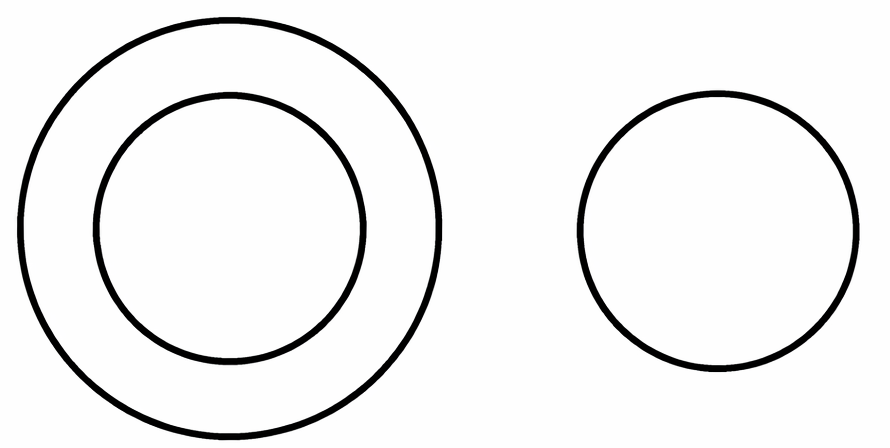
Select the Venn diagram that best represents the relationship between the following three classes.
Fruit, Coffee, Drink.
To determine the correct Venn diagram, we need to analyze the relationship between the three classes: Fruit, Coffee, and Drink. Understanding how these categories overlap or are distinct will help in selecting the appropriate diagram.
Correct Option: A) The diagram shows "Drink" as a large circle encompassing two separate circles for "Fruit" and "Coffee," which do not overlap with each other, accurately representing the relationships.