
The question asks for the headquarters location of the Food Safety & Standards Authority of India (FSSAI). This is a factual question related to Indian regulatory bodies and their administrative centers. Knowledge of the FSSAI's structure and key locations is essential for competitive exams.
C) New Delhi — The Food Safety & Standards Authority of India (FSSAI) has its headquarters in New Delhi, the capital city of India. This is where its main administrative functions and policy-making decisions are carried out.
How many triangles are there in the following figure?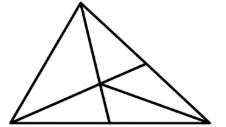
To determine the number of triangles in the given figure, we need to identify all possible triangles formed by the intersecting lines within the larger triangle.
Upon counting, we find a total of 12 triangles in the figure.
Correct Option: C) 12
The problem asks us to determine who the dentist will attend first among three patients (Y, U, K) based on a first-come-first-serve basis. We need to evaluate if the given statements provide enough information to establish the order of arrival.
D) Statements 1 and 2 together are sufficient.
By combining both statements, we can establish the complete order of arrival as K, U, Y. Therefore, K will be attended first.
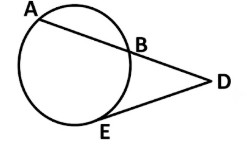
In the given circle, chord \(\overline{AB}\) is extended to meet the tangent at \(\overline{DE}\) at D. If \(\overline{AB}\) = 10 cm and \(\overline{DE}\) = 12 cm, what is the length of BD?
To find the length of BD, we use the power of a point theorem, which relates the lengths of a tangent and a secant drawn from a point outside a circle.
Correct Option: B) 8 cm
To solve this problem, we need to track the changes in Surya's direction by calculating the net angular displacement. We will assign positive values to clockwise turns and negative values to anticlockwise turns, then sum them up to find the final orientation relative to the initial direction.
Correct Option: D) East
If m men can do \( \frac{1}{n} \) of a piece of work in p days, find the expression for the number of persons required to do the whole work in q days.
\( \frac{mn}{pq} \)
\( \frac{mp}{nq} \)
\( \frac{mnp}{q} \)
\( \frac{mnq}{p} \)
This problem can be solved using the concept of work and time, specifically the man-days formula. The total work done is proportional to the number of men, the number of days, and the fraction of work completed. We will first find the rate of work per man per day and then use it to determine the number of men required for the whole work in a given number of days.
C) \( \frac{mnp}{q} \)
This expression correctly represents the number of persons required to do the whole work in \(q\) days, derived from the man-days formula.
To find the mass of a given number of moles of a substance, we need to use its molar mass. The molar mass of an element is numerically equal to its atomic mass expressed in grams per mole (g/mol).
Substituting the values:
\[ \text{Mass} = 0.6 \text{ mol} \times 1 \frac{\text{g}}{\text{mol}} \]\[ \text{Mass} = 0.6 \text{ g} \]
B) 0.6 g — The mass of 0.6 moles of hydrogen atoms is 0.6 g, as calculated by multiplying the number of moles by the molar mass of hydrogen (1 g/mol).
To find the next number in the series, we need to identify the pattern or rule that governs the sequence of numbers provided. We will examine the relationship between consecutive terms.
A) 288 is the correct option because, following the established pattern of multiplying each term by 2, the next number in the series after 144 is \(144 \times 2 = 288\).
Evaluate: 42 × {(2 + 3) − 11}
To evaluate the given expression, we need to follow the order of operations, often remembered by the acronym PEMDAS/BODMAS (Parentheses/Brackets, Exponents/Orders, Multiplication and Division (from left to right), Addition and Subtraction (from left to right)).
Wait, there seems to be a discrepancy between my calculation and the given correct answer. Let's re-evaluate the interpretation of "4 2". If "4 2" is interpreted as \(4^2\), then:
This result matches option D. Therefore, it is highly probable that "4 2" was intended to be \(4^2\).
D) -96 is the correct answer, assuming "4 2" means \(4^2\). Following the order of operations:
To evaluate the given expression, we need to follow the order of operations, often remembered by the acronym PEMDAS/BODMAS (Parentheses/Brackets, Exponents/Orders, Multiplication and Division (from left to right), Addition and Subtraction (from left to right)).
Thus, the value of the expression is 30.
A) 30 is the correct answer, as derived by following the order of operations.