
The question asks for the name of the molecular units that form long chains carrying genetic information. This refers to the basic building blocks of DNA and RNA.
D) Nucleotides — Nucleotides are the fundamental building blocks (monomers) that link together to form the long chains of DNA and RNA, which carry genetic information.
The question asks why astronauts use radio links for communication in space. This requires understanding the nature of sound waves and their propagation requirements, especially in the vacuum of space.
A) Sound waves can’t travel in space — This is correct because space is a vacuum, and sound waves are mechanical waves that require a medium to propagate. Without a medium, sound cannot travel.
Choose the mirror image for the following figure: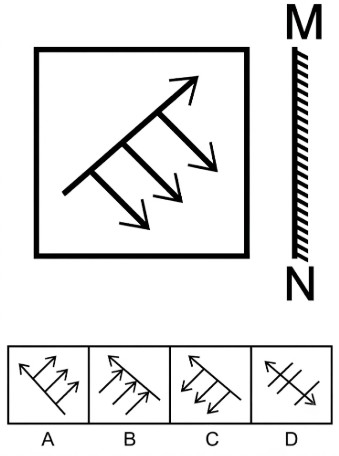
To find the mirror image of a figure, we need to reflect it across a specified axis. In this case, the mirror is placed vertically along the line labeled MN. The task is to determine which option correctly represents the mirror image of the given figure.
Correct Option: B) The diagonal line and arrows are correctly mirrored.
The question asks to identify the person known as the 'Plastic Man of India' for his innovative method of using plastic waste in road construction. This requires knowledge of prominent Indian innovators and their contributions to environmental sustainability.
Correct Option: A) Rajagopalan Vasudevan is famously known as the 'Plastic Man of India' for his groundbreaking work in developing a technique to reuse plastic waste for constructing roads, making them more durable and resistant to water.
This problem involves tracking a person's movement and changes in direction. We need to visualize the path taken and the direction the person is facing at each turn to determine the final facing direction.
Therefore, at point F, the man is facing South.
B) South — As determined by tracking his turns and movements, the man's final facing direction at point F is South.
The kinetic energy acquired by a mass (m) in traveling a distance starting from rest under the action of the constant force is directly proportional to:
To determine the relationship between kinetic energy and mass under a constant force and distance, we will use Newton's second law of motion and the work-energy theorem or equations of motion.
The constant force \(F\) acting on the mass \(m\) produces an acceleration \(a\).
\[ F = ma \]Since \(F\) is constant, the acceleration \(a\) is given by:
\[ a = \frac{F}{m} \]We can use the third equation of motion to find the final velocity \(v\):
\[ v^2 = u^2 + 2as \]Since \(u = 0\), this simplifies to:
\[ v^2 = 2as \]Substitute the expression for \(a\):
\[ v^2 = 2 \left(\frac{F}{m}\right) s \] \[ v^2 = \frac{2Fs}{m} \]The kinetic energy (KE) acquired by the mass is given by:
\[ \text{KE} = \frac{1}{2}mv^2 \]Substitute the expression for \(v^2\):
\[ \text{KE} = \frac{1}{2}m \left(\frac{2Fs}{m}\right) \]Simplify the expression:
\[ \text{KE} = \frac{1}{2} \times 2Fs \] \[ \text{KE} = Fs \]From the final expression, \(\text{KE} = Fs\). Since \(F\) is a constant force and \(s\) is a constant distance, their product \(Fs\) is also a constant. This means the kinetic energy acquired is constant and does not depend on the mass \(m\).
Therefore, the kinetic energy is proportional to \(m^0\) (which is 1, a constant).
B) \(m^0\). The kinetic energy acquired is \(Fs\), which is a constant value as both \(F\) and \(s\) are constant. Thus, it is independent of mass, meaning it is proportional to \(m^0\).
The question asks to identify the Mughal Emperor responsible for building the royal city of Fatehpur Sikri in honor of Sufi saint Shaikh Salim Chishti. This requires knowledge of Mughal history and the architectural patronage of its emperors.
Correct Option: D) Akbar built the royal city at Fatehpur Sikri. He constructed it to honor the Sufi saint Shaikh Salim Chishti, whose blessings were believed to have led to the birth of Akbar's son, Prince Salim (later Emperor Jahangir). The city served as the Mughal capital from 1571 to 1585.
This is a question based on logical deduction from a given statement. We need to analyze the statement and determine which of the conclusions can be logically inferred without making any additional assumptions.
B) Only conclusion 2 follows. Conclusion 2 is a direct and logical inference from the statement, indicating that the entity making the statement has a need for good computer programmers. Conclusion 1 is an overgeneralization and does not necessarily follow.
Find out the two signs that need to be switched for the equation to be equated.
5 + 6 × 3 – 4 ÷ 2 = (-1)
The problem requires us to find which two mathematical signs, when interchanged in the given equation, will make the equation true. We need to test each option by swapping the specified signs and then evaluating the expression using the BODMAS/PEMDAS rule (Brackets, Orders, Division, Multiplication, Addition, Subtraction).
The original equation is: \(5 + 6 \times 3 - 4 \div 2 = (-1)\)
First, let's evaluate the original equation to see if it's already true:
Since \(21 \neq -1\), the original equation is false. Now we test the options.
C) \(\div \) & \(\times \)
If we interchange \(\div \) and \(\times \), the equation becomes:
\(5 + 6 \div 3 - 4 \times 2\)
Since \(-1 = -1\), this option makes the equation true.
Select the option that is related to the third term in the same way as the second term is related to the first term.
Alight : Descend ∷ House : _____?
The problem asks us to find a relationship between the first two terms and apply the same relationship to the third term to find the fourth term. This is a classic analogy question where we need to identify the type of relationship (e.g., synonym, antonym, part-whole, cause-effect, etc.).
Correct Option: B) Home