
The buoyant force, also known as buoyancy, is an upward force exerted by a fluid that opposes the weight of an immersed object. Archimedes' principle states that the buoyant force on an object submerged in a fluid is equal to the weight of the fluid displaced by the object. We will use this principle to determine the factors influencing buoyant force.
Correct Option: D) The buoyant force depends on the density of the fluid and the volume of the body immersed in it. This directly aligns with the derived formula \(F_b = \rho_{\text{fluid}} \times V_{\text{immersed}} \times g\).
To solve this problem, we need to calculate the individual filling/emptying rates of each tap and then combine them to find the net filling rate when all three taps are open simultaneously. Finally, we can determine the total time required to fill the tank.
Tap A fills the tank in 4 hours. So, in 1 hour, Tap A fills \(\frac{1}{4}\) of the tank.
Tap B fills the tank in 6 hours. So, in 1 hour, Tap B fills \(\frac{1}{6}\) of the tank.
Tap C empties the tank in 8 hours. So, in 1 hour, Tap C empties \(\frac{1}{8}\) of the tank.
When all three taps are opened simultaneously, the net part of the tank filled in 1 hour will be the sum of the filling rates minus the emptying rate:
\[ \text{Net filling rate} = \left(\frac{1}{4} + \frac{1}{6}\right) - \frac{1}{8} \]To add and subtract these fractions, find a common denominator, which is 24:
\[ \text{Net filling rate} = \frac{6}{24} + \frac{4}{24} - \frac{3}{24} \] \[ \text{Net filling rate} = \frac{6 + 4 - 3}{24} = \frac{10 - 3}{24} = \frac{7}{24} \]So, \(\frac{7}{24}\) of the tank is filled in 1 hour.
If \(\frac{7}{24}\) of the tank is filled in 1 hour, then the total time to fill the entire tank (1 unit) is the reciprocal of the net filling rate:
\[ \text{Time} = \frac{1}{\text{Net filling rate}} = \frac{1}{\frac{7}{24}} = \frac{24}{7} \text{ hours} \]This means 3 full hours and \(\frac{3}{7}\) of an hour. To convert the fraction of an hour to minutes:
\[ \frac{3}{7} \times 60 \text{ minutes} = \frac{180}{7} \text{ minutes} \approx 25.71 \text{ minutes} \]Rounding to the nearest minute, this is approximately 26 minutes.
Therefore, the total time taken is approximately 3 hours and 26 minutes.
Correct Option: A) 3 hours, 26 minutes
The question asks for the most appropriate and respectful term to describe elderly individuals who have Alzheimer's disease. We need to choose the option that is medically accurate and socially sensitive.
Correct Option: C) Elderly person. This option uses person-first language, which is generally preferred in healthcare and social contexts. It respects the individual's identity by referring to them as a "person" who happens to have a condition, rather than defining them solely by their illness. Therefore, "Elderly people with Alzheimer's are called elderly persons (who have Alzheimer's)" is the most appropriate phrasing.
To find the next number in the series, we need to identify the pattern or relationship between consecutive numbers. This often involves looking at the differences between terms, or differences of differences (second-order differences), or other mathematical operations.
Analyze the given series: 4, 17, 43, 82, ?
Calculate the first differences between consecutive terms:
The series of first differences is: 13, 26, 39.
Identify the pattern in the first differences:
We can observe that the first differences (13, 26, 39) form an arithmetic progression where each term is a multiple of 13. Specifically:
This indicates that the next difference in this sequence should be \(13 \times 4\).
Calculate the next difference:
\[ 13 \times 4 = 52 \]Add this difference to the last term of the original series to find the next number:
The last term in the given series is 82. The next difference is 52.
\[ 82 + 52 = 134 \]Therefore, the next number in the series is 134.
B) 134 is the correct answer because the pattern of first differences (13, 26, 39) suggests that the next difference should be 52, which when added to 82 gives 134.
The question asks to identify the organism that reproduces by spore formation. We need to recall the modes of reproduction for each given option.
Correct Option: D) Rhizopus reproduces by spore formation.
To solve this problem, we need to follow the order of operations, often remembered by the acronym PEMDAS/BODMAS (Parentheses/Brackets, Exponents/Orders, Multiplication and Division (from left to right), Addition and Subtraction (from left to right)).
Correct Option: B) 0.81
Choose the Odd one out from the given figure: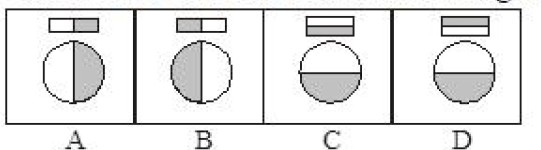
To find the odd one out, we need to analyze the patterns in the given figures. Each figure consists of a circle divided into two parts with a shaded region, and a rectangle above it.
Correct Option: A) The shaded region is on the left side, unlike the others where it is at the bottom.
What fraction of the day is 7 minutes and 12 seconds?
\( \frac{1}{300} \)
\( \frac{1}{200} \)
\( \frac{1}{240} \)
\( \frac{1}{225} \)
To find the fraction of the day that 7 minutes and 12 seconds represents, we need to convert both the given time and one full day into a common unit, preferably seconds. Then, we can express the given time as a fraction of the total time in a day and simplify it.
The fraction is the given time divided by the total time in a day:
\[ \text{Fraction} = \frac{\text{Given time in seconds}}{\text{Total seconds in a day}} = \frac{432}{86400} \]We can simplify this fraction by dividing both the numerator and the denominator by common factors.
Alternatively, recognize that \(432 \times 2 = 864\), so \(432 \times 200 = 86400\). Thus, \[\frac{432}{86400} = \frac{1}{200}\].
Correct Option: B) \( \frac{1}{200} \)
We need to determine the youngest person among Beena, Meena, Swathi, and Kavi using the initial information and then evaluate the sufficiency of each statement.
From this, we know the relative ages of Beena and Meena, and Swathi and Kavi. However, we don't know how these two pairs relate to each other. So, we cannot determine the youngest person yet.
Combining these, we have \(\text{Beena} > \text{Meena}\) and \(\text{Beena} > \text{Swathi}\). We also know \(\text{Kavi} > \text{Swathi}\). However, we still don't know the relationship between Meena and Swathi, or Kavi and Beena/Meena. For example, if \(\text{Meena} < \text{Swathi}\), then Meena could be the youngest. If \(\text{Swathi} < \text{Meena}\), then Swathi could be the youngest. We cannot definitively determine the youngest person.
Combining these inequalities:
Putting them together, we get a clear order: \(\text{Beena} > \text{Meena} > \text{Kavi} > \text{Swathi}\).
From this combined order, it is clear that Swathi is the youngest.
Therefore, Statement II alone is sufficient to answer the question.
D) Data in II alone is sufficient
Study the following pattern and select the figure relating to the third figure in the same way the second figure is related to first figure
Problem figure: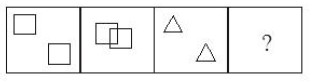
Option figures: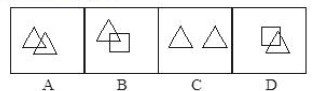
The problem involves identifying a pattern between the figures and selecting the option that follows the same pattern.
Correct Option: A) Two overlapping triangles