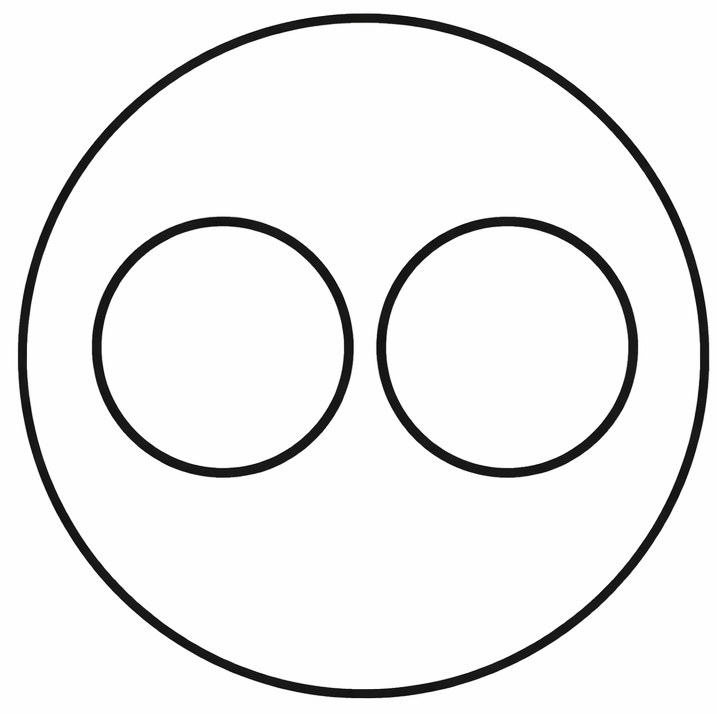
This is a syllogism problem that can be solved using Venn diagrams or by applying logical rules of inference. We will draw Venn diagrams for the given statements and then check if the conclusions logically follow.
C) Both conclusions 1 and 2 follow. As determined from the Venn diagrams and logical inference, both conclusion 1 ("Some glasses are plates") and conclusion 2 ("Some glasses are spoons") are true based on the given statements.
This question tests understanding of Newton's Third Law of Motion, which describes the nature of forces between interacting bodies.
Correct Option: D) equal and in the opposite direction
A girl is observing a bird sitting at a height of 500 m from the ground. The angle of elevation of the bird from the girl’s eyes is 45° at the initial position. After some time, the girl moves on the ground towards the bird by 50 m and bird flies away from her. At this point, the angle of elevation reduces to 30°. Find the distance traveled by the bird. Take \(\sqrt{3}\) = 1.73
We will use trigonometry to solve this problem. We need to find the initial horizontal distance of the bird from the girl, and the final horizontal distance. Then, we can calculate the horizontal distance the bird traveled. Since the bird's height is given, we can use the tangent function (opposite/adjacent) for the angles of elevation.
Initial Position: Let the initial position of the girl be point G1 and the initial position of the bird be B1. The height of the bird from the ground is \(h_1 = 500 \text{ m}\). The angle of elevation is \(45^\circ\).
Let \(x_1\) be the initial horizontal distance of the bird from the girl. In the right-angled triangle formed:
\[ \tan(45^\circ) = \frac{h_1}{x_1} \]\[ 1 = \frac{500}{x_1} \]\[ x_1 = 500 \text{ m} \]Final Position: The girl moves 50 m towards the bird. Let her new position be G2. The bird flies away, and its new position is B2. The angle of elevation from G2 to B2 is \(30^\circ\).
Let \(h_2\) be the new height of the bird and \(x_2\) be the new horizontal distance of the bird from the girl's new position G2.
In the right-angled triangle formed:
\[ \tan(30^\circ) = \frac{h_2}{x_2} \]\[ \frac{1}{\sqrt{3}} = \frac{h_2}{x_2} \]\[ x_2 = h_2 \sqrt{3} \]Relating Distances: The girl moved 50 m towards the bird. So, the distance from the initial position of the girl (G1) to her final position (G2) is 50 m.
The initial horizontal distance of the bird (B1) from G1 was \(x_1\). The final horizontal distance of the bird (B2) from G2 is \(x_2\).
The horizontal distance of the bird from the initial position of the girl (G1) in the final scenario would be \(x_2 + 50\).
Let's assume the bird maintains the same height initially. If the bird flies away, its height might change. The problem states "bird flies away from her" and the angle of elevation reduces. It doesn't explicitly state the bird's height changes. However, typically in such problems, the bird's height is considered constant unless stated otherwise, or the problem implies a new height. Let's re-evaluate.
The problem states "bird flies away from her". This implies that the bird's horizontal position changes, and its height might also change. Let's assume the bird's height is not constant, and we need to find the distance traveled by the bird, which is the straight-line distance between B1 and B2.
Let \(H_1\) be the initial height of the bird (500 m). Let \(H_2\) be the final height of the bird. Let \(D_{G1B1}\) be the initial horizontal distance of the bird from the girl, and \(D_{G2B2}\) be the final horizontal distance of the bird from the girl's new position.
From the initial position:
\[ \tan(45^\circ) = \frac{H_1}{D_{G1B1}} \]\[ 1 = \frac{500}{D_{G1B1}} \]\[ D_{G1B1} = 500 \text{ m} \]Understanding the Bird's Movement: The phrase "bird flies away from her" and "angle of elevation reduces" implies that the bird moves both horizontally and potentially vertically. However, without more information on the bird's final height, we cannot determine the exact path. A common interpretation in such problems is that the bird maintains its height unless a new height is given. Let's assume the bird maintains its height, i.e., \(H_2 = H_1 = 500 \text{ m}\).
If \(H_2 = 500 \text{ m}\), then from the final position:
\[ \tan(30^\circ) = \frac{H_2}{D_{G2B2}} \]\[ \frac{1}{\sqrt{3}} = \frac{500}{D_{G2B2}} \]\[ D_{G2B2} = 500 \sqrt{3} \text{ m} \]Calculating Horizontal Distance Traveled by Bird:
Initial horizontal distance of bird from G1 = \(D_{G1B1} = 500 \text{ m}\).
The girl moves 50 m towards the bird. So, her new position G2 is 50 m closer to the initial vertical line of the bird. The horizontal distance of the initial bird position (B1) from G2 would be \(500 - 50 = 450 \text{ m}\).
The final horizontal distance of the bird (B2) from G2 is \(D_{G2B2} = 500 \sqrt{3} \text{ m}\).
The bird flew away from her. This means the bird moved horizontally away from the girl's line of sight. The horizontal distance of the bird from G2 increased from 450 m (if it stayed at B1) to \(500\sqrt{3}\) m.
The horizontal distance traveled by the bird is the difference between its final horizontal position relative to G2 and its initial horizontal position relative to G2.
Horizontal distance bird traveled \( = D_{G2B2} - (D_{G1B1} - 50) \)
Horizontal distance bird traveled \( = 500\sqrt{3} - (500 - 50) \)
Horizontal distance bird traveled \( = 500\sqrt{3} - 450 \)
Using \(\sqrt{3} = 1.73\):
Horizontal distance bird traveled \( = 500 \times 1.73 - 450 \)
Horizontal distance bird traveled \( = 865 - 450 \)
Horizontal distance bird traveled \( = 415 \text{ m} \)
Since the height of the bird is assumed to be constant, the distance traveled by the bird is purely horizontal.
A) 415 m is the calculated horizontal distance traveled by the bird, assuming its height remained constant.
The problem asks us to identify the relationship between the first two terms and apply the same relationship to find the fourth term from the third term. This is a word analogy question where we need to find the antonym of the given word.
D) Worst — "Worst" is the antonym of "Best", just as "Shallow" is the antonym of "Deep".
Which of the following newspapers was published by Lokamanya Tilak during Indian National movement?
The question asks to identify the newspaper published by Lokamanya Tilak during the Indian National Movement. This requires knowledge of prominent nationalist leaders and their associated publications.
C) Kesari. Bal Gangadhar Tilak, popularly known as Lokamanya Tilak, started two newspapers: 'Kesari' (in Marathi) and 'Mahratta' (in English). Both played a crucial role in propagating nationalist views and mobilizing public opinion against British rule. Kesari was particularly influential among the Marathi-speaking population.
To find the Least Common Multiple (LCM) of two numbers, we can use the prime factorization method. This involves finding the prime factors of each number, then taking the highest power of all common and uncommon prime factors and multiplying them together.
Divide 63 by the smallest prime number that divides it.
\[ 63 = 3 \times 21 \]\[ 21 = 3 \times 7 \]\[ 7 = 7 \times 1 \]So, the prime factorization of 63 is \(3 \times 3 \times 7 = 3^2 \times 7^1\).Divide 140 by the smallest prime number that divides it.
\[ 140 = 2 \times 70 \]\[ 70 = 2 \times 35 \]\[ 35 = 5 \times 7 \]\[ 7 = 7 \times 1 \]So, the prime factorization of 140 is \(2 \times 2 \times 5 \times 7 = 2^2 \times 5^1 \times 7^1\).To find the LCM, take the highest power of all prime factors that appear in either factorization.
Multiply these highest powers together:
\[ \text{LCM}(63, 140) = 2^2 \times 3^2 \times 5^1 \times 7^1 \]\[ \text{LCM}(63, 140) = 4 \times 9 \times 5 \times 7 \]\[ \text{LCM}(63, 140) = 36 \times 35 \]\[ \text{LCM}(63, 140) = 1260 \]D) 1260 is the correct LCM of 63 and 140.
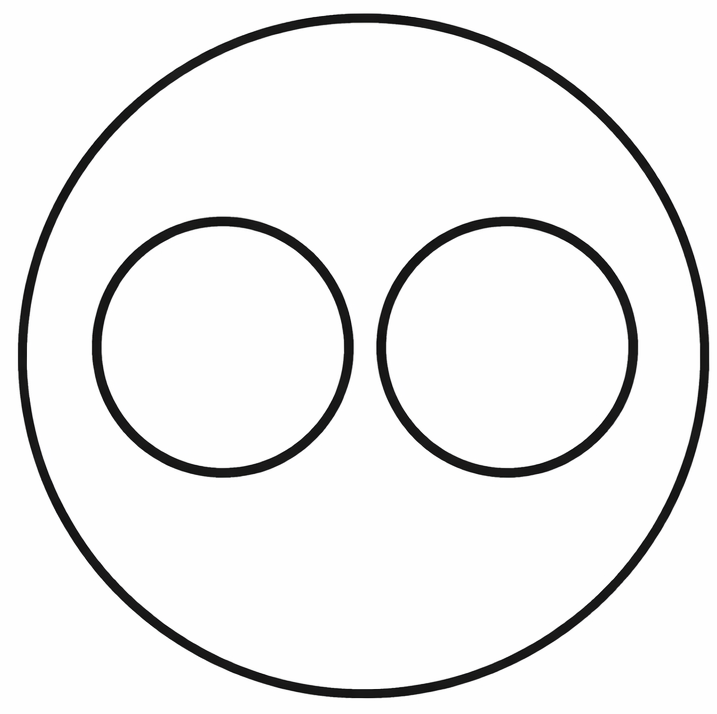
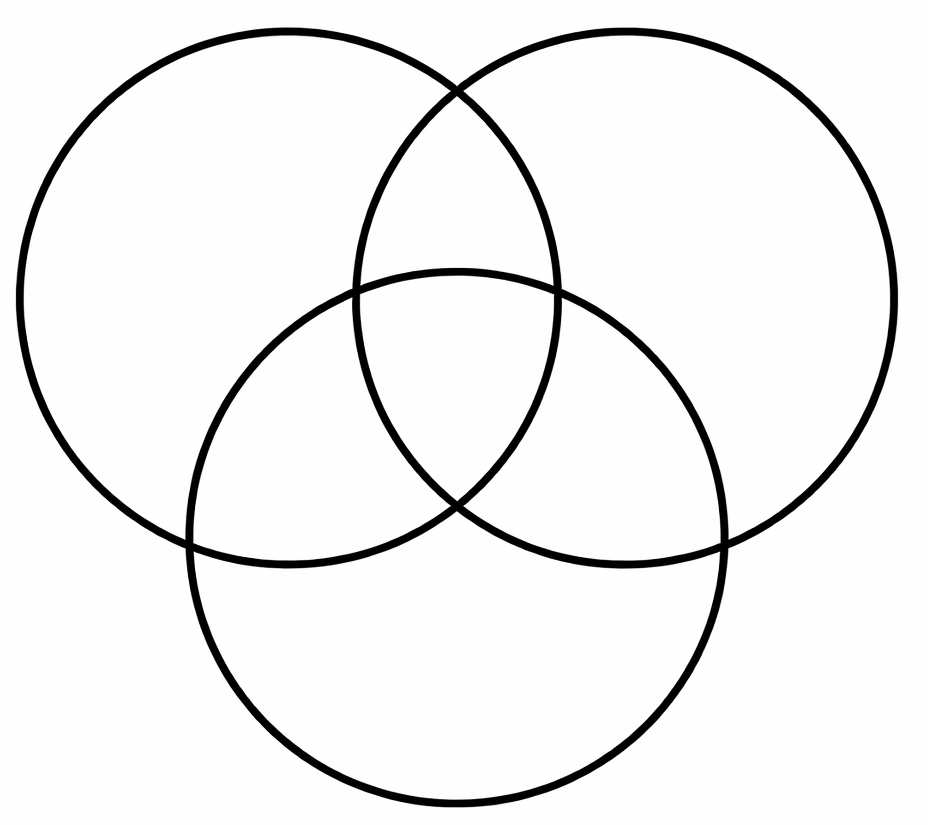
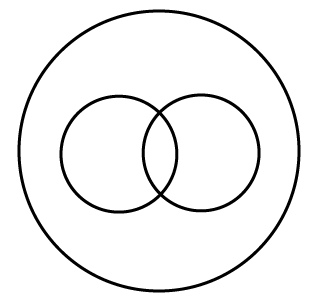
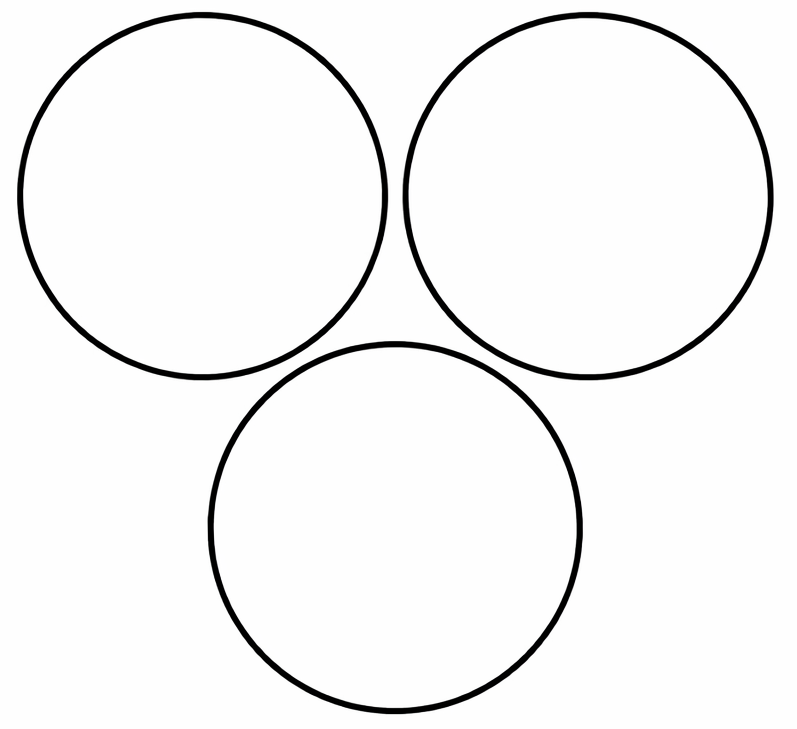
Identify the Venn Diagram that best represents the following classes:
Grapes, Pineapples, Fruits
To determine the correct Venn Diagram representation for the classes "Grapes," "Pineapples," and "Fruits," we need to understand the relationship between these classes. Both grapes and pineapples are types of fruits, meaning they are subsets of the larger category "Fruits." Therefore, the diagram should reflect this hierarchical relationship.
The correct diagram should show two smaller circles inside a larger circle, indicating that both "Grapes" and "Pineapples" are subsets of "Fruits" but do not overlap with each other.
Correct Option: A) The diagram shows two separate circles within a larger circle, correctly representing "Grapes" and "Pineapples" as subsets of "Fruits."
Pabitra had 19\( \frac{2}{7} \) litres of petrol in the fuel tank of his vehicle at the start of a journey. During the journey, 13\( \frac{1}{2} \) litres of petrol was consumed. What fraction of the initial petrol was left in the fuel tank after the journey?
\( \frac{11}{40} \)
\( \frac{3}{10} \)
\( \frac{3}{5} \)
\( \frac{7}{10} \)
To find the fraction of initial petrol left, we first need to calculate the amount of petrol remaining after consumption. This involves converting mixed fractions to improper fractions, performing subtraction, and then expressing the remaining amount as a fraction of the initial amount. Finally, simplify the fraction to its lowest terms.
Initial petrol = \( 19\frac{2}{7} \) litres
\[ 19\frac{2}{7} = \frac{(19 \times 7) + 2}{7} = \frac{133 + 2}{7} = \frac{135}{7} \text{ litres} \]Consumed petrol = \( 13\frac{1}{2} \) litres
\[ 13\frac{1}{2} = \frac{(13 \times 2) + 1}{2} = \frac{26 + 1}{2} = \frac{27}{2} \text{ litres} \]Petrol left = Initial petrol - Consumed petrol
\[ \text{Petrol left} = \frac{135}{7} - \frac{27}{2} \]To subtract these fractions, find a common denominator, which is \( 7 \times 2 = 14 \).\[ \text{Petrol left} = \frac{135 \times 2}{7 \times 2} - \frac{27 \times 7}{2 \times 7} = \frac{270}{14} - \frac{189}{14} = \frac{270 - 189}{14} = \frac{81}{14} \text{ litres} \]Fraction left = (Petrol left) / (Initial petrol)
\[ \text{Fraction left} = \frac{\frac{81}{14}}{\frac{135}{7}} \]To divide by a fraction, multiply by its reciprocal:\[ \text{Fraction left} = \frac{81}{14} \times \frac{7}{135} \]We can simplify by canceling common factors. Both 81 and 135 are divisible by 27 (\( 81 = 3 \times 27 \), \( 135 = 5 \times 27 \)). Also, 7 and 14 are divisible by 7.
\[ \text{Fraction left} = \frac{3 \times 27}{2 \times 7} \times \frac{7}{5 \times 27} = \frac{3}{2 \times 5} = \frac{3}{10} \]B) \( \frac{3}{10} \)
Read the following table carefully and answer the question given below:
Classification of 100 students based on the marks obtained by them in Mathematics and Science in an Engineering Entrance Examination.
| Subject | Marks out of 50 | ||||
| 40 and above | 30 and above | 20 and above | 10 and above | 0 and above | |
| Maths | 23 | 26 | 70 | 90 | 100 |
| Science | 15 | 36 | 75 | 95 | 100 |
| (Aggregate) Average | 19 | 31 | 80 | 93 | 100 |
The number of students scoring 60% marks in aggregate is?
The problem asks for the number of students scoring 60% marks in aggregate. The aggregate marks are out of 50. Therefore, we need to calculate 60% of 50 and then find the corresponding number of students from the provided table.
Determine the passing marks for 60% in aggregate:
The maximum aggregate marks are 50. We need to find 60% of these marks.
\[ \text{Required marks} = 60\% \text{ of } 50 \] \[ \text{Required marks} = \frac{60}{100} \times 50 \] \[ \text{Required marks} = 0.60 \times 50 \] \[ \text{Required marks} = 30 \]So, we are looking for the number of students who scored 30 marks or above in aggregate.
Refer to the table:
Look at the row labeled "(Aggregate) Average" in the table.
Find the column that corresponds to "30 and above" marks.
The value in the table for "(Aggregate) Average" and "30 and above" is 69.
Conclusion:
The number of students scoring 60% marks (i.e., 30 marks) in aggregate is 69.
A) 69 — As calculated, 60% of 50 is 30. From the table, 69 students scored 30 and above in aggregate.
The question asks about the frequency range of ultrasonic sound waves. To answer this, we need to recall the classification of sound waves based on their frequency, particularly the human hearing range.
Correct Option: C) 20000 Hz