
The question asks about the conditions under which a concave mirror forms a virtual, erect, and enlarged image. This requires recalling the image formation rules for concave mirrors based on the object's position.
A) Between F and P — When the object is placed between the focal point (F) and the pole (P) of a concave mirror, the reflected rays diverge and appear to come from a point behind the mirror. This results in a virtual, erect, and enlarged image.
The problem requires calculating the amount spent on arrangements, which is 50% of the total entry fee collected. First, we need to find the total number of participants, then the total amount collected, and finally, 50% of that amount.
D) Rs. 75,000 is the correct answer. This matches the calculated amount spent on arrangements.
The question asks to identify which of the given languages was NOT granted Classical Language status by the Government of India in 2017. This requires knowledge of the languages that have received this status and their respective years of recognition.
Correct Option: C) Prakrit
Prakrit is a group of Middle Indo-Aryan languages, but it has not been officially designated as a Classical Language by the Government of India. The question specifically asks about the status in 2017, and by then, the six languages listed above had already received the status. Prakrit is not among them.
To determine which element has three completely filled electron shells, we need to examine the electron configuration of each given element. A shell is considered completely filled when it contains the maximum number of electrons it can hold. The maximum number of electrons in a shell \(n\) is given by \(2n^2\).
Therefore, Argon is the element with three completely filled shells in the context of its stable noble gas configuration.
Correct Option: A) Argon
If 22x2 - ax + 2 = ax2 + 18x - 7 has only one (repeated) solution, then the positive integral solution of a is
The problem states that the given equation has only one (repeated) solution. This implies that the equation, when rearranged into the standard quadratic form \(Ax^2 + Bx + C = 0\), must have its discriminant equal to zero. The discriminant of a quadratic equation is given by \(D = B^2 - 4AC\).
First, rearrange the given equation into the standard quadratic form \(Ax^2 + Bx + C = 0\):
\[ 22x^2 - ax + 2 = ax^2 + 18x - 7 \]Move all terms to one side of the equation:
\[ 22x^2 - ax^2 - ax - 18x + 2 + 7 = 0 \]Group the terms by powers of \(x\):
\[ (22 - a)x^2 + (-a - 18)x + (2 + 7) = 0 \]\[ (22 - a)x^2 - (a + 18)x + 9 = 0 \]Now, identify the coefficients \(A\), \(B\), and \(C\) for this quadratic equation:
\[ A = (22 - a) \]\[ B = -(a + 18) \]\[ C = 9 \]For a quadratic equation to have only one (repeated) solution, its discriminant must be zero. The discriminant \(D\) is given by \(B^2 - 4AC\).
\[ D = B^2 - 4AC = 0 \]Substitute the values of \(A\), \(B\), and \(C\) into the discriminant formula:
\[ (-(a + 18))^2 - 4(22 - a)(9) = 0 \]\[ (a + 18)^2 - 36(22 - a) = 0 \]Expand and simplify the equation:
\[ a^2 + 36a + 324 - (36 \times 22 - 36a) = 0 \]\[ a^2 + 36a + 324 - (792 - 36a) = 0 \]\[ a^2 + 36a + 324 - 792 + 36a = 0 \]\[ a^2 + 72a - 468 = 0 \]Solve this quadratic equation for \(a\). We can use the quadratic formula \(a = \frac{-b \pm \sqrt{b^2 - 4ac}}{2a}\) or factorize it. Let's try to factorize:
We need two numbers that multiply to -468 and add up to 72. Let's consider factors of 468:
Notice that \(78 - 6 = 72\). So, the factors are 78 and -6.
\[ (a + 78)(a - 6) = 0 \]This gives two possible values for \(a\):
\[ a + 78 = 0 \implies a = -78 \]\[ a - 6 = 0 \implies a = 6 \]The problem asks for the positive integral solution of \(a\).
Therefore, \(a = 6\).
Correct Option: B) 6
If the edge of a cube is increased by 4 cm, the surface area will increase by 432 cm2. Then the original length of each edge of the cube is _____.
We need to find the original length of the edge of a cube. We are given information about how its surface area changes when the edge length is increased. We will use the formula for the surface area of a cube and set up an equation based on the given increase in surface area.
Let the original length of each edge of the cube be \(a\) cm.
The original surface area of the cube is given by the formula \(A_1 = 6a^2\) cm\(^2\).
When the edge of the cube is increased by 4 cm, the new edge length becomes \((a+4)\) cm.
The new surface area of the cube is \(A_2 = 6(a+4)^2\) cm\(^2\).
We are given that the surface area increases by 432 cm\(^2\). This means the difference between the new surface area and the original surface area is 432 cm\(^2\).
So, \(A_2 - A_1 = 432\).
Substitute the expressions for \(A_1\) and \(A_2\) into the equation:
\[ 6(a+4)^2 - 6a^2 = 432 \]Divide the entire equation by 6 to simplify:
\[ (a+4)^2 - a^2 = \frac{432}{6} \] \[ (a+4)^2 - a^2 = 72 \]Expand \((a+4)^2\) using the identity \((x+y)^2 = x^2 + 2xy + y^2\):
\[ (a^2 + 2 \cdot a \cdot 4 + 4^2) - a^2 = 72 \] \[ (a^2 + 8a + 16) - a^2 = 72 \]Simplify the equation:
\[ a^2 + 8a + 16 - a^2 = 72 \] \[ 8a + 16 = 72 \]Solve for \(a\):
\[ 8a = 72 - 16 \] \[ 8a = 56 \] \[ a = \frac{56}{8} \] \[ a = 7 \]Therefore, the original length of each edge of the cube is 7 cm.
Correct Option: B) 7 cm
The problem provides a division result and asks to find the result of a similar division involving decimals. The key is to understand how decimal places affect the division result. We can convert the decimal numbers into fractions to make the relationship clearer and then use the given information.
We are given the initial division:
\[ 703 \div 37 = 19 \]We need to find the value of \(7.03 \div 0.0037\). Let's express these decimal numbers as fractions:
\[ 7.03 = \frac{703}{100} \]\[ 0.0037 = \frac{37}{10000} \]Now, substitute these fractional forms into the expression we need to evaluate:
\[ 7.03 \div 0.0037 = \frac{703}{100} \div \frac{37}{10000} \]To divide by a fraction, we multiply by its reciprocal:
\[ \frac{703}{100} \times \frac{10000}{37} \]Rearrange the terms to group the known division:
\[ \left(\frac{703}{37}\right) \times \left(\frac{10000}{100}\right) \]From the given information, we know that \(\frac{703}{37} = 19\). Also, simplify the fraction of powers of 10:
\[ \frac{10000}{100} = 100 \]Substitute these values back into the expression:
\[ 19 \times 100 \]Perform the multiplication:
\[ 19 \times 100 = 1900 \]Thus, \(7.03 \div 0.0037 = 1900\).
B) 1900 — As calculated in the step-by-step explanation, the result of the division is 1900.
The question asks to identify which of the given actions is NOT an involuntary action. An involuntary action is one that occurs without conscious thought or control, typically regulated by the autonomic nervous system. A voluntary action, on the other hand, is one that is performed consciously and intentionally.
Correct Option: B) Bicycling is a voluntary action, meaning it is not an involuntary action. It requires conscious thought and control.
How many triangles are there in the following figure?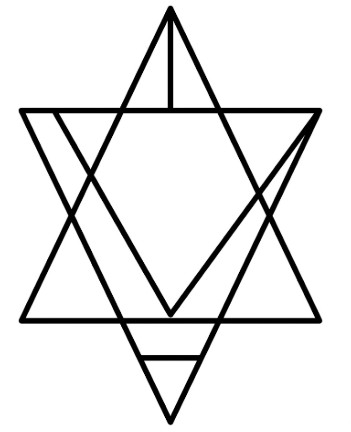
To determine the number of triangles in the given figure, we need to systematically count all possible triangles, considering different sizes and orientations.
Correct Option: D) 18
Find the odd figure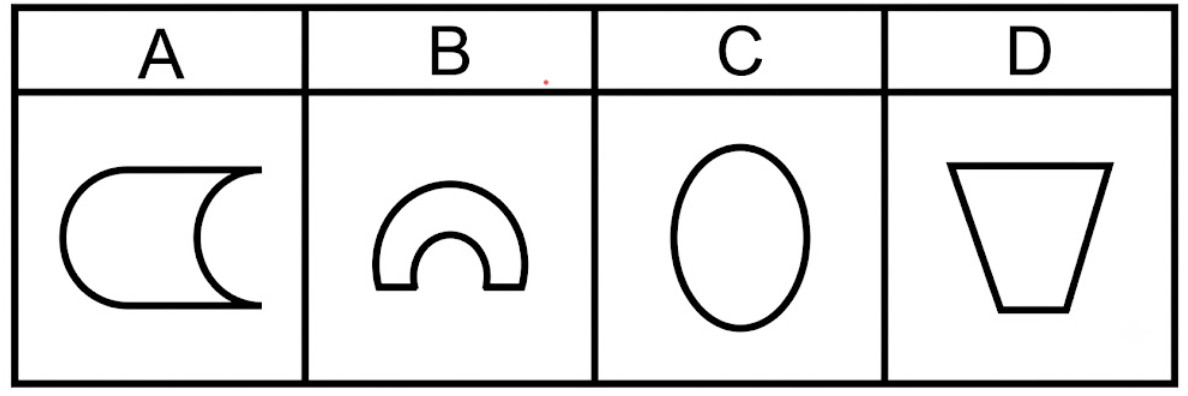
To find the odd figure among the given options, we need to identify a pattern or characteristic that is common to most figures but absent in one.
Thus, the odd figure is option A due to its lack of symmetry.
Correct Option: A) Option A is the odd figure because it lacks symmetry, unlike the other options.