
The question asks for the specific date on which World Press Freedom Day is celebrated. This is a factual question related to important international observances.
World Press Freedom Day is an annual event observed globally to raise awareness of the importance of freedom of the press and to remind governments of their duty to respect and uphold the right to freedom of expression enshrined under Article 19 of the 1948 Universal Declaration of Human Rights. The United Nations General Assembly declared 3 May as World Press Freedom Day in 1993, following a recommendation adopted by the UNESCO General Conference in 1991. The date also marks the anniversary of the Declaration of Windhoek, a statement of press freedom principles put together by African newspaper journalists in 1991.
Correct Option: D) 3 May is the correct date for World Press Freedom Day.
Choose the correct mirror image of the following figure from the given four alternatives
Question Figure: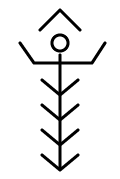
Option Figure: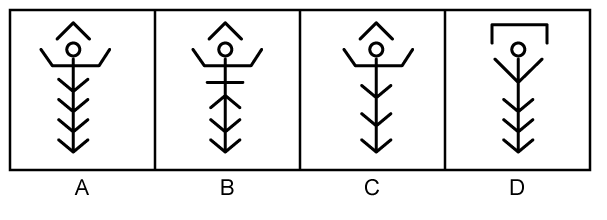
To find the correct mirror image of a figure, visualize how the figure would look if reflected across a vertical axis. This involves reversing the orientation of the figure horizontally while maintaining its vertical alignment.
Correct Option: C) The figure in Option C is the correct mirror image as it accurately reverses the horizontal orientation of the branches.
The given series is a number series where we need to find the missing term. We will analyze the pattern of the given numbers to determine the rule governing the series.
D) 25 — The series consists of squares of consecutive natural numbers: \(1^2, 2^2, 3^2, 4^2, 5^2, 6^2, 7^2\). The missing term is \(5^2 = 25\).
To solve this problem, we need to track the net angular displacement from the initial direction. We will assign positive values to clockwise turns and negative values to anticlockwise turns. The sum of these turns will give the final angular position relative to the starting direction.
Therefore, Varsha is now facing North-West.
Correct Option: C) North west
This question asks us to identify which assumptions are implicit in a given statement. We need to analyze the statement and each assumption to determine if the assumption is a necessary underlying belief or premise for the statement to be made.
B) Only assumption I is implicit.
Assumption I is implicit because the teacher's warning is given with the expectation that it might lead to the desired outcome (the student listening). If there were no such expectation, the warning would be pointless. Assumption II is not implicit because the statement only indicates the use of punishment in a specific scenario, not that it is considered the 'best' method overall.
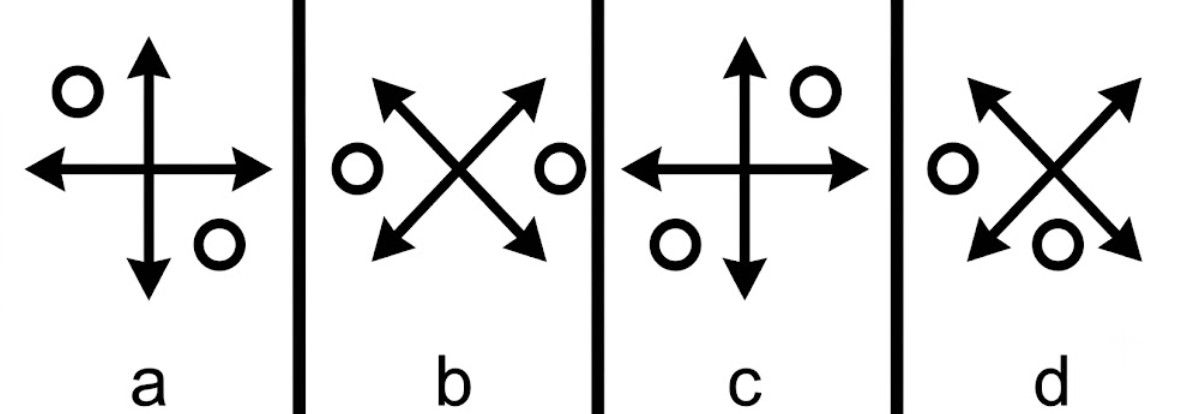
To identify the odd one out, we need to analyze the patterns and arrangements of the elements in each figure. The focus is on the orientation and arrangement of arrows and circles.
Correct Option: B) Figure B has a diagonal arrow arrangement, unlike the cross pattern in others.
The problem asks for the sum of the squares of two integers, given the sum of their square roots. The key is to simplify the given expression \(\sqrt{14+8\sqrt{3}}\) into the form \((a+b)^2\) or \((a-b)^2\) under the square root, which will then simplify to \(a+b\) or \(a-b\). Once we find the individual square roots, we can identify the integers and then calculate the sum of their squares.
We are given \(\sqrt{14+8\sqrt{3}}\). We want to express the term inside the square root as a perfect square, i.e., \((x+y)^2 = x^2+y^2+2xy\).
Let's rewrite \(8\sqrt{3}\) as \(2 \times 4 \times \sqrt{3}\). We need to find two numbers \(x\) and \(y\) such that \(x^2+y^2 = 14\) and \(2xy = 8\sqrt{3}\).
From \(2xy = 8\sqrt{3}\), we have \(xy = 4\sqrt{3}\). We can try to split \(4\sqrt{3}\) into factors. Consider \(x=4\) and \(y=\sqrt{3}\). Let's check if \(x^2+y^2 = 14\):
\[ x^2+y^2 = (4)^2 + (\sqrt{3})^2 = 16 + 3 = 19 \]This is not 14. So, this combination is incorrect.
Let's try to rewrite \(8\sqrt{3}\) differently. We can write \(8\sqrt{3} = 2 \times (2\sqrt{3}) \times 2\). This doesn't seem to simplify easily.
Let's try to make \(xy\) simpler. We can write \(8\sqrt{3} = 2 \times \sqrt{16} \times \sqrt{3} = 2 \times \sqrt{48}\). So we need \(x^2+y^2=14\) and \(xy=\sqrt{48}\).
Consider factors of 48: (1, 48), (2, 24), (3, 16), (4, 12), (6, 8).
If \(x^2=6\) and \(y^2=8\), then \(x^2+y^2 = 6+8=14\). This works!
So, we can write \(14+8\sqrt{3}\) as \(6+8+2\sqrt{48}\) or \(6+8+2\sqrt{6}\sqrt{8}\).
This means \(14+8\sqrt{3} = (\sqrt{6})^2 + (\sqrt{8})^2 + 2\sqrt{6}\sqrt{8}\). This is in the form \((a+b)^2\).
So, \(14+8\sqrt{3} = (\sqrt{6}+\sqrt{8})^2\).
Therefore, \(\sqrt{14+8\sqrt{3}} = \sqrt{(\sqrt{6}+\sqrt{8})^2} = \sqrt{6}+\sqrt{8}\).
We can simplify \(\sqrt{8}\) as \(\sqrt{4 \times 2} = 2\sqrt{2}\).
So, \(\sqrt{14+8\sqrt{3}} = \sqrt{6}+2\sqrt{2}\).
Alternatively, we can write \(14+8\sqrt{3} = 14+2(4\sqrt{3}) = 14+2\sqrt{16 \times 3} = 14+2\sqrt{48}\). We need two numbers whose sum is 14 and product is 48. These numbers are 6 and 8. So, \[ \sqrt{14+2\sqrt{48}} = \sqrt{6} + \sqrt{8} = \sqrt{6} + 2\sqrt{2} \] This is the sum of the square roots of two integers. Let the two integers be \(a\) and \(b\). Then \(\sqrt{a} + \sqrt{b} = \sqrt{6} + 2\sqrt{2}\). This implies that \(\sqrt{a} = \sqrt{6}\) and \(\sqrt{b} = 2\sqrt{2} = \sqrt{8}\) (or vice-versa). So, the two integers are \(a=6\) and \(b=8\).
The two integers are 6 and 8.
Sum of their squares \(= 6^2 + 8^2\)
\[ 6^2 + 8^2 = 36 + 64 = 100 \]C) 100
The question asks to identify a property that consistently increases with an increase in atomic number in both Group 1 (alkali metals) and Group 17 (halogens) of the modern periodic table. We need to analyze the trends of each given property down these groups.
Based on this analysis, only atomic size consistently increases with atomic number in both groups.
B) Atomic size — As we move down any group in the periodic table, a new electron shell is added with each successive element. This addition of electron shells leads to an increase in the distance between the outermost electrons and the nucleus, causing the atomic radius to increase. This trend is observed in both Group 1 (alkali metals) and Group 17 (halogens).
The problem asks us to decode a word based on a given coding pattern. We need to identify the rule used to transform "HUG" into "SFT" and then apply the same rule to "PET" to find its code.
The rule is that each letter is replaced by its opposite letter in the alphabet, where the sum of their alphabetical positions is 27.
D) KVG — As derived from the step-by-step analysis, applying the "sum of positions equals 27" rule to each letter of PET results in KVG.
The question asks to identify which of the given options is NOT a connective tissue. To answer this, we need to recall the different types of animal tissues and classify the given options accordingly.
Correct Option: A) Nerve cells are the basic units of the nervous system, responsible for transmitting electrical signals. They are a type of nervous tissue, not connective tissue.