
Two pipes A and B can fill an empty cistern in 1.8 and 2.7 hours, respectively. Pipe C can drain the entire cistern in 4.5 hours when no other pipe is in operation. Initially when the cistern was empty, Pipe A and Pipe C were turned on. After a few hours, Pipe A was turned off and Pipe B was turned on instantly. In all it took 5.5 hours to fill the cistern. For how many hours was Pipe B turned on?
This problem involves calculating work rates of pipes (filling and draining) and combining them over different time intervals to find an unknown duration. We will determine the individual filling/draining rates, then set up an equation based on the total work done (filling the cistern) and the total time taken.
Calculate the filling/draining rates:
Simplify the rates:
Define variables for time:
Formulate equations based on total time and total work:
Set up the total work equation:
The work done in the first phase plus the work done in the second phase equals 1 (full cistern).
\[ \left(\frac{1}{3}\right) t_1 + \left(\frac{4}{27}\right) t_2 = 1 \]Solve the system of equations:
We have two equations:
Substitute \(t_1\) from equation (1) into equation (2):
\[ \frac{1}{3} (5.5 - t_2) + \frac{4}{27} t_2 = 1 \] \[ \frac{5.5}{3} - \frac{t_2}{3} + \frac{4t_2}{27} = 1 \]Multiply the entire equation by 27 to clear denominators:
\[ 9 \times 5.5 - 9t_2 + 4t_2 = 27 \] \[ 49.5 - 5t_2 = 27 \] \[ 5t_2 = 49.5 - 27 \] \[ 5t_2 = 22.5 \] \[ t_2 = \frac{22.5}{5} \] \[ t_2 = 4.5 \]So, Pipe B was turned on for 4.5 hours.
B) 4.5
This problem involves analyzing logical statements and determining which conclusions can be drawn from them. We will use Venn diagrams or logical deduction to represent the given statements and then evaluate each conclusion based on these representations.
Correct Option: D) Only conclusion 1 follows
The problem provides the percentage distribution of expenses and the actual amount spent on one category (rent and electricity). We need to find the amount spent on another category (procurement) using these percentages.
Since ₹15,000 represents 10% of the total monthly expenses, we can write this as:
\[ 10\% \text{ of Total Expenses} = \text{₹}15,000 \]To find the total expenses, we can set up a proportion or simply multiply the given amount by the reciprocal of its percentage (as a decimal).
\[ \text{Total Expenses} = \frac{\text{₹}15,000}{10\%} = \frac{\text{₹}15,000}{0.10} = \text{₹}150,000 \]Procurement accounts for 90% of the total expenses. So, we calculate 90% of the total expenses:
\[ \text{Procurement Expense} = 90\% \text{ of } \text{₹}150,000 \] \[ \text{Procurement Expense} = 0.90 \times \text{₹}150,000 \] \[ \text{Procurement Expense} = \text{₹}135,000 \]₹135,000 is equal to 1.35 lakh.
A) 1.35 lakh is the correct amount spent on procurement.
This is a blood relation question. We need to establish the relationship between Supriya and Akhil's father's mother by tracing the family tree based on the given information.
Therefore, Akhil's father's mother is Supriya's paternal grandmother.
B) Paternal grandmother — As established, Akhil's father is Supriya's father, and his mother is Supriya's paternal grandmother.
The problem asks us to find the missing number in a given series: 7, 10, 14, ?, 25, 32. To solve this, we need to identify the pattern or rule governing the sequence of numbers.
Let's find the difference between each adjacent pair of numbers in the given series:
So far, the differences are 3 and 4. This suggests a pattern where the difference increases by 1 each time.
Following the pattern of increasing differences (3, 4), the next difference should be 5.
If the difference between the missing term and 14 is 5, then the missing term would be:
\[ 14 + 5 = 19 \]Now, let's check if this pattern holds for the rest of the series. If the missing term is 19, the next difference should be 6, and the term after that should be 25:
This matches our predicted difference of 6.
Finally, the next difference should be 7, and the term after that should be 32:
This also matches our predicted difference of 7. The pattern of increasing differences (3, 4, 5, 6, 7) is consistent throughout the series.
The missing number in the series is 19.
B) 19 is the correct option because it fits the established pattern of increasing differences between consecutive terms (3, 4, 5, 6, 7).
To calculate the current drawn from a generator, we can use the fundamental relationship between power, voltage, and current in an electrical circuit. The formula for electrical power is \(P = V \times I\), where \(P\) is power, \(V\) is voltage, and \(I\) is current. We are given the power and voltage, and we need to find the current.
The relationship between power, voltage, and current is given by:
\[ P = V \times I \]To find the current, we can rearrange the formula as:
\[ I = \frac{P}{V} \]Substitute \(P = 1100 \text{ W}\) and \(V = 220 \text{ V}\) into the rearranged formula:
\[ I = \frac{1100 \text{ W}}{220 \text{ V}} \]Perform the division:
\[ I = 5 \text{ A} \]Thus, the current drawn from the generator is 5 A.
Correct Option: A) 5 A is the correct current calculated using the power, voltage, and current relationship.
This problem involves analyzing logical statements and deriving conclusions using Venn diagrams or direct logical deduction. We need to determine which of the given conclusions logically follow from the provided statements.
C) All the conclusions follow. Both Conclusion 1 ("All vessels are mud") and Conclusion 2 ("Some mud are pot") are logically derivable from the given statements.
The question asks about the form of energy into which the work done by friction is converted. This relates to the principle of conservation of energy and the nature of friction as a dissipative force.
D) heat — When friction acts between two surfaces in relative motion, it converts the kinetic energy of the system into internal energy, which is observed as an increase in temperature, i.e., the generation of heat. This is a fundamental concept in thermodynamics and mechanics.
Which figure follows next in pattern:
Problem Figure: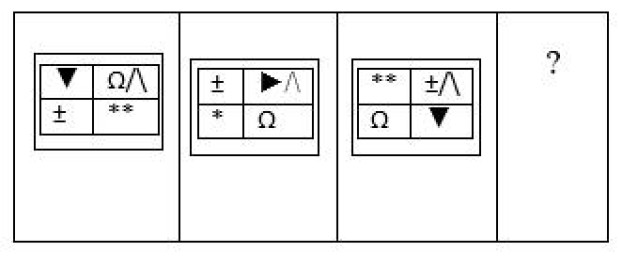
Answer Figures: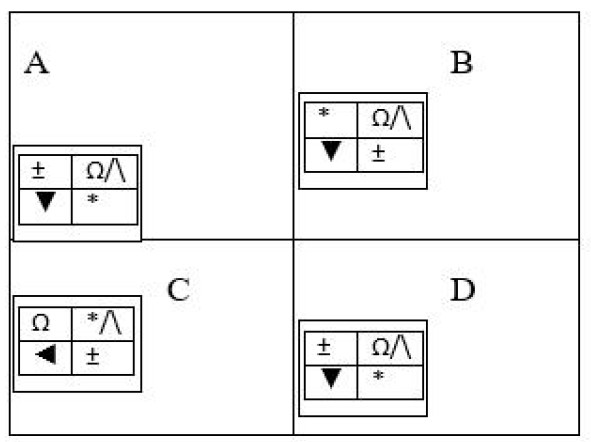
To determine which figure follows next in the pattern, we need to analyze the sequence of symbols and their positions in the given problem figures.
Correct Option: B) The symbols are correctly rotated clockwise from the third problem figure.
To find the area of a rhombus, we need the lengths of both its diagonals. We are given the length of one diagonal and the side length. We can use the property that the diagonals of a rhombus bisect each other at right angles. This forms four right-angled triangles, allowing us to find the length of the second diagonal using the Pythagorean theorem.
Let the side length of the rhombus be \(a\). Given \(a = 5 \text{ m}\).
Let the length of the first diagonal be \(d_1\). Given \(d_1 = 2.8 \text{ m}\).
The diagonals of a rhombus bisect each other at right angles. This means half of the first diagonal, \(d_1/2\), and half of the second diagonal, \(d_2/2\), form the legs of a right-angled triangle, with the side of the rhombus \(a\) as the hypotenuse.
Calculate half the length of the first diagonal:
\[ \frac{d_1}{2} = \frac{2.8 \text{ m}}{2} = 1.4 \text{ m} \]Apply the Pythagorean theorem to find half the length of the second diagonal, \(d_2/2\):
\[ a^2 = \left(\frac{d_1}{2}\right)^2 + \left(\frac{d_2}{2}\right)^2 \]\[ (5 \text{ m})^2 = (1.4 \text{ m})^2 + \left(\frac{d_2}{2}\right)^2 \]\[ 25 \text{ m}^2 = 1.96 \text{ m}^2 + \left(\frac{d_2}{2}\right)^2 \]\[ \left(\frac{d_2}{2}\right)^2 = 25 \text{ m}^2 - 1.96 \text{ m}^2 \]\[ \left(\frac{d_2}{2}\right)^2 = 23.04 \text{ m}^2 \]\[ \frac{d_2}{2} = \sqrt{23.04 \text{ m}^2} \]\[ \frac{d_2}{2} = 4.8 \text{ m} \]Calculate the full length of the second diagonal \(d_2\):
\[ d_2 = 2 \times 4.8 \text{ m} = 9.6 \text{ m} \]The area of a rhombus is given by the formula:
\[ \text{Area} = \frac{1}{2} \times d_1 \times d_2 \]Substitute the values of \(d_1\) and \(d_2\):
\[ \text{Area} = \frac{1}{2} \times 2.8 \text{ m} \times 9.6 \text{ m} \]\[ \text{Area} = 1.4 \text{ m} \times 9.6 \text{ m} \]\[ \text{Area} = 13.44 \text{ m}^2 \]Correct Option: B) 13.44 m²