
This is a syllogism problem. We will use Venn diagrams to represent the given statements and then evaluate each conclusion based on these diagrams. The key is to consider all possible valid Venn diagram configurations that satisfy the statements.
C) Only conclusion 2 is correct.
The question asks for the date of the public screening of India's first feature film, 'Raja Harishchandra'. This requires knowledge of a specific historical event in Indian cinema.
B) 3 May 1913 is the correct date for the public screening of 'Raja Harishchandra', India's first full-length feature film. This event marked the beginning of the Indian film industry.
The pattern in which of the following options most closely resembles the pattern in the given image?
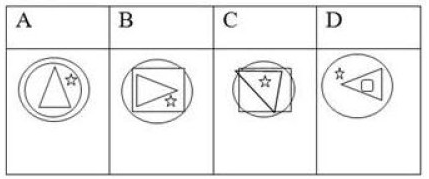
To solve this pattern recognition question, we need to identify which option most closely resembles the given pattern in the question image. The key is to analyze the arrangement and types of shapes within the images.
Correct Option: D) Option D most closely resembles the pattern in the given image.
The problem states that the given equation has only one (repeated) solution. This implies that the equation, when rearranged into a standard quadratic form \(Ax^2 + Bx + C = 0\), must have its discriminant equal to zero. The discriminant of a quadratic equation \(Ax^2 + Bx + C = 0\) is given by \(\Delta = B^2 - 4AC\). For a repeated solution, \(\Delta = 0\).
Rearrange the given equation into standard quadratic form:
The given equation is \(3x^2 - ax + 9 = ax^2 + 2x + 5\).
Move all terms to one side to get a standard quadratic equation \(Ax^2 + Bx + C = 0\):
\[ 3x^2 - ax^2 - ax - 2x + 9 - 5 = 0 \]\[ (3 - a)x^2 + (-a - 2)x + (9 - 5) = 0 \]\[ (3 - a)x^2 - (a + 2)x + 4 = 0 \]Identify the coefficients A, B, and C:
From the standard form \((3 - a)x^2 - (a + 2)x + 4 = 0\), we have:
Apply the condition for a repeated solution:
For a quadratic equation to have only one (repeated) solution, its discriminant must be zero. That is, \(\Delta = B^2 - 4AC = 0\).
Substitute the values of A, B, and C into the discriminant formula:
\[ (-(a + 2))^2 - 4(3 - a)(4) = 0 \]\[ (a + 2)^2 - 16(3 - a) = 0 \]Solve the resulting equation for 'a':
Expand and simplify the equation:
\[ (a^2 + 4a + 4) - (48 - 16a) = 0 \]\[ a^2 + 4a + 4 - 48 + 16a = 0 \]\[ a^2 + 20a - 44 = 0 \]Factorize the quadratic equation for 'a':
We need two numbers that multiply to -44 and add up to 20. These numbers are 22 and -2.
\[ a^2 + 22a - 2a - 44 = 0 \]\[ a(a + 22) - 2(a + 22) = 0 \]\[ (a - 2)(a + 22) = 0 \]Find the possible values of 'a':
From the factored form, we get two possible values for \(a\):
\[ a - 2 = 0 \implies a = 2 \]\[ a + 22 = 0 \implies a = -22 \]Select the positive integral solution:
The question asks for the positive integral solution of \(a\). Between 2 and -22, the positive integral solution is \(a = 2\).
C) 2 — The calculations show that the positive integral value of \(a\) that results in a single (repeated) solution for the given equation is 2.
The question asks about the source from which litmus solution, a common acid-base indicator, is extracted. This is a direct knowledge-based question related to general science, specifically chemistry and biology.
Litmus is a natural indicator that is used to test the acidity or alkalinity of a solution. It is derived from certain types of lichens.
D) Lichen — Litmus solution is a natural indicator extracted from lichens. Lichens are composite organisms that arise from algae or cyanobacteria living among filaments of multiple fungi species in a mutualistic relationship. The dye extracted from lichens is used to make litmus paper, which turns red in acidic solutions and blue in basic solutions.
The question asks about the top-performing Indian state in governance according to the 2017 Public Affairs Index (PAI). This requires knowledge of specific rankings and reports related to governance in India.
Correct Option: A) Kerala
To find "x% of y", we convert the percentage to a decimal or fraction and then multiply it by the number. In this case, we need to calculate 45% of 250.
To convert a percentage to a decimal, divide it by 100.
\[ 45\% = \frac{45}{100} = 0.45 \]Now, multiply the decimal form of the percentage by 250.
\[ 0.45 \times 250 \]We can perform this multiplication:
\[\begin{align*} & \quad 0.45 \ \times & \quad 250 \ \hline & \quad 000 \quad (\text{for } 0.45 \times 0) \ & 2250 \quad (\text{for } 0.45 \times 50) \ + & 9000 \quad (\text{for } 0.45 \times 200) \ \hline & 112.50 \end{align*}\]Alternatively, we can calculate it as a fraction:
\[ 45\% \text{ of } 250 = \frac{45}{100} \times 250 \]Simplify the expression:
\[ \frac{45}{100} \times 250 = \frac{45 \times 250}{100} \]Divide both 250 and 100 by 50:
\[ \frac{45 \times 5}{2} = \frac{225}{2} \]Perform the division:
\[ \frac{225}{2} = 112.5 \]Both methods yield the same result.
A) 112.5 is the correct calculation for 45% of 250.
This question tests the understanding of phase changes, specifically melting, and how temperature behaves during such processes. The key concept here is latent heat.
C) Does not change. During the melting of a solid, the temperature remains constant because the heat energy supplied is utilized as latent heat of fusion to change the state from solid to liquid, rather than increasing the kinetic energy of the molecules.
The question asks to evaluate the strength of two arguments regarding awareness programs for rainwater harvesting. A strong argument is one that is logical, relevant, and directly supports or refutes the given statement. We need to assess each argument independently.
Correct Option: C) Only argument I is strong
This question tests general knowledge about prestigious awards in India, specifically the Indira Gandhi Award for National Integration. To answer correctly, one needs to recall the recipient of this award for the 2015-16 period.
Correct Option: A) T. M. Krishna