In a bank, Deepa deposits a sum of Rs 6,250, which amounts to Rs 7,562.50 in two years compounded annually. The rate of interest is:
The problem involves compound interest. We are given the principal amount, the final amount after a certain period, and the time duration. We need to find the annual rate of interest. The formula for compound interest will be used to solve this problem.
The formula for the amount \(A\) after \(n\) years with compound interest is:
\[ A = P \left(1 + \frac{R}{100}\right)^n \]Divide both sides by 6250:
\[ \frac{7562.50}{6250} = \left(1 + \frac{R}{100}\right)^2 \]\[ 1.21 = \left(1 + \frac{R}{100}\right)^2 \]Subtract 1 from both sides:
\[ 1.1 - 1 = \frac{R}{100} \]\[ 0.1 = \frac{R}{100} \]Thus, the rate of interest is 10%.
A) 10% is the correct rate of interest calculated using the compound interest formula.
The given series consists of terms that combine a number and a letter. To find the next term, we need to analyze the pattern for both the numerical part and the alphabetical part separately.
The numbers in the series are: 12, 2, 14, 4, 16, ______
This sequence can be broken down into two alternating sub-sequences:
Since the blank is at an even position (the 6th term), the numerical part of the next term will be 6.
The letters in the series are: B, H, C, G, D, ______
This sequence can also be broken down into two alternating sub-sequences based on their position in the alphabet:
Since the blank is at an even position (the 6th term), the alphabetical part of the next term will be F.
The numerical part for the 6th term is 6.
The alphabetical part for the 6th term is F.
Therefore, the next term in the series is 6F.
B) 6F — This option correctly follows both the numerical and alphabetical patterns identified.
Choose the mirror image of the following figure: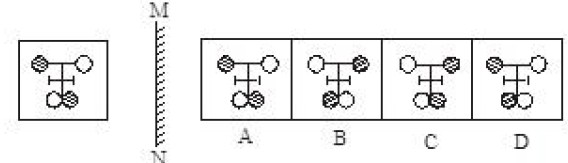
To find the mirror image of a given figure, we need to reflect the figure across a vertical axis. This means reversing the orientation of the elements in the figure horizontally.
Correct Option: A) Option A accurately represents the mirror image of the original figure.
The question asks for the state where the Sela Pass is located, referencing its mention in the Union Budget 2018 for tunnel construction. This requires knowledge of Indian geography, specifically the location of important mountain passes.
B) Arunachal Pradesh is the correct answer. The Sela Pass is a crucial mountain pass located in Arunachal Pradesh, providing connectivity to the Tawang region.
The problem asks us to find the distance covered by an elevator given the work done and the constant force applied. We can use the fundamental formula relating work, force, and displacement (distance) to solve this problem.
Identify the given values:
Recall the formula for work done:
Work done is defined as the product of the force applied and the displacement (distance) in the direction of the force.
Rearrange the formula to solve for distance (\(d\)):
\[ d = \frac{W}{F} \]Substitute the given values into the formula:
\[ d = \frac{1000 \text{ J}}{200 \text{ N}} \]Calculate the distance:
\[ d = 5 \text{ m} \]Thus, the distance covered by the elevator is 5 meters.
D) 5 m — This is the correct distance calculated using the work-force-distance formula.
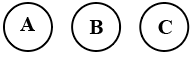
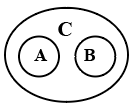
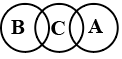
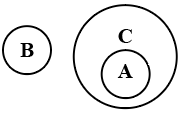
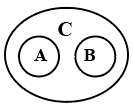
Which of the following correctly describes the relationship between
A) Length
B) Breadth
C) Dimension
To determine the correct relationship between length, breadth, and dimension, we need to understand how these elements are typically related in geometry. Length and breadth are dimensions of a two-dimensional shape, such as a rectangle.
Correct Option: B) The diagram correctly shows that length and breadth together form the dimension.
The question asks us to evaluate the strength of two arguments regarding whether students should be permitted to evaluate their teachers. We need to determine which argument presents a strong and logical reason for its stance.
Correct Option: B) Only Argument 1 is strong
To find the total surface area of the combined solid (a cone on top of a cube), we need to calculate the surface area of the cube that is exposed, and the curved surface area of the cone. The base of the cone will be resting on the cube, so that area will not be part of the total surface area. We also need to account for the area of the top face of the cube that is not covered by the cone's base.
Calculate the dimensions of the cone:
Calculate the slant height (\(l\)) of the cone:
The slant height can be found using the Pythagorean theorem:
\[ l = \sqrt{r^2 + h^2} \] \[ l = \sqrt{7^2 + 24^2} \] \[ l = \sqrt{49 + 576} \] \[ l = \sqrt{625} \] \[ l = 25 \text{ cm} \]Calculate the curved surface area (CSA) of the cone:
\[ \text{CSA}_{\text{cone}} = \pi r l \] \[ \text{CSA}_{\text{cone}} = \frac{22}{7} \times 7 \times 25 \] \[ \text{CSA}_{\text{cone}} = 22 \times 25 \] \[ \text{CSA}_{\text{cone}} = 550 \text{ cm}^2 \]Calculate the surface area of the cube:
Calculate the area of the base of the cone:
This is the area covered by the cone on the top face of the cube.
\[ \text{Area}_{\text{cone base}} = \pi r^2 \] \[ \text{Area}_{\text{cone base}} = \frac{22}{7} \times 7^2 \] \[ \text{Area}_{\text{cone base}} = \frac{22}{7} \times 49 \] \[ \text{Area}_{\text{cone base}} = 22 \times 7 \] \[ \text{Area}_{\text{cone base}} = 154 \text{ cm}^2 \]Calculate the exposed area of the top face of the cube:
\[ \text{Exposed area}_{\text{cube top}} = \text{Area}_{\text{cube face}} - \text{Area}_{\text{cone base}} \] \[ \text{Exposed area}_{\text{cube top}} = 225 - 154 \] \[ \text{Exposed area}_{\text{cube top}} = 71 \text{ cm}^2 \]Calculate the total surface area of the combined solid:
Total Surface Area = (Area of 5 faces of cube) + (Exposed area of top face of cube) + (Curved surface area of cone)
\[ \text{TSA}_{\text{combined}} = 1125 + 71 + 550 \] \[ \text{TSA}_{\text{combined}} = 1746 \text{ cm}^2 \]Correct Option: C) 1746 sq cm
The question asks to identify the Veda that contains information about magical rituals and charms. To answer this, one needs to recall the primary focus and content of each of the four Vedas.
Correct Option: C) Atharvana veda is the Veda that mentions magical rituals and charms. It is distinct from the other three Vedas (Rig, Sama, Yajur) which are primarily concerned with sacrificial rites and hymns.
The question asks to identify the principal means of transportation in the Indian economy. This requires knowledge of the dominant modes of transport used for both passengers and freight across the country.
Correct Option: D) the railways