To find the average speed, we need to calculate the total distance covered and the total time taken. The average speed is then the ratio of total distance to total time.
Identify the given information:
Convert time to standard units (seconds):
Since speed is usually expressed in meters per second (\(\text{ms}^{-1}\)), convert the time from minutes to seconds.
\[ T = 1 \text{ minute} = 1 \times 60 \text{ seconds} = 60 \text{ s} \]Calculate the average speed:
The formula for average speed is:
\[ \text{Average Speed} = \frac{\text{Total Distance}}{\text{Total Time}} \]Substitute the values:
\[ \text{Average Speed} = \frac{144 \text{ m}}{60 \text{ s}} \] \[ \text{Average Speed} = 2.4 \text{ ms}^{-1} \]B) \(2.4 \text{ ms}^{-1}\)
The calculation shows that Ram's average speed is \(2.4 \text{ ms}^{-1}\).
Which of the following correctly represents the relationship between:
A) Appendix
B) Preface
C) Books
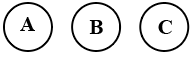
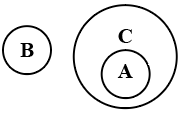
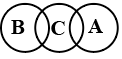
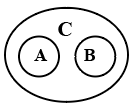
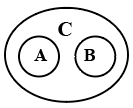
To determine the correct relationship between Appendix, Preface, and Books, we need to understand their roles. An appendix and a preface are parts of a book, not standalone entities. Therefore, both should be contained within the category of books.
Correct Option: D) This diagram shows A and B as separate circles within a larger circle labeled C, correctly representing that both the appendix and preface are parts of a book.
The question asks to identify the specific animal for which the Sunderbans is famously known. This requires knowledge of the prominent wildlife found in the Sunderbans region.
Correct Option: C) The Sunderbans is internationally recognized as the largest reserve for the Royal Bengal Tiger. These tigers are uniquely adapted to the mangrove environment, capable of swimming and hunting in the tidal waterways.
Select the most appropriate option to solve the given equation.
\(\left(\frac{\cot30^\circ}{1+\sin45^\circ}\right)+\left(\frac{1+\sin45^\circ}{\cot30^\circ}\right)\) =?
\(\dfrac{14\sqrt{3}-5\sqrt{6}}{6}\)
\(\dfrac{6\sqrt{6}-5\sqrt{3}}{6}\)
\(3-2\sqrt{3}\)
\(\dfrac{5\sqrt{3}-6\sqrt{6}}{6}\)
The question asks to identify the term for objects that produce their own light. This is a basic concept in physics related to light and optics.
Correct Option: B) Luminous objects are those that emit light of their own. Examples include the sun, stars, light bulbs, and candles.
To determine Viki's final direction relative to his initial position, we can visualize his movements on a coordinate plane or by drawing a simple diagram. We'll track his path step-by-step and then identify the resultant direction.
Correct Option: B) North-West
The problem presents a numerical series, and we need to find the next term. We should analyze the relationship between consecutive terms to identify the pattern.
C) 150 — Based on the identified pattern, the next term in the series is 150.
The question asks what is necessary for work to be done. In physics, work is defined as the transfer of energy. We will analyze the definition of work and its relationship with the given options.
B) energy — Work is done when there is a transfer or conversion of energy. It is the capacity to do work. Without energy, no work can be performed.
This problem involves setting up equations based on the given age difference and ratio. We can use a common multiplier for the ratio to represent the ages and then use the age difference to find the value of this multiplier.
Let the ages of S and R be represented by variables based on their ratio. Given the ratio of their ages is 7 : 9, let S's age be \(7x\) years and R's age be \(9x\) years, where \(x\) is a common multiplier.
We are told that S is younger than R by 7 years. This can be written as an equation:
\[ \text{R's age} - \text{S's age} = 7 \]Substitute the expressions for their ages into the equation:
\[ 9x - 7x = 7 \]Simplify the equation to find the value of \(x\):
\[ 2x = 7 \]\[ x = \frac{7}{2} \]\[ x = 3.5 \]Now that we have the value of \(x\), we can find S's age. S's age is \(7x\):
\[ \text{S's age} = 7 \times 3.5 \]\[ \text{S's age} = 24.5 \text{ years} \]Correct Option: D) 24.5 years
{40 − [90 ÷ 5 × (\(\overline{16-8}\)) ÷ 2 ÷ 3]} =?