
The problem asks us to find a number given that a certain percentage of it is equal to a specific value. We can set up an algebraic equation to represent this relationship and then solve for the unknown number.
Correct Option: B) 350
The question asks about a specific event in June 2017 related to the promotion of Goods and Services Tax (GST) by the Union Government of India. This requires knowledge of current affairs and government campaigns from that period.
C) Amitabh Bachchan — In June 2017, the Union Government of India engaged veteran Bollywood actor Amitabh Bachchan to promote the Goods and Services Tax (GST). He featured in a promotional video explaining the concept of 'one nation, one tax' to the public, just before its implementation on July 1, 2017.
To find the square root of 15625, we can use either the prime factorization method or the long division method. Alternatively, we can use a shortcut method by looking at the last digit and estimating the range of the square root.
We can find the prime factors of 15625:
\[ 15625 = 5 \times 3125 \\ 3125 = 5 \times 625 \\ 625 = 5 \times 125 \\ 125 = 5 \times 25 \\ 25 = 5 \times 5 \]So, \(15625 = 5 \times 5 \times 5 \times 5 \times 5 \times 5 = 5^6\).
The square root of \(15625\) is \(\sqrt{5^6} = 5^{6/2} = 5^3\).
Calculating \(5^3\):
\[ 5^3 = 5 \times 5 \times 5 = 25 \times 5 = 125 \]Both methods confirm that the square root of 15625 is 125.
Correct Option: A) 125
The problem asks us to find the missing term in a given number series. We need to identify the pattern or rule governing the sequence of numbers.
Let's write down the given series:
\(32, 64, 256, 1536, ?, 122880, 1474560\)
Examine the relationship between consecutive terms:
From the first term to the second term:
\[ 64 \div 32 = 2 \]From the second term to the third term:
\[ 256 \div 64 = 4 \]From the third term to the fourth term:
\[ 1536 \div 256 = 6 \]Observe the multipliers: The multipliers are \(2, 4, 6\). This suggests a pattern where the multiplier increases by \(2\) each time.
Following this pattern, the next multiplier should be \(8\).
To find the missing term, multiply the fourth term (\(1536\)) by \(8\):
\[ 1536 \times 8 = 12288 \]Let's verify this pattern with the subsequent terms. The next multiplier should be \(10\).
Multiply the calculated missing term (\(12288\)) by \(10\):
\[ 12288 \times 10 = 122880 \]This matches the sixth term in the series.
The next multiplier should be \(12\).
Multiply the sixth term (\(122880\)) by \(12\):
\[ 122880 \times 12 = 1474560 \]This matches the seventh term in the series.
The pattern holds true. The missing term is \(12288\).
D) 12288 — The series follows a pattern where each term is obtained by multiplying the previous term by a sequence of even numbers: \( \times 2, \times 4, \times 6, \times 8, \times 10, \times 12 \). Applying this rule, \(1536 \times 8 = 12288\).
If tanα = \( \sqrt{3} \) + 2, then the value of tanα − cotα is:
To find the value of \( \tan\alpha - \cot\alpha \), we are given the value of \( \tan\alpha \). We know that \( \cot\alpha \) is the reciprocal of \( \tan\alpha \). Therefore, we can first find \( \cot\alpha \) and then substitute both values into the expression.
Given value of \( \tan\alpha \):
\[ \tan\alpha = \sqrt{3} + 2 \]
Find \( \cot\alpha \):
We know that \( \cot\alpha = \frac{1}{\tan\alpha} \).
\[ \cot\alpha = \frac{1}{\sqrt{3} + 2} \]
To simplify this expression, we rationalize the denominator by multiplying the numerator and denominator by the conjugate of the denominator, which is \( 2 - \sqrt{3} \) or \( -2 + \sqrt{3} \). Let's use \( 2 - \sqrt{3} \) for convenience, or \( \sqrt{3} - 2 \) if we write \( \sqrt{3} + 2 \) as \( 2 + \sqrt{3} \).
Let's rewrite \( \sqrt{3} + 2 \) as \( 2 + \sqrt{3} \). Its conjugate is \( 2 - \sqrt{3} \).
\[ \cot\alpha = \frac{1}{2 + \sqrt{3}} \times \frac{2 - \sqrt{3}}{2 - \sqrt{3}} \]
Using the identity \( (a+b)(a-b) = a^2 - b^2 \) in the denominator:
\[ \cot\alpha = \frac{2 - \sqrt{3}}{(2)^2 - (\sqrt{3})^2} \]
\[ \cot\alpha = \frac{2 - \sqrt{3}}{4 - 3} \]
\[ \cot\alpha = \frac{2 - \sqrt{3}}{1} \]
\[ \cot\alpha = 2 - \sqrt{3} \]
Calculate \( \tan\alpha - \cot\alpha \):
Substitute the values of \( \tan\alpha \) and \( \cot\alpha \) into the expression:
\[ \tan\alpha - \cot\alpha = (\sqrt{3} + 2) - (2 - \sqrt{3}) \]
Remove the parentheses:
\[ \tan\alpha - \cot\alpha = \sqrt{3} + 2 - 2 + \sqrt{3} \]
Combine like terms:
\[ \tan\alpha - \cot\alpha = (\sqrt{3} + \sqrt{3}) + (2 - 2) \]
\[ \tan\alpha - \cot\alpha = 2\sqrt{3} + 0 \]
\[ \tan\alpha - \cot\alpha = 2\sqrt{3} \]
Correct Option: B) \( 2\sqrt{3} \)
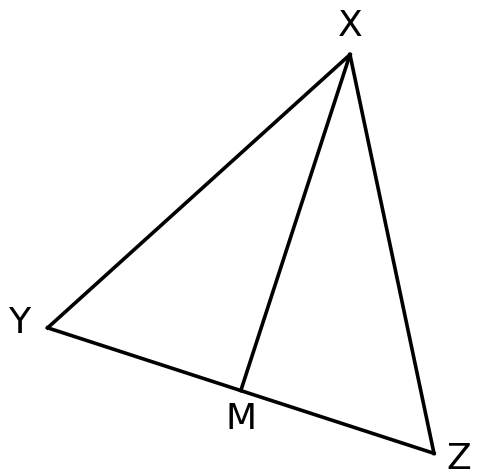
In the diagram, M is the midpoint of \( \overline{YZ} \), ∠XMZ = 32°, and ∠XYZ = 16°. The measure of ∠XZY is:
To find the measure of \( \angle XZY \), we will use the properties of triangles and the given angles. The triangle \( \triangle XYZ \) has point \( M \) as the midpoint of \( \overline{YZ} \), making \( \triangle XMZ \) an isosceles triangle. We will apply the angle properties and sum of angles in a triangle to solve this.
Correct Option: D) 74°
The question asks about the primary acid found in soft drinks. Soft drinks are carbonated beverages, meaning they contain dissolved carbon dioxide. We need to identify which acid is formed when carbon dioxide dissolves in water.
Correct Option: C) Carbonic acid is formed when carbon dioxide dissolves in water, which is the basis of carbonated soft drinks.
Raghu has invested Rs 1,000 and received Rs 1,300 at 6% per annum simple interest after X years. Find the value of X.
The problem involves calculating the time period (X years) for a simple interest investment. We are given the principal amount, the final amount received, and the annual simple interest rate. We will first calculate the simple interest earned, then use the simple interest formula to find the time period.
The amount received is the sum of the principal and the simple interest.
\[ A = P + SI \]\[ SI = A - P \]\[ SI = 1300 - 1000 \]\[ SI = \text{Rs } 300 \]The formula for simple interest is:
\[ SI = \frac{P \times R \times T}{100} \]First, simplify the right side of the equation:
\[ 300 = \frac{6000 \times X}{100} \]\[ 300 = 60 \times X \]Thus, the value of X is 5 years.
D) 5 years is the correct answer. The calculation shows that it takes 5 years for Rs 1,000 to grow to Rs 1,300 at a 6% simple interest rate per annum.
The question asks to identify the region where thorn forests are typically found. This requires knowledge of the climatic conditions and geographical distribution of different forest types in India.
D) Rajasthan — Rajasthan is predominantly an arid and semi-arid region with very low rainfall, making it the most suitable habitat for thorn forests and scrubs. These forests are well adapted to water scarcity, featuring thorny, small-leaved trees and bushes.
The question asks for the term describing the bending of light rays when they pass into a denser medium. We need to identify the optical phenomenon that involves the change in direction of light as it crosses the boundary between two different media.
Correct Option: C) Refraction is the phenomenon where light rays bend as they pass from one medium to another, especially when entering a denser medium, due to a change in speed.