
This question tests knowledge about the natural occurrence of gold. Gold is known for its low reactivity, which dictates how it is found in nature.
Correct Option: A) In a free state
The question asks to identify a famous swimming champion from the given options. This requires knowledge of prominent Indian athletes and their respective sports.
Correct Option: D) Sandeep Sejwal is a renowned Indian swimmer. He specializes in breaststroke events and has won multiple medals at international competitions, including the Asian Games and Asian Indoor Games.
The question asks to identify the statement that is NOT a property of alkalis. We need to recall the characteristic properties of alkalis and compare them with the given options.
Correct Option: A) They produce hydrogen ions in water
To identify a polyatomic element, we need to understand the definition of a polyatomic molecule. A polyatomic molecule is one that consists of three or more atoms. We will examine the common forms in which each of the given options exists.
C) Sulfur. Sulfur commonly exists as \(\text{S}_8\) molecules, which are composed of eight sulfur atoms, making it a polyatomic element.
We need to determine if the given statements are sufficient to find the exact number of rectangular boards Nayan has. We will analyze each statement individually and then together to see if a unique answer can be derived.
C) Statements 1 and 2 are not sufficient.
This problem involves understanding directions and turns. We need to visualize the initial direction and then apply a 90-degree right turn to find the final direction.
Correct Option: D) South-West
Which of the following is closest to \(\sqrt{2}\)?
To find the number closest to \(\sqrt{2}\), we need to calculate the square of each given option and compare it to 2. The option whose square is closest to 2 will be the correct answer. Alternatively, we can recall the common approximation of \(\sqrt{2}\) and compare the options directly.
If the exact value was not known, we could square each option and see which result is closest to 2.
Now, let's find the absolute difference of each squared value from 2:
Upon re-checking the squares, it seems there was a slight miscalculation in the initial approximation for the options. Let's recalculate with higher precision or rely on the direct comparison if the exact value is known to sufficient decimal places.
The standard value of \(\sqrt{2}\) is 1.41421356237...
Comparing the options to this more precise value:
The smallest absolute difference is for option C, which is \(0.00000000237\).
Correct Option: C) 1.41421356 is the closest to \(\sqrt{2}\).
What figure will come in place of (?) in the given series?
Question Figures: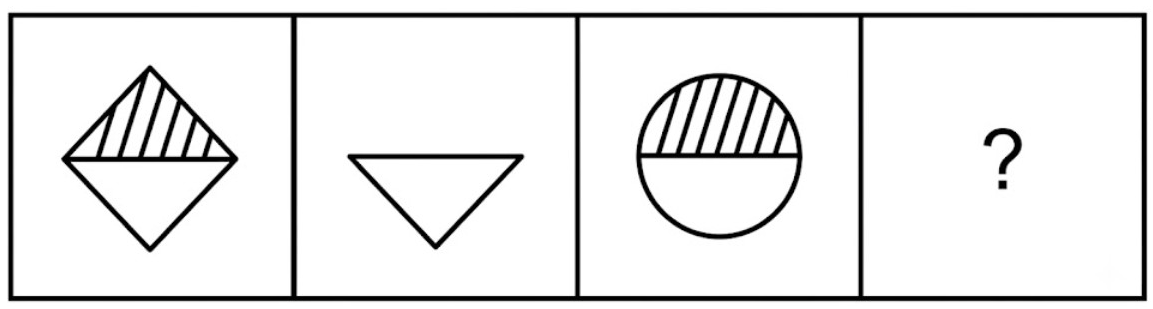
Answer Figures: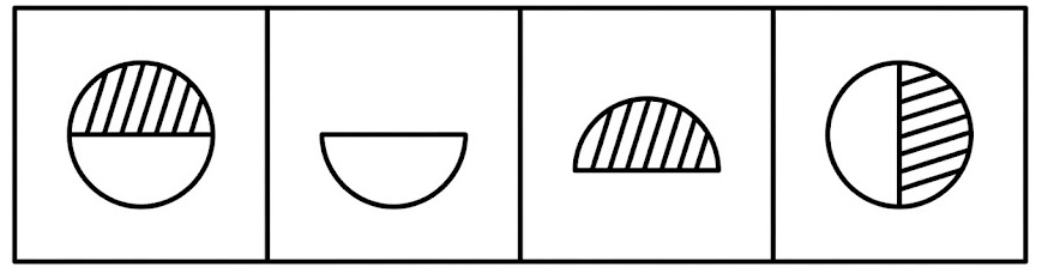
The sequence involves identifying patterns in shapes and shading. Observing the sequence, we see a progression in shapes and shading styles.
The correct option is the circle with the left half shaded, matching the pattern observed.
Correct Option: C) Circle with left half shaded
The question asks to identify which of the given options is NOT a part of the periodic table. This requires knowledge of the classification of elements and groups within the periodic table.
B) Carcinogenic is the correct answer because it is a term used to describe substances that cause cancer, which is a biological property, not a classification of elements or a group within the periodic table.
The question asks about the primary function of cytokinin, a plant hormone. To answer this, one needs to recall the main roles of different plant hormones.
Correct Option: B) Aids in cell division. Cytokinins are essential for cell division (cytokinesis) and play a crucial role in plant growth and development by promoting cell proliferation.