Find the value of:
\( \tan\left(\frac{\pi}{24}\right) \tan\left(\frac{3\pi}{24}\right) \tan\left(\frac{5\pi}{24}\right) \tan\left(\frac{7\pi}{24}\right) \tan\left(\frac{9\pi}{24}\right) \tan\left(\frac{11\pi}{24}\right) \tan\left(\frac{16\pi}{24}\right) \)
The problem asks us to find the value of a product of several tangent functions. We will use trigonometric identities, specifically \(\tan(\frac{\pi}{2} - x) = \cot(x)\) and \(\tan(\pi - x) = -\tan(x)\), along with the fact that \(\tan(x) \cot(x) = 1\), to simplify the expression. We will pair terms such that their arguments sum up to \(\frac{\pi}{2}\) or \(\pi\), or are related to known angles.
Let the given expression be \(E\). First, let's list the arguments in degrees for better understanding:
\[ \frac{\pi}{24} = 7.5^\circ \]\[ \frac{3\pi}{24} = \frac{\pi}{8} = 22.5^\circ \]\[ \frac{5\pi}{24} = 37.5^\circ \]\[ \frac{7\pi}{24} = 52.5^\circ \]\[ \frac{9\pi}{24} = \frac{3\pi}{8} = 67.5^\circ \]\[ \frac{11\pi}{24} = 82.5^\circ \]\[ \frac{16\pi}{24} = \frac{2\pi}{3} = 120^\circ \]The expression is:
\[ E = \tan\left(\frac{\pi}{24}\right) \tan\left(\frac{3\pi}{24}\right) \tan\left(\frac{5\pi}{24}\right) \tan\left(\frac{7\pi}{24}\right) \tan\left(\frac{9\pi}{24}\right) \tan\left(\frac{11\pi}{24}\right) \tan\left(\frac{16\pi}{24}\right) \]We can pair terms such that their arguments sum to \(\frac{\pi}{2}\):
Using the identity \(\tan(\frac{\pi}{2} - x) = \cot(x)\) and \(\tan(x) \cot(x) = 1\):
Substitute these simplifications back into the expression:
\[ E = \left(\tan\left(\frac{\pi}{24}\right) \tan\left(\frac{11\pi}{24}\right)\right) \left(\tan\left(\frac{3\pi}{24}\right) \tan\left(\frac{9\pi}{24}\right)\right) \left(\tan\left(\frac{5\pi}{24}\right) \tan\left(\frac{7\pi}{24}\right)\right) \tan\left(\frac{16\pi}{24}\right) \]\[ E = (1) \times (1) \times (1) \times \tan\left(\frac{16\pi}{24}\right) \]\[ E = \tan\left(\frac{16\pi}{24}\right) \]Simplify the remaining term:
\[ \tan\left(\frac{16\pi}{24}\right) = \tan\left(\frac{2\pi}{3}\right) \]We know that \(\frac{2\pi}{3}\) is in the second quadrant. Using the identity \(\tan(\pi - x) = -\tan(x)\):
\[ \tan\left(\frac{2\pi}{3}\right) = \tan\left(\pi - \frac{\pi}{3}\right) = -\tan\left(\frac{\pi}{3}\right) \]The value of \(\tan\left(\frac{\pi}{3}\right)\) is \(\sqrt{3}\).
\[ -\tan\left(\frac{\pi}{3}\right) = -\sqrt{3} \]Therefore, \(E = -\sqrt{3}\).
D) \(-\sqrt{3}\) is the correct value obtained after simplifying the expression using trigonometric identities.
The question asks for the date on which National Youth Day is celebrated in India. This is a factual question related to important days and dates in India, often covered in general knowledge sections of competitive exams.
Correct Option: C) 12 January
The question asks to identify the scientist who proposed the idea that life originated from simple inorganic molecules. This concept is central to the theory of abiogenesis, specifically the chemical evolution of life.
C) Haldane
J.B.S. Haldane, along with A.I. Oparin, independently proposed the theory of abiogenesis, also known as the Oparin-Haldane hypothesis. This hypothesis suggests that the early Earth's atmosphere was reducing (lacking free oxygen) and contained inorganic molecules like methane, ammonia, water vapor, and hydrogen. Under the influence of energy sources like lightning and UV radiation, these simple inorganic molecules could have reacted to form more complex organic molecules (amino acids, nucleotides), which then aggregated to form self-replicating structures, eventually leading to the first forms of life. Haldane specifically coined the term "primordial soup" to describe the accumulation of organic molecules in the early oceans.
To find the day of the week for a given date, we use the concept of odd days. Odd days are the number of days remaining after dividing the total number of days by 7. We calculate the total odd days from a reference date (e.g., 1600 AD or 0 AD) up to the day before the given date, and then add the odd days for the given month and day. Finally, we map the total odd days to the days of the week (Sunday=0, Monday=1, ..., Saturday=6).
Number of leap years in 86 years (from 1901 to 1986):
\[ \text{Number of leap years} = \left\lfloor \frac{86}{4} \right\rfloor = 21 \]Number of normal years in 86 years:
\[ \text{Number of normal years} = 86 - 21 = 65 \]Odd days in 86 years:
\[ (21 \times 2) + (65 \times 1) = 42 + 65 = 107 \text{ odd days} \]Total odd days up to 1986:
\[ 1 \text{ (for 1900)} + 107 \text{ (for 1901-1986)} = 108 \text{ odd days} \]To find the effective odd days, divide by 7:
\[ 108 \div 7 = 15 \text{ weeks and } 3 \text{ odd days} \]So, odd days up to 1986 = 3.
Total odd days in 1987 up to 5th August:
\[ 3 + 0 + 3 + 2 + 3 + 2 + 3 + 5 = 21 \text{ odd days} \]To find the effective odd days, divide by 7:
\[ 21 \div 7 = 3 \text{ weeks and } 0 \text{ odd days} \]So, odd days for 1987 up to 5th August = 0.
Since the total odd days is 3, the day is Wednesday.
D) Wednesday is the correct day for 5th August, 1987.
To solve this problem, we need to determine Narendra's final direction after his rotations. Then, we need to figure out how much Sunil must rotate from his initial north-facing position to face Narendra. Facing each other means their directions are exactly opposite.
Therefore, Sunil must rotate \(90^\circ\) anticlockwise.
C) 90º anticlockwise
Choose the best suitable Venn diagram for the following words:
"Sun, Jupiter, Solar System"
To find the best suitable Venn diagram for "Sun, Jupiter, Solar System," we need to understand the relationship between these entities. The Sun and Jupiter are both parts of the Solar System, but they are distinct from each other.
Correct Option: A) The diagram accurately represents the relationship between "Sun, Jupiter, Solar System" with separate circles for the Sun and Jupiter within a larger circle for the Solar System.
The question asks to identify the Indian state from which political leader Sudesh Mahto belongs. This requires general knowledge about prominent political figures in India and their respective states.
C) Jharkhand — Sudesh Mahto is a well-known political figure and the president of the AJSU party, which is primarily active in the state of Jharkhand. He has been an MLA and a minister in the Jharkhand government.
This problem involves work and time. We need to calculate the individual work rates, then the combined work done in 3 days, and finally the remaining work to be completed by B alone.
A can do a piece of work in 12 days. So, A's 1-day work is:
\[ \text{A's 1-day work} = \frac{1}{12} \]B can do a piece of work in 16 days. So, B's 1-day work is:
\[ \text{B's 1-day work} = \frac{1}{16} \]When A and B work together, their combined 1-day work is:
\[ \text{Combined 1-day work} = \text{A's 1-day work} + \text{B's 1-day work} \]\[ = \frac{1}{12} + \frac{1}{16} \]To add these fractions, find a common denominator, which is 48:
\[ = \frac{4}{48} + \frac{3}{48} \]\[ = \frac{7}{48} \]A and B work together for 3 days. The work done in 3 days is:
\[ \text{Work done in 3 days} = \text{Combined 1-day work} \times 3 \]\[ = \frac{7}{48} \times 3 \]\[ = \frac{7}{16} \]The total work is considered as 1 unit. The remaining work after A leaves is:
\[ \text{Remaining work} = 1 - \text{Work done in 3 days} \]\[ = 1 - \frac{7}{16} \]\[ = \frac{16 - 7}{16} \]\[ = \frac{9}{16} \]B's 1-day work is \(\frac{1}{16}\). To find the number of days B will take to complete the remaining work, divide the remaining work by B's 1-day work:
\[ \text{Days for B} = \frac{\text{Remaining work}}{\text{B's 1-day work}} \]\[ = \frac{9/16}{1/16} \]\[ = 9 \text{ days} \]Correct Option: C) 9
The given pie chart shows the total sales made by different mobile companies in the year 2017.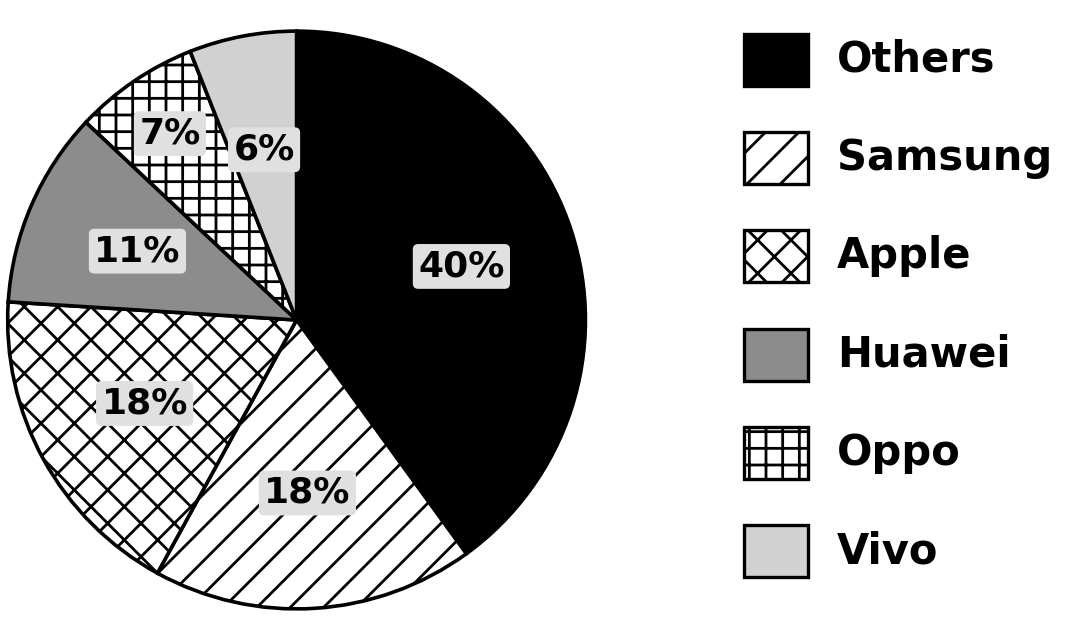
If the total sales in the year 2017 is Rs. 5,000 crores, then the total sales made by the Huawei company was Rs. _________ crores.
To find the total sales made by Huawei, we need to calculate the percentage of total sales represented by Huawei in the pie chart and apply it to the total sales amount.
\[ \text{Huawei Sales} = \left( \frac{11}{100} \right) \times 5000 = 550 \text{ crores} \]
Thus, the sales made by Huawei is Rs. 550 crores.
Correct Option: B) 550
The question asks to identify a film based on the life of a young girl who climbed Mount Everest at the age of 13 years and 11 months. This requires knowledge of biographical films and the real-life achievements they depict.
Correct Option: D) Poorna
The film Poorna: Courage Has No Limit (2017) is a biographical drama directed by Rahul Bose. It is based on the true story of Malavath Poorna, an Indian mountaineer who, at the age of 13 years and 11 months, became the youngest girl in the world to reach the summit of Mount Everest on May 25, 2014. The film chronicles her journey from a small village in Telangana to the top of the world.