
The problem asks us to find the fifteenth letter from the left side of a modified word. The modification rule is to interchange adjacent pairs of letters: the first and second, third and fourth, and so on. We need to apply this rule to the given word and then identify the letter at the specified position.
How many triangles are present in the picture below?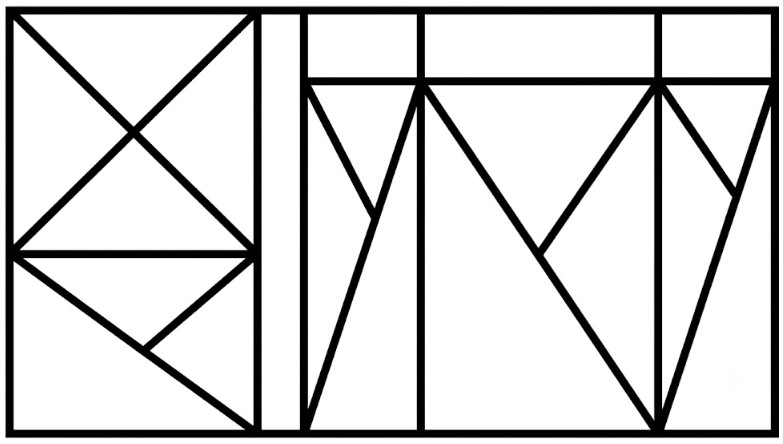
To determine the number of triangles in the given diagram, we need to systematically count all possible triangles formed by the intersecting lines within the larger rectangle.
Correct Option: A) 27
The question asks to identify a horticultural crop from the given options. To answer this, we need to understand the definition of a horticultural crop and classify each option accordingly.
C) Tea — Tea is a plantation crop, which is a sub-category of horticultural crops. Horticultural crops include fruits, vegetables, flowers, and plantation crops like tea, coffee, and rubber.
Consider the given statement and decide which of the given assumptions is implicit in the given statement.
Statement:
An advertisement in the newspaper - Managing Director of Bank XYZ said, "We do not send messages to customers nor make calls to make any corrections, updates to bank account details"
Assumption:
(I) People are getting fake calls for stealing bank account details
(II) Bank officials call customers to change ATM PIN
Neither I nor II is implicit
Only I is implicit
Only II is implicit
Either I or II is implicit
The problem asks us to identify the implicit assumption(s) behind a bank's advertisement. We need to analyze the statement made by the Managing Director and determine what underlying situation or belief would necessitate such a public announcement.
Correct Option: B) Only I is implicit
The question asks to identify the parts of a stamen. The stamen is the male reproductive organ of a flower. Understanding the basic anatomy of a flower's reproductive structures is key to answering this question.
Correct Option: C) Anthers and Filaments
The stamen, which is the male reproductive organ of a flower, consists of two primary parts: the anther and the filament. The anther produces and contains pollen, while the filament is the stalk that supports the anther.
When a train crosses a bridge, the total distance covered by the train is the sum of its own length and the length of the bridge. We are given the speed of the train and the time it takes to cross the bridge. We can use the formula: \(\text{Distance} = \text{Speed} \times \text{Time}\) to find the total distance covered, and then subtract the bridge's length to find the train's length.
\[ \text{Speed} = 66 \text{ km/hr} \]
To convert km/hr to m/s, multiply by \(\frac{5}{18}\):
\[ \text{Speed} = 66 \times \frac{5}{18} \text{ m/s} \]
\[ \text{Speed} = \frac{11 \times 5}{3} \text{ m/s} \]
\[ \text{Speed} = \frac{55}{3} \text{ m/s} \]
\[ \text{Total Distance} = \text{Speed} \times \text{Time} \]
\[ \text{Total Distance} = \frac{55}{3} \text{ m/s} \times 33 \text{ s} \]
\[ \text{Total Distance} = 55 \times 11 \text{ m} \]
\[ \text{Total Distance} = 605 \text{ m} \]
\[ \text{Total Distance} = \text{Length of Train} + \text{Length of Bridge} \]
\[ 605 \text{ m} = \text{Length of Train} + 465 \text{ m} \]
\[ \text{Length of Train} = 605 \text{ m} - 465 \text{ m} \]
\[ \text{Length of Train} = 140 \text{ m} \]
D) 140 m
This question tests knowledge of common metallurgical processes, specifically the methods used for concentrating and extracting metals from their ores. The key is to distinguish between roasting and calcination based on the presence or absence of oxygen during heating.
A) Roasting is the process of heating an ore (especially sulfide ores) strongly in the presence of oxygen or air to convert it into its metallic oxide or sulfate. This makes the subsequent reduction process easier.
The problem requires us to find the correct sequence of mathematical operators (–, ÷, +, ×) that, when substituted into the question marks in the given equation, makes the equation true. We will test each option by substituting the given symbols sequentially into the equation and evaluating the expression using the order of operations (BODMAS/PEMDAS).
The given equation is: \([(100 \text{ ? } 2) \text{ ? } 2] \text{ ? } 10 = 59\)
Substitute the symbols into the equation:
\[ [(100 - 2) \div 2] + 10 \]First, solve the innermost parenthesis:
\[ (100 - 2) = 98 \]Next, perform the division:
\[ 98 \div 2 = 49 \]Finally, perform the addition:
\[ 49 + 10 = 59 \]Since \(59 = 59\), this option correctly completes the equation.
Correct Option: A) –, ÷, +
Substitute the symbols: \([(100 - 2) \times 2] \div 10\)
\[ [(98) \times 2] \div 10 \] \[ 196 \div 10 = 19.6 \]Since \(19.6 \neq 59\), this option is incorrect.
Substitute the symbols: \([(100 + 2) \times 2] \times 10\)
\[ [(102) \times 2] \times 10 \] \[ 204 \times 10 = 2040 \]Since \(2040 \neq 59\), this option is incorrect.
Substitute the symbols: \([(100 + 2) \div 2] \div 10\)
\[ [(102) \div 2] \div 10 \] \[ 51 \div 10 = 5.1 \]Since \(5.1 \neq 59\), this option is incorrect.
Which of the following matches is correct?
Butene : CH3 - CH2 - CH = CH2
Propane : CH3 - CH2 = CH2
Pentene : CH3 - CH2 - CH - CH = CH2
Ethane : CH2 = CH3
To determine the correct match, we need to recall the general formulas and naming conventions for alkanes, alkenes, and alkynes, and then verify the given chemical structures against these rules. Specifically, we'll look at the number of carbon atoms and the type of carbon-carbon bonds (single, double, or triple).
A) Butene : CH 3 - CH 2 - CH = CH 2 — This structure correctly represents 1-butene, an alkene with four carbon atoms and one double bond, matching the name "Butene" and the valency rules for carbon and hydrogen.
The question asks to identify the artist who won the "Best New Artist" award at the 60th Grammy Awards. This requires knowledge of Grammy Award winners for a specific year and category.
The 60th Annual Grammy Awards ceremony was held on January 28, 2018, honoring the best recordings, compositions, and artists of the eligibility year (October 1, 2016, to September 30, 2017). Alessia Cara won the Grammy Award for Best New Artist at this ceremony.
D) Alessia Cara won the "Best New Artist" award at the 60th Grammy Awards in 2018.