
To identify a saturated hydrocarbon, we need to understand the definition of saturated and unsaturated hydrocarbons. Saturated hydrocarbons contain only single bonds between carbon atoms, while unsaturated hydrocarbons contain at least one double or triple bond between carbon atoms.
Correct Option: D) Ethane
The question asks to identify the individual popularly known as India's first female blade runner. This requires knowledge of prominent figures in Indian sports, particularly those who have overcome physical challenges.
Kiran Kanojia is widely recognized as India's first female blade runner. She lost her left leg in a train accident in 2011 but went on to become an accomplished marathon runner using a prosthetic blade.
B) Kiran Kanojia is popularly known as India's first female blade runner. She is an inspiration for many, having overcome a tragic accident to pursue her passion for running.
To find the kinetic energy of an object, we use the formula for kinetic energy, which depends on the object's mass and velocity. We are given the mass and uniform velocity of the object, so we can directly apply the formula.
The kinetic energy (\(KE\)) of an object is given by the formula:
\[ KE = \frac{1}{2}mv^2 \]Substitute \(m = 15 \text{ kg}\) and \(v = 2 \text{ ms}^{-1}\) into the kinetic energy formula:
\[ KE = \frac{1}{2} \times 15 \text{ kg} \times (2 \text{ ms}^{-1})^2 \]The standard unit for energy is Joules (\(\text{J}\)).
Correct Option: B) The kinetic energy possessed by the object is \(30 \text{ J}\).
The question asks us to find the relationship between the first pair of words and apply the same relationship to the third word to find the fourth word. This is a common type of analogy question where we need to identify the logical connection.
Correct Option: A) Failure
This problem involves rates of work, specifically filling a tank. We can express the rate of each pipe as the reciprocal of the time it takes to fill the tank. Since the fast pipe fills the tank 6 times as fast as the slower pipe, we can establish a relationship between their individual times. Then, using the combined time, we can solve for the individual times.
Let the time taken by the slower pipe to fill the tank be \(x\) minutes.
Since the fast pipe fills the tank 6 times as fast as the slower pipe, the time taken by the fast pipe to fill the tank will be \(\frac{x}{6}\) minutes.
The rate of the slower pipe is \(\frac{1}{x}\) tank per minute.
The rate of the fast pipe is \[\frac{1}{\frac{x}{6}} = \frac{6}{x}\] tank per minute.
When working together, their combined rate is the sum of their individual rates. They fill the tank in 22 minutes, so their combined rate is \(\frac{1}{22}\) tank per minute.
Set up the equation for their combined rates:
\[ \frac{1}{x} + \frac{6}{x} = \frac{1}{22} \]Combine the terms on the left side:
\[ \frac{1+6}{x} = \frac{1}{22} \]\[ \frac{7}{x} = \frac{1}{22} \]Solve for \(x\):
\[ x = 7 \times 22 \]\[ x = 154 \text{ minutes} \]This is the time taken by the slower pipe. We need to find the time taken by the fast pipe, which is \(\frac{x}{6}\).
Time for the fast pipe = \(\frac{154}{6}\) minutes.
Calculate the value:
\[ \frac{154}{6} = \frac{77}{3} \approx 25.666... \text{ minutes} \]C) 25.66 min is the closest approximation to 25.666... minutes.
\( \frac{4.8}{125} \), written as pure decimal, will be:
To express the given fraction as a pure decimal, we need to perform the division. We can simplify the division by first removing the decimal from the numerator and then performing long division or by manipulating the denominator to a power of 10.
Remove the decimal from the numerator:
The given expression is \( \frac{4.8}{125} \). To remove the decimal from the numerator, we can multiply both the numerator and the denominator by 10:
\[ \frac{4.8 \times 10}{125 \times 10} = \frac{48}{1250} \]Perform the division:
Now we need to divide 48 by 1250.
Since 48 is less than 1250, we start by adding zeros to 48 and placing a decimal point:
Let's estimate: \( 1250 \times 3 = 3750 \). \( 1250 \times 4 = 5000 \).
So, \( 4800 \div 1250 = 3 \) with a remainder of \( 4800 - 3750 = 1050 \).
The decimal so far is \( 0.03 \).
Let's estimate: \( 1250 \times 8 = 10000 \). \( 1250 \times 9 = 11250 \).
So, \( 10500 \div 1250 = 8 \) with a remainder of \( 10500 - 10000 = 500 \).
The decimal so far is \( 0.038 \).
We know \( 1250 \times 4 = 5000 \).
So, \( 5000 \div 1250 = 4 \) with a remainder of 0.
The final decimal is \( 0.0384 \).
Alternative Method (Multiplying to get a power of 10 in the denominator):
We have \( \frac{4.8}{125} \).
We know that \( 125 = 5^3 \). To make the denominator a power of 10, we need to multiply it by \( 2^3 = 8 \).
\[ \frac{4.8}{125} = \frac{4.8 \times 8}{125 \times 8} \]Calculate the numerator:
\[ 4.8 \times 8 = 38.4 \]Calculate the denominator:
\[ 125 \times 8 = 1000 \]So, the expression becomes:
\[ \frac{38.4}{1000} \]Dividing by 1000 means moving the decimal point three places to the left:
\[ 38.4 \div 1000 = 0.0384 \]Correct Option: D) 0.0384
The question asks about the nature of the gravitational force between two bodies. We need to recall the fundamental properties of gravity as described by Newton's Law of Universal Gravitation.
C) Gravitational force between two bodies is always attractive
This statement correctly describes the fundamental nature of gravity. Gravity is an attractive force that pulls any two objects with mass towards each other.
Difference between selling prices of an article at profits of 5% and 10% is Rs. 30. Then cost price of the article is:
The problem asks for the cost price of an article given the difference in its selling prices at two different profit percentages. We can set up equations for the selling prices based on the cost price and profit percentages, then use the given difference to find the cost price.
Let the Cost Price (CP) of the article be \(C\).
When the article is sold at a profit of 5%, the Selling Price (\(SP_1\)) is given by:
\[ SP_1 = C + (0.05 \times C) = C(1 + 0.05) = 1.05C \]When the article is sold at a profit of 10%, the Selling Price (\(SP_2\)) is given by:
\[ SP_2 = C + (0.10 \times C) = C(1 + 0.10) = 1.10C \]The problem states that the difference between these two selling prices is Rs. 30. Since 10% profit is higher than 5% profit, \(SP_2\) will be greater than \(SP_1\). So, the difference is \(SP_2 - SP_1\).
\[ SP_2 - SP_1 = 30 \]Substitute the expressions for \(SP_1\) and \(SP_2\) into the difference equation:
\[ 1.10C - 1.05C = 30 \]Simplify the equation:
\[ (1.10 - 1.05)C = 30 \]\[ 0.05C = 30 \]Solve for \(C\):
\[ C = \frac{30}{0.05} \]\[ C = \frac{30}{\frac{5}{100}} \]\[ C = \frac{30 \times 100}{5} \]\[ C = 6 \times 100 \]\[ C = 600 \]Therefore, the cost price of the article is Rs. 600.
Correct Option: A) Rs. 600
The question asks to identify the state of matter that glows with a special color depending on the nature of the gas. This phenomenon is characteristic of a specific state of matter where atoms are ionized and emit light.
B) Plasma is an ionized gas that glows when excited. The specific color of the glow is dependent on the type of gas present in the plasma state, due to the unique atomic emission spectra of each element. This is the principle behind technologies like neon signs and plasma displays.
Find the odd figure out.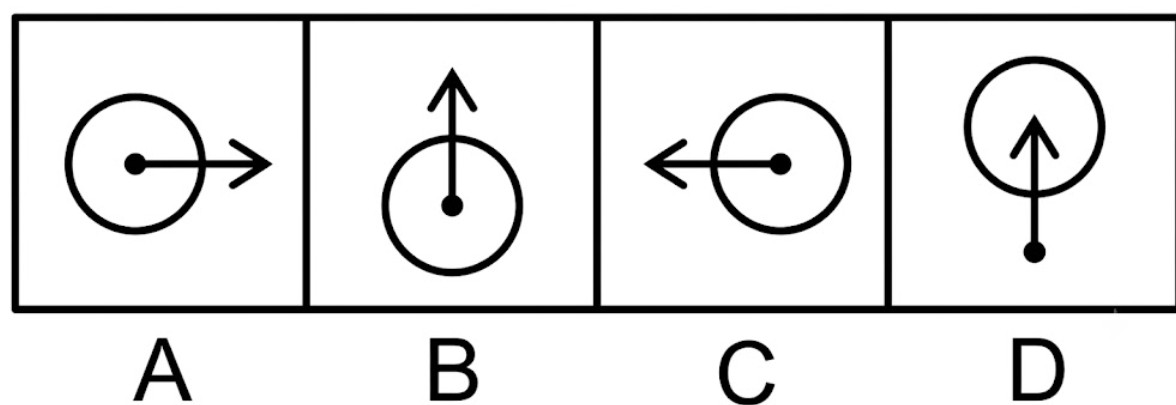
To find the odd figure out, we need to identify the pattern or rule that applies to most of the figures and see which one does not follow it.
Correct Option: B) The arrow does not cross the circle's boundary, making it the odd one out.