
The question asks to identify the scientist who proposed the modern system of using one or two letters from the element's name as its symbol. This is a direct recall question from the history of chemistry.
Correct Option: A) Berzelius is credited with proposing the system of using one or two letters from the name of the element as its symbol, which is the basis of the modern chemical notation.
Choose the mirror image for the following image: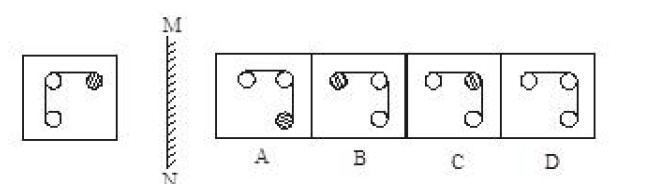
To find the mirror image of a given figure, imagine flipping the figure over a vertical axis. The left side becomes the right side and vice versa, while the top and bottom remain unchanged.
Correct Option: D) Option D correctly reflects the original image across the vertical axis.
The question asks for the full form of the acronym RNA. This is a basic biology question related to molecular biology and genetics. Recalling the standard scientific terminology for this molecule will lead to the correct answer.
A) Ribonucleic acid is the universally accepted full form for RNA. It is a polymer of ribonucleotides, playing crucial roles in gene expression, protein synthesis, and regulation.
The problem asks us to evaluate which of the given conclusions logically follows from the statement. We need to analyze the statement and each conclusion independently to determine if the conclusion is a direct and necessary consequence of the statement, without introducing outside information or assumptions.
D) Only conclusion I follows. Conclusion I logically follows from the statement because if exercising early morning is "good," it implies a benefit, and health is a primary benefit associated with exercise. Conclusion II does not follow as the statement does not provide any information about choosing free time for workouts.
The question refers to Newlands' Law of Octaves, an early attempt at classifying elements. We need to recall the limitations and specific anomalies of this law, particularly regarding elements with similar properties being placed far apart.
Correct Option: C) Fe
In Newlands' Law of Octaves, Iron (Fe), which strongly resembles cobalt (Co) and nickel (Ni) in properties (e.g., magnetic properties, formation of colored compounds), was placed far away from these elements. Cobalt and nickel were placed in the same slot as fluorine, chlorine, and bromine, while iron was placed in a different octave with oxygen and sulfur, highlighting a significant flaw in his classification.
To find the next term in the series, we need to identify the pattern in both the numerical part and the alphabetical part of each term.
The numerical part follows an arithmetic progression with a common difference of 4. So, the next number will be \(29 + 4 = 33\).
The alphabetical part also follows a pattern where each letter is 3 positions after the previous one (C to F is +3, F to I is +3, I to L is +3). So, the next letter will be 3 positions after L. Counting 3 letters after L (L, M, N, O), the next letter is O.
Correct Option: D) 33O
This problem involves analyzing statements and conclusions based on logical reasoning, often visualized using Venn diagrams. We need to determine which conclusions logically follow from the given statements.
D) Neither (1) nor (2) follows. Both conclusions cannot be definitively drawn from the given statements. The Venn diagrams for these statements allow for scenarios where neither conclusion is true.
Find the number of circles in the given figure: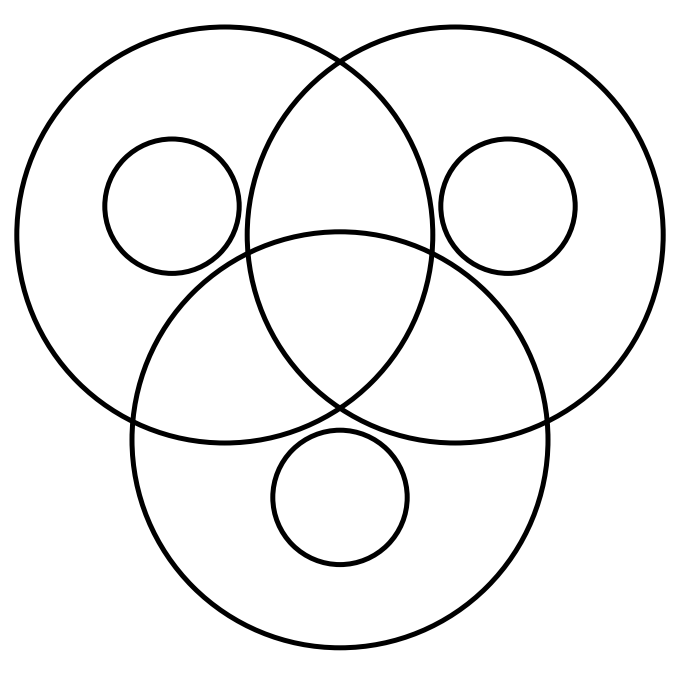
To find the number of circles in the given diagram, we need to carefully count each distinct circle present in the image.
Thus, the total number of circles in the diagram is 6.
Correct Option: B) 6
Find the odd one out: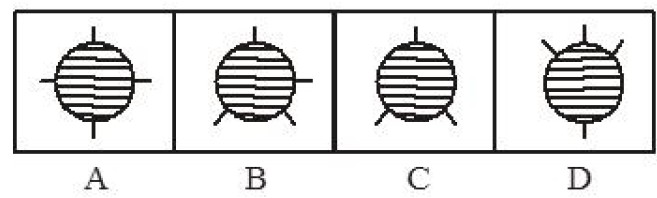
The question requires identifying the odd one out from a set of diagrams. Each diagram consists of a circle with horizontal lines inside and lines extending outward.
Correct Option: B) The diagram is asymmetric compared to others.
To find the ratio of the two numbers, we first need to express them in terms of a third number. We can assume the third number to be a convenient value, such as 100, to easily calculate percentages. Then, we will find the ratio of these two numbers.
Assume the third number: Let the third number be \(X\).
Calculate the first number: The first number is 30% more than the third number. So, the first number \(N_1\) will be:
\[ N_1 = X + 0.30X = 1.30X \]Calculate the second number: The second number is 60% more than the third number. So, the second number \(N_2\) will be:
\[ N_2 = X + 0.60X = 1.60X \]Find the ratio of the two numbers: The ratio of the first number to the second number is \(N_1 : N_2\).
\[ N_1 : N_2 = 1.30X : 1.60X \]Simplify the ratio: We can cancel out \(X\) from both sides and multiply by 100 to remove decimals:
\[ 1.30 : 1.60 = 130 : 160 = 13 : 16 \]A) 13 : 16 is the correct ratio of the two numbers.