
Find the odd one out from the given figure: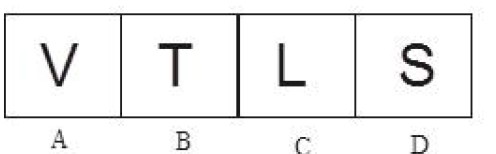
The task is to identify the odd one out from the given set of letters. Each letter is placed in a separate box labeled A, B, C, and D.
Therefore, the letter S (option D) is the odd one out because it is the only letter that includes curves, whereas the others are composed solely of straight lines.
Correct Option: D) S
The problem provides information about four numbers arranged in ascending order and their averages in two groups of three. We need to find the range of this data set. The range is the difference between the largest and the smallest number.
C) 18. The calculation shows that the difference between the largest number (\(z\)) and the smallest number (\(w\)) is 18, which is the range of the data.
The question asks to identify the item that does not belong to the group formed by the other items. This is a classification question where we need to find a common characteristic among most items and then identify the outlier.
Correct Option: D) Carriage — A carriage is typically an animal-drawn vehicle, whereas a bike (in its common motorized form), car, and bus are all engine-powered vehicles. This distinguishes the carriage from the rest of the group.
The problem asks for the maximum possible value of \(x\) given an inequality. To solve this, we need to manipulate the inequality to isolate \(x\) on one side. Once \(x\) is isolated, we can determine its maximum possible integer value.
Write down the given inequality:
\[ 3x + 9 \ge 5x + 7 \]To isolate \(x\), first move all terms containing \(x\) to one side and constant terms to the other side. It's generally easier to move the smaller \(x\) term to the side with the larger \(x\) term to keep the coefficient of \(x\) positive, but it's not strictly necessary. Let's move \(3x\) to the right side and \(7\) to the left side:
\[ 9 - 7 \ge 5x - 3x \]Simplify both sides of the inequality:
\[ 2 \ge 2x \]Divide both sides by \(2\) to solve for \(x\). Since we are dividing by a positive number, the direction of the inequality sign does not change:
\[ \frac{2}{2} \ge \frac{2x}{2} \]\[ 1 \ge x \]This inequality can also be written as \(x \le 1\). This means that \(x\) can be any value less than or equal to \(1\). The possible integer values for \(x\) are \(\dots, -2, -1, 0, 1\).
The question asks for the maximum possible value of \(x\). From the inequality \(x \le 1\), the largest value \(x\) can take is \(1\).
Correct Option: B) 1
To solve this blood relation puzzle, we need to break down the statement made by Gaurav from the end to the beginning to identify the relationship between the boy and Gaurav.
Let's trace it clearly:
If Gaurav is the elder brother, then the boy is Gaurav. But the question asks how the boy is related to Gaurav, implying they are distinct individuals. Thus, the boy must be Gaurav's sibling.
Correct Option: C) Brother
The question asks to identify the device that does NOT operate on the principle of the heating effect of electric current. We need to analyze each option and determine its primary working principle.
D) Microwave — A microwave oven heats food by using electromagnetic radiation (microwaves) that causes water molecules to vibrate, generating heat. This is a different principle (dielectric heating) and not the heating effect of current flowing through a resistive element.
The question asks which of the given metals is most susceptible to significant damage due to corrosion. Corrosion is a natural process that converts a refined metal into a more stable form, such as its oxide, hydroxide, or sulfide. It is a gradual destruction of materials (usually metals) by chemical and/or electrochemical reaction with their environment. We need to identify the metal that commonly suffers extensive damage from this process.
B) Fe — Iron (Fe) is highly susceptible to corrosion, commonly known as rusting, which causes significant and continuous damage to its structure. Rust is porous and flaky, allowing the corrosive agents (oxygen and water) to penetrate deeper, leading to extensive degradation of the metal.
Taimur gained 37.5% on the resale of a used stereo. If he purchased the item for Rs 3,880, how much did he sell it for?
To find the selling price, we need to calculate the profit amount based on the given percentage gain and then add it to the purchase price (cost price).
C) Rs 5,335 is the correct selling price after a 37.5% gain on the purchase price of Rs 3,880.
The question asks to identify the type of chemical reaction involved in the hydrogenation of vegetable oil. We need to recall the definitions of different types of reactions and apply them to the process of hydrogenation.
B) Addition reaction. Hydrogenation of vegetable oil involves the addition of hydrogen atoms across the carbon-carbon double bonds present in unsaturated fatty acids, converting them into single bonds. This fits the definition of an addition reaction.
To solve this problem, we need to add several decimal numbers and one whole number. The key is to align the decimal points correctly before performing the addition. If a number does not have a decimal point, it is considered to be at the end of the number (e.g., \(309 = 309.000\)).
It's helpful to add trailing zeros to ensure all numbers have the same number of decimal places for easier addition.
\[ \begin{array}{r} 30.900 \\ 3.090 \\ 0.309 \\ 0.039 \\ + \quad 309.000 \\ \hline \end{array} \]The sum is:
\[ \begin{array}{r} 30.900 \\ 3.090 \\ 0.309 \\ 0.039 \\ + \quad 309.000 \\ \hline 343.338 \end{array} \]C) 343.338 is the correct sum obtained by carefully aligning the decimal points and adding the numbers.