
This problem involves analyzing statements and conclusions based on the principles of syllogism, often visualized using Venn diagrams. We need to determine which conclusions logically follow from the given statements.
Therefore, only conclusion 1 logically follows from the given statements.
Correct Option: C) Only conclusion 1 follows
The mass of an object is 10 kg. What would be its weight on earth? (g = 10 ms-2)
This question asks for the weight of an object given its mass and the acceleration due to gravity. The relationship between mass, weight, and acceleration due to gravity is a fundamental concept in physics.
Weight (\(W\)) is the force exerted on an object due to gravity. It is calculated using the formula:
\[ W = m \times g \]The unit kg·m/s\(^2\) is equivalent to a Newton (N). Therefore, the weight is 100 N.
Correct Option: B) 100 N
The weight of an object is the force of gravity acting on it. It is calculated by multiplying the mass (10 kg) by the acceleration due to gravity (10 m/s\(^2\)). The resulting value is 100 N, where N (Newton) is the standard unit for force.
The formula for the mirror is -
\( \frac{1}{f} \) + \( \frac{1}{u} \) = \( \frac{1}{v} \)
\( \frac{1}{f} \) + \( \frac{1}{v} \) = \( \frac{1}{u} \)
\( \frac{1}{u} \) + \( \frac{1}{v} \) = \( \frac{1}{f} \)
\( \frac{1}{u} \) - \( \frac{1}{v} \) = \( \frac{1}{f} \)
The question asks for the correct formula for a mirror. This formula relates the object distance, image distance, and focal length of a spherical mirror. It is a fundamental equation in optics.
C) \[\frac{1}{u} + \frac{1}{v} = \frac{1}{f}\]
This is the standard mirror formula that correctly relates the object distance (\(u\)), image distance (\(v\)), and focal length (\(f\)) of a spherical mirror.
This question tests knowledge of organic nomenclature and functional groups, specifically identifying compounds with a triple bond. We need to recall the general formulas and characteristic endings for alkanes, alkenes, alkynes, alcohols, and carboxylic acids.
Correct Option: D) Propyne has the suffix "-yne", which denotes the presence of a carbon-carbon triple bond. Its chemical formula is \(\text{CH}_3\text{C}\equiv\text{CH}\).
The question asks to identify the Executive Director and CEO of HCL as of 2018. This requires knowledge of the leadership structure of HCL Technologies during that specific period.
Correct Option: D) Roshni Nadar
Roshni Nadar Malhotra was the Executive Director and CEO of HCL Corporation, the holding company for HCL Technologies, as of 2018. She later became the Chairperson of HCL Technologies in July 2020.
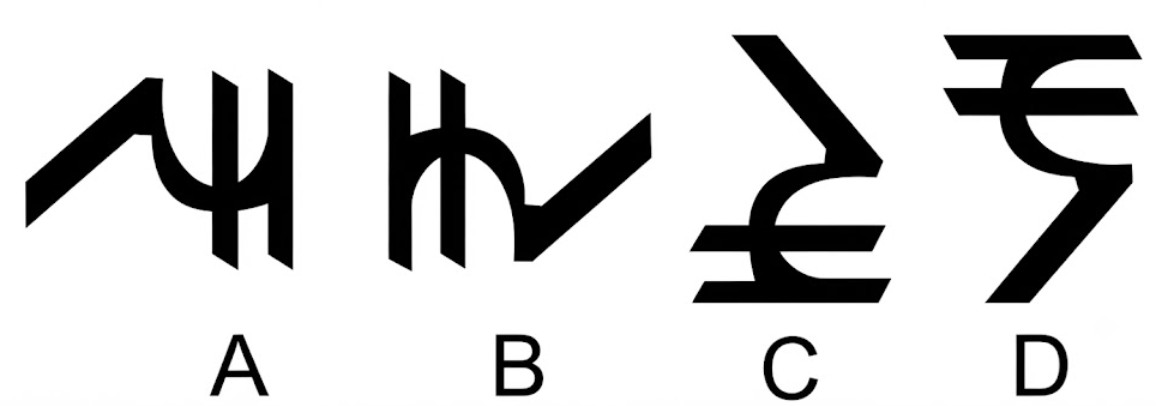
Identify the figure which does not belong to this group -
The task is to identify the figure that does not belong to the group based on a common characteristic shared by the other figures.
Correct Option: D) Figure D is the odd one out as it contains a curved line, unlike the other figures which are composed of straight lines and angular shapes.
The question asks for the term that describes the measurement of an object's mass. This relates to fundamental concepts in physics, specifically Newton's laws of motion and the properties of matter.
B) Inertia — Inertia is the resistance of any physical object to any change in its state of motion, including changes to its speed, direction, or state of rest. The mass of an object is a quantitative measure of its inertia. A more massive object has greater inertia and is harder to accelerate or decelerate.
The question asks to identify the actress who received the 'Best Actress' award at the Filmfare Awards in 2017. This is a factual question related to Indian cinema awards.
Correct Option: B) Alia Bhatt was awarded the 'Best Actress' at the 62nd Filmfare Awards in 2017 for her role in Udta Punjab.
The question asks to identify the true statement among the given options regarding the properties of states of matter (solid, liquid, gas).
Correct Option: A) Only A is true
Two inlet pipes can fill a tank in 5 and 7 hours respectively. And one outlet pipe can empty this full tank in 14 hours. If all the three pipes are opened simultaneously in a completely empty tank, then how much time will it take to fill the tank completely?
4\( \frac{11}{13} \) hours
5\( \frac{11}{13} \) hours
3\( \frac{13}{19} \) hours
5\( \frac{2}{13} \) hours
This problem involves calculating the combined work rate of multiple pipes (inlet and outlet) to determine the total time required to fill a tank. We will find the individual filling/emptying rates per hour and then sum them up to get the net rate when all pipes are open simultaneously. Finally, we will take the reciprocal of the net rate to find the total time.
Calculate the filling rate of the first inlet pipe:
The first pipe fills the tank in 5 hours. So, in 1 hour, it fills \(\frac{1}{5}\) of the tank.
Calculate the filling rate of the second inlet pipe:
The second pipe fills the tank in 7 hours. So, in 1 hour, it fills \(\frac{1}{7}\) of the tank.
Calculate the emptying rate of the outlet pipe:
The outlet pipe empties the full tank in 14 hours. So, in 1 hour, it empties \(\frac{1}{14}\) of the tank. Since it's an emptying pipe, its contribution to filling is negative.
Calculate the net filling rate when all three pipes are open:
When all pipes are opened simultaneously, the net part of the tank filled in 1 hour will be the sum of the filling rates minus the emptying rate:
Find a common denominator for the fractions:
The least common multiple (LCM) of 5, 7, and 14 is 70.
Perform the addition/subtraction of fractions:
\[ \text{Net rate} = \frac{14}{70} + \frac{10}{70} - \frac{5}{70} \]\[ \text{Net rate} = \frac{14 + 10 - 5}{70} \]\[ \text{Net rate} = \frac{24 - 5}{70} \]\[ \text{Net rate} = \frac{19}{70} \text{ of the tank per hour} \]Calculate the total time to fill the tank:
If \(\frac{19}{70}\) of the tank is filled in 1 hour, then the total time to fill the entire tank (1 unit) is the reciprocal of the net rate:
Convert the improper fraction to a mixed fraction:
\[ \frac{70}{19} = 3 \frac{13}{19} \text{ hours} \]Correct Option: C) 3\(\frac{13}{19}\) hours