This question tests knowledge of significant diplomatic appointments made by India. Specifically, it asks about the Ambassador to Peru in a particular year (2017). Such questions often appear in competitive exams to check awareness of current affairs and international relations.
Based on official records, M. Subbarayudu was indeed appointed as the Ambassador of India to the Republic of Peru in 2017.
A) M. Subbarayudu was appointed as the Ambassador of India to the Republic of Peru in 2017. He is an Indian Foreign Service (IFS) officer of the 1994 batch.
The problem states a relationship between the circumference and the diameter of a circle. We need to use the standard formulas for circumference and diameter in terms of the radius to set up an equation and solve for the radius.
Correct Option: B) 3.5 cm
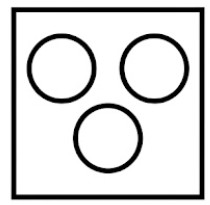
Select the appropriate Venn diagram for the following words.
shoes, grass, mobile
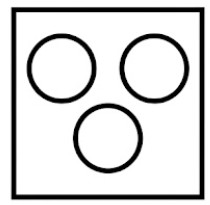
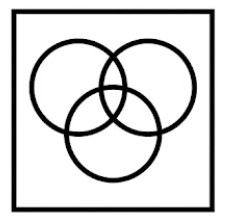
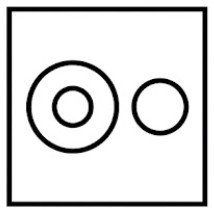
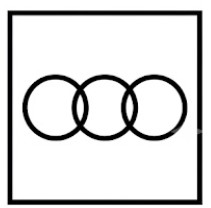
To solve this question, we need to select the Venn diagram that appropriately represents the relationship between the words: shoes, grass, and mobile. These items are unrelated and belong to different categories.
Correct Option: A) The diagram with three separate circles correctly represents the unrelated nature of shoes, grass, and mobile.
The question asks for the year in which the First Battle of Panipat was fought. This is a direct factual question from Indian history. Recall the key battles and their dates.
Correct Option: C) 1526. The First Battle of Panipat was fought on April 21, 1526, between the invading forces of Babur and the Lodi dynasty under Ibrahim Lodi. This battle led to the establishment of the Mughal Empire in India.
The question asks about the tenure of members of the Lok Sabha, which is the lower house of the Indian Parliament. Understanding the constitutional provisions related to the term of elected representatives is key to answering this question.
Correct Option: D) The tenure of Lok Sabha members is 5 Years, as stipulated by Article 83(2) of the Indian Constitution, unless the Lok Sabha is dissolved earlier.
The question asks to identify the type of element that typically has 1 to 3 electrons in its outermost shell. This characteristic is directly related to the chemical properties and classification of elements in the periodic table.
B) Metal. Metals are characterized by having 1, 2, or 3 valence electrons, which they readily lose to form positive ions and achieve a stable electron configuration.
The question asks to identify an organism that reproduces through both regeneration and budding. We need to recall the reproductive methods of each given option.
Correct Option: B) Hydra — Hydra are known for both their ability to regenerate lost body parts and their common method of asexual reproduction through budding.
The question asks to identify the period in the modern periodic table that consists exclusively of gaseous elements. To answer this, we need to recall the elements present in the initial periods of the periodic table and their physical states at room temperature.
B) 1 — Period 1 of the modern periodic table contains only two elements: Hydrogen (H) and Helium (He). Both hydrogen and helium are gases at room temperature and standard atmospheric pressure. Thus, Period 1 is the only period consisting solely of gases.
For what value of p will the following equations have only one solution?
2x + 3y = -5 and 2x + py = 2
The only value of p is 3
all values of p can be
The value of p is any number other than 3
The only value of p is 2
To determine the condition for a unique solution for a system of two linear equations, we use the ratio of their coefficients. For a system of linear equations given by \(a_1x + b_1y = c_1\) and \(a_2x + b_2y = c_2\), there is a unique solution if and only if the ratio of the coefficients of \(x\) is not equal to the ratio of the coefficients of \(y\), i.e., \[\frac{a_1}{a_2} \neq \frac{b_1}{b_2}\].
Identify the given equations:
\[ 2x + 3y = -5 \quad \text{(Equation 1)} \]\[ 2x + py = 2 \quad \text{(Equation 2)} \]Compare these equations with the general form \(a_1x + b_1y = c_1\) and \(a_2x + b_2y = c_2\).
From Equation 1, we have \(a_1 = 2\), \(b_1 = 3\), and \(c_1 = -5\).
From Equation 2, we have \(a_2 = 2\), \(b_2 = p\), and \(c_2 = 2\).
For the system of linear equations to have only one solution (a unique solution), the condition is:
\[ \frac{a_1}{a_2} \neq \frac{b_1}{b_2} \]Substitute the values of the coefficients into the condition:
\[ \frac{2}{2} \neq \frac{3}{p} \]Simplify the inequality:
\[ 1 \neq \frac{3}{p} \]Solve for \(p\):
Multiply both sides by \(p\) (assuming \(p \neq 0\)):
\[ p \neq 3 \]Consider the case if \(p=0\). If \(p=0\), the second equation becomes \(2x = 2\), which means \(x=1\). Substituting \(x=1\) into the first equation: \(2(1) + 3y = -5 \Rightarrow 2 + 3y = -5 \Rightarrow 3y = -7 \Rightarrow y = -7/3\). In this case, \((1, -7/3)\) is a unique solution. Since \(p=0\) satisfies \(p \neq 3\), our condition holds.
Therefore, the system of equations will have only one solution for any value of \(p\) except for \(p=3\).
Correct Option: C) The value of p is any number other than 3
To find the area of a triangle given its vertices, we can use the determinant formula (also known as the shoelace formula). This formula is particularly useful when the coordinates of the vertices are known.
Identify the coordinates of the vertices:
Let the vertices be \(A = (x_1, y_1) = (3, 5)\), \(B = (x_2, y_2) = (-2, 0)\), and \(C = (x_3, y_3) = (6, 4)\).
Apply the formula for the area of a triangle:
The area of a triangle with vertices \((x_1, y_1)\), \((x_2, y_2)\), and \((x_3, y_3)\) is given by the formula:
\[ \text{Area} = \frac{1}{2} |x_1(y_2 - y_3) + x_2(y_3 - y_1) + x_3(y_1 - y_2)| \]Substitute the given coordinates into the formula:
\[ \text{Area} = \frac{1}{2} |3(0 - 4) + (-2)(4 - 5) + 6(5 - 0)| \]Perform the calculations:
Now, sum these values:
\[ \text{Sum} = -12 + 2 + 30 = 20 \]Calculate the final area:
Substitute the sum back into the area formula:
\[ \text{Area} = \frac{1}{2} |20| = \frac{1}{2} \times 20 = 10 \]The area of the triangle is 10 square units.
C) 10 square units is the correct answer, as calculated using the determinant formula for the area of a triangle.