The question asks to identify an organism that uses regenerated cells for reproduction through budding. We need to recall the modes of reproduction for the given options and identify which one fits the description.
C) Hydra uses regenerated cells for reproduction through the process of budding. Hydra's body wall contains interstitial cells which are totipotent and can differentiate to form the various cell types needed for the developing bud, making it a clear example of using regenerated cells for budding.
4 W X Z 8 Q P O J 6 G T M V E U H 5 3 B
In the above sequence, the 5th term to the right of 15th term from the left is:
To find the required term, we need to first locate the 15th term from the left end of the sequence. Then, from that position, we count 5 terms to its right to identify the final answer.
Correct Option: C) B
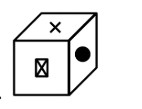
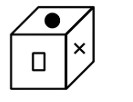
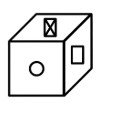
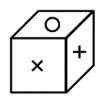
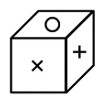
To make a cube, the given shape is folded from the edges. Identify the option that correctly represents the faces of the cube.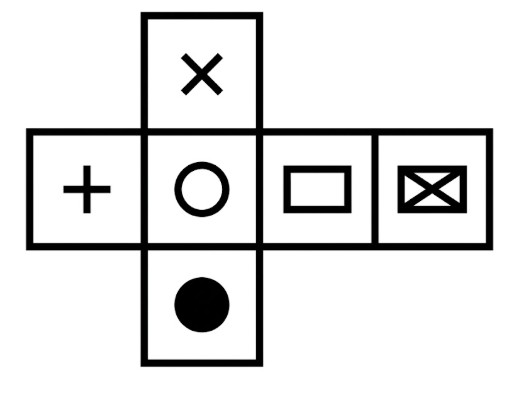
The task is to determine which option correctly represents the cube formed by folding the given net. Each face of the net has a unique symbol, and understanding their positions relative to each other is key to solving this problem.
Correct Option: D) This option correctly represents the cube with the cross, plus, and circle on visible faces, consistent with the net's layout.
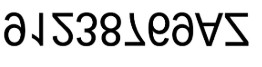
91238769AZ
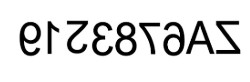
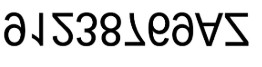
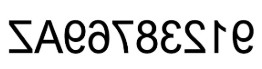
The water image of the above figure is
To find the water image of a given figure, we need to reflect the figure vertically, as if it were mirrored on a horizontal axis. This means each element from the top will appear at the bottom in reverse order.
The correct sequence for the water image is: 91Z68732A.
Correct Option: B) 91Z68732A
A boy clapped near a rock and after 3 seconds he heard an echo. If the speed of the sound is 346 ms-1, then how far is the boy from the rock?
This problem involves calculating distance based on the speed of sound and the time taken to hear an echo. An echo occurs when sound travels to a surface and reflects back to the source. Therefore, the total distance covered by the sound is twice the distance between the source (boy) and the reflecting surface (rock).
For an echo to be heard, the sound travels from the source to the obstacle and then back to the source. This means the sound covers the distance between the boy and the rock twice.
Let \(d\) be the distance between the boy and the rock. The total distance covered by the sound is \(2d\).
We know the formula: \[\text{Distance} = \text{Speed} \times \text{Time}\]
So, for the echo, the total distance covered is:
\[2d = v \times t\]Thus, the boy is 519 meters away from the rock.
Correct Option: D) 519 meter
Read the given statements and conclusions carefully and select the conclusions to be logically followed from the statements.
Statement: In a democracy, majority rules.
Conclusion 1: In a democracy, candidates are elected by the majority.
Conclusion 2: Amendment of laws in democracy is done by majority vote in Parliament.
Only conclusion 1 follows
Only conclusion 2 follows
Both 1 and 2 follow
Neither 1 nor 2 follows
The question asks us to evaluate two conclusions based on the given statement: "In a democracy, majority rules." We need to determine which conclusion(s) logically follow from this fundamental principle of democracy.
C) Both 1 and 2 follow. Both conclusions accurately describe scenarios where the principle of majority rule is applied in a democratic system – in elections and in legislative processes like amending laws.
To find the time when the clock hands overlap, we need to determine when the angle between the hour hand and the minute hand is 0 degrees. We can use the relative speed of the minute hand with respect to the hour hand.
Correct Option: A) \(5 \frac{5}{11}\) minutes before 11 o'clock
The question asks for the specific part of a flower that serves as the base or receptacle for other floral organs. Understanding the basic anatomy of a flower is crucial to answer this question.
Correct Option: D) Thalamus is the swollen part of the pedicel that serves as the base for the attachment of all floral organs (sepals, petals, stamens, and carpels).
The question asks to identify the pair of physical quantities that do not share the same unit. To answer this, we need to recall the definitions and standard units (SI units) for each quantity mentioned in the options.
C) Momentum and force
Momentum has the unit \(\text{kg} \cdot \text{m/s}\), while force has the unit \(\text{kg} \cdot \text{m/s}^2\) (or Newton). These units are different.
This problem involves a one-dimensional collision between two balls. We need to use two fundamental principles: the conservation of linear momentum and the definition of the coefficient of restitution. We will set up two equations based on these principles and solve them simultaneously to find the final velocities of the two balls.
Correct Option: D) 0, 1