
The question asks to identify a river that was historically present in the Sapta Sindhu region (the land of seven rivers) and is believed to have subsequently dried up. This requires knowledge of ancient Indian geography and the historical accounts of rivers, particularly those mentioned in Vedic texts.
C) Saraswati — The Saraswati River is prominently mentioned in the Rigveda as a large and significant river in the Sapta Sindhu region. Modern geological and hydrological research, supported by satellite imagery and archaeological findings, strongly suggests that the Ghaggar-Hakra river system is the dried-up remnant of the ancient Saraswati River. It is widely accepted that this river dried up thousands of years ago, making it the correct answer.
To find the ratio of Aditya's sum to Suraj's sum, we need to establish a relationship between their sums using Ravi's sum as an intermediary. We will express all sums in terms of one variable, preferably Aditya's sum, and then form the required ratio.
Let Aditya's sum be \(A\).
According to the problem, Ravi's sum is sixteen times Aditya's sum. So, Ravi's sum (\(R\)) can be written as:
\[ R = 16A \]The problem states that Suraj's sum is four times that of Ravi's sum. So, Suraj's sum (\(S\)) can be written as:
\[ S = 4R \]Now, substitute the expression for \(R\) from step 2 into the equation from step 3 to express Suraj's sum in terms of Aditya's sum:
\[ S = 4 \times (16A) \] \[ S = 64A \]We need to find the ratio of the sums of Aditya and Suraj, which is \(A : S\).
\[ \frac{A}{S} = \frac{A}{64A} \]Simplify the ratio:
\[ \frac{A}{S} = \frac{1}{64} \]So, the ratio \(A : S\) is \(1 : 64\).
Correct Option: A) 1 : 64
Read the given question and decide which of the following statements is correct to answer the question.
Question:
Who among P, N, K and J gets the highest payment?
Statement:
1. P earns more than K and J.
2. N earns more than K
Statements 1 and 2 are both correct
Statements 1 and 2 both are not correct
Only statement 1 is correct.
Only statement 2 is correct.
The problem asks us to determine who among P, N, K, and J gets the highest payment based on two given statements. We need to evaluate if the statements, individually or together, are sufficient to answer the question.
Correct Option: B) Statements 1 and 2 both are not correct
An object of 20 kg mass moves with a speed of 5 ms-1, its kinetic energy will be ______
To find the kinetic energy of an object, we use the formula for kinetic energy, which relates the object's mass and its speed. We then calculate the value and identify the correct unit for energy.
The kinetic energy (\(KE\)) of an object is given by the formula:
\[ KE = \frac{1}{2} m v^2 \]The unit \(\text{kg m}^2 \text{ s}^{-2}\) is equivalent to Joules (J), which is the standard SI unit for energy.
The kinetic energy of the object is \(250 \text{ J}\).
Correct Option: D) 250 J
If 3x2 + ax - 12 is completely divisible by x - 8, then the value of a is:
This problem can be solved using the Remainder Theorem. The Remainder Theorem states that if a polynomial \(P(x)\) is divided by \(x - c\), the remainder is \(P(c)\). If a polynomial is completely divisible by \(x - c\), then the remainder is 0, which means \(P(c) = 0\).
The given polynomial is \(P(x) = 3x^2 + ax - 12\).
The divisor is \(x - 8\).
Since \(P(x)\) is completely divisible by \(x - 8\), the remainder must be 0 when \(x = 8\). According to the Remainder Theorem, we set \(x - 8 = 0\), which gives \(x = 8\). Then, we must have \(P(8) = 0\).
Substitute \(x = 8\) into \(P(x) = 3x^2 + ax - 12\):
\[ P(8) = 3(8)^2 + a(8) - 12 \]Correct Option: C) -22.5
The given series is an alternating series where the pattern involves addition and subtraction. We need to identify the sequence of operations and the values involved to find the next term.
Correct Option: B) 160
Select a mirror image for the following figure.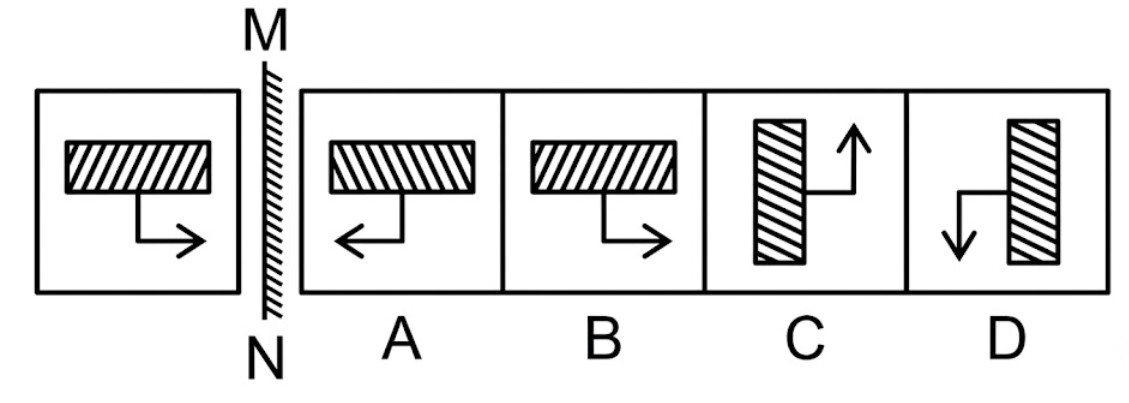
To determine the mirror image of a figure, we need to visualize how the figure would appear if reflected across a vertical mirror line. This involves reversing the orientation of the elements in the figure horizontally.
Correct Option: B) The rectangle's orientation and arrow direction match the mirror image.
This problem involves work and time. We need to find the individual work rate of C and then calculate the time C takes to complete double the work. We will use the concept that if a person completes a work in \(x\) days, their one day's work is \(\frac{1}{x}\) of the total work.
We know (A+B)'s one day's work and A's one day's work. So, B's one day's work can be found by subtracting A's work from (A+B)'s work.
\[ \text{B's one day's work} = (\text{A+B})\text{'s one day's work} - \text{A's one day's work} \] \[ = \frac{1}{7} - \frac{2}{21} \] \[ = \frac{3 - 2}{21} = \frac{1}{21} \]We know (B+C)'s one day's work and B's one day's work. So, C's one day's work can be found by subtracting B's work from (B+C)'s work.
\[ \text{C's one day's work} = (\text{B+C})\text{'s one day's work} - \text{B's one day's work} \] \[ = \frac{4}{35} - \frac{1}{21} \]To subtract these fractions, find a common denominator, which is 105 (LCM of 35 and 21).
\[ = \frac{4 \times 3}{35 \times 3} - \frac{1 \times 5}{21 \times 5} \] \[ = \frac{12}{105} - \frac{5}{105} \] \[ = \frac{12 - 5}{105} = \frac{7}{105} = \frac{1}{15} \]So, C's one day's work is \(\frac{1}{15}\) of the total work.
If C's one day's work is \(\frac{1}{15}\), then C will take 15 days to complete the original work alone.
To complete double the amount of work, C will take twice the time.
\[ \text{Time for double work} = 2 \times 15 \text{ days} = 30 \text{ days} \]Correct Option: C) 30
The problem asks us to identify the option that is different or unique from the others. This is a classification type of question where we need to find a common characteristic among three options and identify the one that does not share that characteristic.
C) Write — This option is a verb, representing an action, whereas the other three options (Gun, Sword, Spade) are all nouns representing physical objects (tools or weapons).
The question asks about the trend of valence electrons in elements across the periodic table. We need to recall the structure of the periodic table and how electron configuration changes when moving horizontally (across periods) and vertically (down groups).
C) Period — In a period, as you move from left to right, the atomic number increases by one for each successive element. This means one more electron is added to the outermost shell (for main group elements), leading to an increase in the number of valence electrons.