
How many triangles are there in the following figure?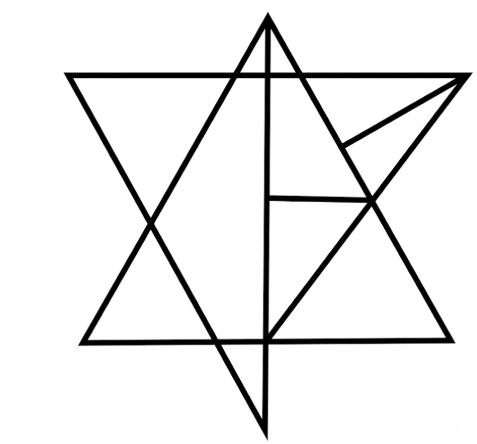
To determine the number of triangles in the figure, we need to systematically count all the possible triangles formed by the intersecting lines and shapes.
After following these steps, the total number of triangles found in the figure is 19.
Correct Option: C) 19
To find the least natural number that leaves a remainder of 1 when divided by 5, 6, 7, and 9, we first need to find the Least Common Multiple (LCM) of these divisors. The required number will be 1 more than this LCM.
Correct Option: D) 631
This question tests knowledge about economic projections made by international financial organizations. Specifically, it asks for the International Monetary Fund's (IMF) growth rate projection for India in 2019. Such figures are often updated, so recalling the specific projection for the given year is key.
Correct Option: C) 7.4%
A rich man divided his property (in the form of land) among his five sons. But later he took back his youngest son's share and divided it among other sons. If the eldest son would now own 93.75 m2, how much land did the rich man actually own?
The problem describes a scenario where a rich man initially divides his property among five sons. Later, he reallocates the youngest son's share among the other four sons. We are given the final share of the eldest son and need to find the total original property owned by the rich man. We will assume that the property was initially divided equally among the five sons, and the youngest son's share was then divided equally among the remaining four sons.
Let the total land owned by the rich man be \(X\) m\(^2\).
Initially, the land was divided among five sons. So, each son's initial share was:
\[ \text{Initial share per son} = \frac{X}{5} \]The youngest son's share was taken back. This share was \(\frac{X}{5}\).
This youngest son's share was then divided equally among the other four sons. So, each of the remaining four sons received an additional share of:
\[ \text{Additional share} = \frac{\left(\frac{X}{5}\right)}{4} = \frac{X}{20} \]The final share of each of the four remaining sons (including the eldest son) is their initial share plus the additional share:
\[ \text{Final share} = \text{Initial share} + \text{Additional share} \] \[ \text{Final share} = \frac{X}{5} + \frac{X}{20} \]To add these fractions, find a common denominator, which is 20:
\[ \text{Final share} = \frac{4X}{20} + \frac{X}{20} = \frac{5X}{20} = \frac{X}{4} \]We are given that the eldest son's final share is 93.75 m\(^2\). Therefore, we can set up the equation:
\[ \frac{X}{4} = 93.75 \]Solve for \(X\):
\[ X = 93.75 \times 4 \] \[ X = 375 \]Thus, the rich man actually owned 375 m\(^2\) of land.
The question asks about the characteristic skin features of animals belonging to the class Aves (birds). We need to recall the general characteristics of birds, specifically regarding their skin and body covering.
B) dry and glandular skin with feathers
Birds possess dry skin, which generally lacks glands, except for the preen gland (uropygial gland) in most species. The most distinctive feature of their integument is the presence of feathers, which are crucial for flight, insulation, and protection. Therefore, "dry and glandular skin with feathers" best describes the integumentary system of class Aves, acknowledging the presence of the preen gland while highlighting the predominant dry nature of the skin and the universal presence of feathers.
The problem states that there are an equal number of 25 paise and 50 paise coins, and their total value is Rs. 22.50. We need to find the number of coins of each type. We can set up an equation based on the total value of the coins, converting all values to the same unit (either paise or rupees).
C) The number of coins of each type is 30. This means there are 30 coins of 25 paise and 30 coins of 50 paise. Let's verify: Value of 30 coins of 25 paise \( = 30 \times 0.25 = 7.50 \) Rupees. Value of 30 coins of 50 paise \( = 30 \times 0.50 = 15.00 \) Rupees. Total value \( = 7.50 + 15.00 = 22.50 \) Rupees. This matches the given total value.
To find the missing number in the series, we need to identify the pattern or relationship between consecutive numbers.
The differences are 6 and 9. It appears that the difference itself is increasing by 3 each time (\(9 - 6 = 3\)).
If the pattern of increasing differences by 3 continues, the next difference should be \(9 + 3 = 12\).
Add this predicted difference to the last known term before the question mark:
\(30 + 12 = 42\)
If the missing term is 42, the next difference in the series should be \(12 + 3 = 15\).
Let's check if \(42 + 15\) equals the last given term, 57:
\(42 + 15 = 57\)
This matches the given series, confirming our pattern and the missing number.
The series with differences is:
\(15 \xrightarrow{+6} 21 \xrightarrow{+9} 30 \xrightarrow{+12} 42 \xrightarrow{+15} 57\)
D) 42
To solve this blood relation question, we need to decode the given symbols and then apply them to each option to determine the relationship between P and Q. We are looking for the option where P is the maternal uncle of Q. This means P must be the brother of Q's mother.
First, let's decode the given relationships:
We need to find an option where P is the maternal uncle of Q. This implies the following conditions:
Let's analyze each option:
Combining these, Q is the brother of N, and N is the mother of M and P. This makes N Q's sister and P Q's nephew/niece (depending on M's gender). P is the son/daughter of N, who is Q's sister. Therefore, P is Q's nephew/niece, not Q's maternal uncle.
Combining these, Q is the brother of S, and S is the father of P. This means S is Q's brother, and P is S's child. Therefore, P is Q's nephew/niece, not Q's maternal uncle.
Combining these, P is the brother of M, and M is the mother of N and Q. Since M is the mother of Q, and P is the brother of M, P is the brother of Q's mother. This makes P the maternal uncle of Q. Also, P is male (\(P / M\)), which satisfies the first condition.
D) \(P / M \times N @ Q\)
This option correctly establishes P as the brother of M, and M as the mother of Q. Thus, P is the maternal uncle of Q.
This problem can be solved using the principle of inclusion-exclusion for two sets, or by using a Venn diagram approach. We need to find the number of people who drink neither tea nor coffee by first calculating the total number of people who drink at least one of the beverages, and then subtracting this from the total population.
Using the principle of inclusion-exclusion:
\[ n(T \cup C) = n(T) + n(C) - n(T \cap C) \]This is the total population minus the number of people who drink at least one beverage.
\[ \text{Neither} = N - n(T \cup C) \]\[ \text{Neither} = 5000 - 4200 \]\[ \text{Neither} = 800 \]A) 800 is the correct answer. This represents the number of people in the town who do not drink either tea or coffee.
We need to find the present age of the mother. We are given two pieces of information: the relationship between their ages five years ago and the sum of their present ages. We will set up equations based on these conditions and solve them simultaneously.