
To find the least number that leaves a specific remainder when divided by several numbers, we first need to find the Least Common Multiple (LCM) of those numbers. Then, we add the common remainder to the LCM to get the required number.
First, we find the prime factorization of each number:
To find the LCM, we take the highest power of all prime factors present:
\[ \text{LCM}(6, 15, 18) = 2^1 \times 3^2 \times 5^1 = 2 \times 9 \times 5 = 90 \]The problem states that the number leaves a remainder of 5 each time when divided by 6, 15, and 18. Therefore, the required number will be the LCM plus the remainder.
\[ \text{Required Number} = \text{LCM}(6, 15, 18) + \text{Remainder} \] \[ \text{Required Number} = 90 + 5 = 95 \]The number 95 satisfies all the conditions.
What is the energy contained in an object of 15 kg when it is at a height of 5 m above the ground? Given g = 9.8 ms-2
The energy contained in an object due to its position above the ground is potential energy. This can be calculated using the formula for gravitational potential energy, which depends on the object's mass, the acceleration due to gravity, and its height above a reference point.
Gravitational Potential Energy (\(PE\)) is given by:
\[ PE = mgh \]D) The calculated potential energy is 735 J, which matches option D.
What is the relationship between the electric current flowing through a conductor and the potential difference?
\( \frac{I}{V} \) is a constant.
V × I is a constant.
\( \frac{V}{I} \) is a constant
V + I is a constant
This question asks about the fundamental relationship between electric current and potential difference in a conductor, which is described by Ohm's Law.
Correct Option: C) \( \frac{V}{I} \) is a constant. This directly represents Ohm's Law, where the constant is the resistance (R) of the conductor.
A man spends \( \frac{2}{5} \) part of his income and has Rs. 90 left. How much money did he have in the beginning?
To find the initial amount of money, we first determine the fraction of income remaining after spending. Then, we equate this remaining fraction to the given amount (Rs. 90) to calculate the total income.
Correct Option: B) Rs. 150
The question asks to identify the group number in the periodic table where 'inert gases' are located. This requires knowledge of the classification of elements in the periodic table, specifically the noble gases and their traditional group numbering.
These elements have a completely filled outermost electron shell (valence shell), which makes them very stable and unreactive. For instance, Helium has 2 valence electrons, and the others have 8 valence electrons (an octet), except for Oganesson, which is a synthetic element.
C) VIII A — Inert gases (noble gases) are located in Group 18 of the modern periodic table, which corresponds to Group VIII A in the traditional American group numbering system. They are characterized by their full valence electron shells, making them highly unreactive or "inert."
The question asks to identify a metal that melts when placed on the palm. This implies that the metal must have a melting point close to or below the average human body temperature, which is approximately \(37^\circ \text{C}\) (\(98.6^\circ \text{F}\)). We need to recall the melting points of the given metals.
B) Ga (Gallium) has a melting point of approximately \(29.76^\circ \text{C}\). Since the average human body temperature is around \(37^\circ \text{C}\), gallium will readily melt when held in the palm, absorbing heat from the hand.
The following bar graph gives the details of students passed out of the institute 'ABC' in the national level entrance examination in the last 5 years.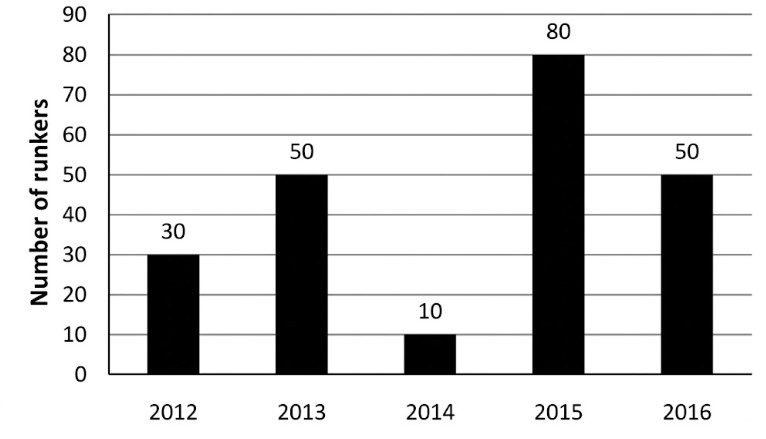
In the year 2016, how many students passed from the institute 'ABC'?
To find the number of students who passed from the institute 'ABC' in the year 2016, we need to analyze the bar graph provided.
Correct Option: B) 50
Which of the following statement(s) is/are true regarding the speed of sound at 25°C in different mediums?
1. The speed of sound in aluminum is 6220 m/s.
2. The speed of sound in nickel is 6240 m/s.
Both 1 and 2 are true.
only 1 is true
Neither 1 nor 2 is true
Only 2 is true.
The question asks to identify the true statement(s) regarding the speed of sound in aluminum and nickel at 25°C. To answer this, we need to recall or refer to the standard values for the speed of sound in these materials at the specified temperature.
C) Neither 1 nor 2 is true. This is correct because the stated values for the speed of sound in aluminum (6220 m/s) and nickel (6240 m/s) at 25°C are different from the generally accepted standard values (approximately 6420 m/s for aluminum and 6040 m/s for nickel).
To solve this problem, we first need to find the Cost Price (CP) of the article using the initial selling price and profit percentage. Once the CP is known, we can calculate the loss and percentage loss if the article were sold for a different price.
Calculate the Cost Price (CP):
Given the selling price (\(\text{SP}_1\)) is Rs. 466 and the profit percentage is 16.5%.
The formula for selling price with profit is:
\[ \text{SP} = \text{CP} \times \left(1 + \frac{\text{Profit Percentage}}{100}\right) \]Substitute the given values:
\[ 466 = \text{CP} \times \left(1 + \frac{16.5}{100}\right) \]\[ 466 = \text{CP} \times \left(1 + 0.165\right) \]\[ 466 = \text{CP} \times 1.165 \]Now, solve for CP:
\[ \text{CP} = \frac{466}{1.165} \]\[ \text{CP} = 400 \]So, the Cost Price of the article is Rs. 400.
Calculate the Loss if sold for Rs. 330:
The new selling price (\(\text{SP}_2\)) is Rs. 330.
Since \(\text{SP}_2 < \text{CP}\), there is a loss.
Loss = \(\text{CP} - \text{SP}_2\)
\[ \text{Loss} = 400 - 330 \]\[ \text{Loss} = 70 \]The loss incurred would be Rs. 70.
Calculate the Percentage Loss:
The formula for percentage loss is:
\[ \text{Percentage Loss} = \frac{\text{Loss}}{\text{CP}} \times 100 \]Substitute the values:
\[ \text{Percentage Loss} = \frac{70}{400} \times 100 \]\[ \text{Percentage Loss} = \frac{70}{4} \]\[ \text{Percentage Loss} = 17.5 \]The percentage loss would be 17.5%.
D) 17.5
5th February 2018 was Monday. In which of the following years will 5th February be Monday again?
To find the year when 5th February will be a Monday again, we need to calculate the number of odd days for each subsequent year. A normal year has 1 odd day, and a leap year has 2 odd days. The day of the week repeats when the cumulative sum of odd days is a multiple of 7.
The sequence of odd days is:
The total odd days accumulated till the end of 2023 (to determine the day for 5th Feb 2024) is \(1+1+2+1+1+1 = 7\). Since 7 is a multiple of 7, the day will repeat.
D) 2024 — As calculated, 5th February 2024 will be a Monday because the cumulative odd days from 2018 to 2023 sum up to 7, which means the day of the week repeats.