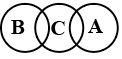
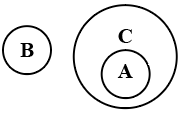
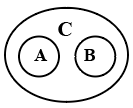
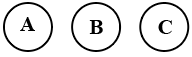
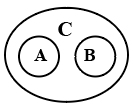
Which of the following Venn diagrams correctly represents the relationship between the given classes?
A) Carrots
B) Cabbages
C) Vegetables
To determine the correct Venn diagram, we need to understand the relationship between the categories: Carrots, Cabbages, and Vegetables. Both carrots and cabbages are types of vegetables.
Correct Option: C) The diagram shows two separate circles labeled A (Carrots) and B (Cabbages) inside a larger circle labeled C (Vegetables), accurately representing the relationship.
On 19th January 2018, who was appointed as the Chief Election Commissioner of India?
Ashok Lavasa
Om Prakash Rawat
Sunil Arora
Sunil Rawar
The question asks to identify the Chief Election Commissioner of India appointed on a specific date, 19th January 2018. This requires knowledge of key appointments in Indian governance.
Correct Option: B) Om Prakash Rawat was appointed as the Chief Election Commissioner of India on 19th January 2018.
The problem asks for the total weight of six boxes, given that all boxes are of equal weight. We need to determine if Statement 1, Statement 2, or both are sufficient to find this total weight. Let's denote the weight of one box as \(W\) kg.
We need to find the total weight of six boxes. Since each box has an equal weight, let the weight of one box be \(W\) kg. The total weight of six boxes will be \(6W\) kg.
Statement 1 says: "One-third of each box's weight is 2 kg."
From this, we can write the equation:
\[ \frac{1}{3} W = 2 \]\[ W = 2 \times 3 \]\[ W = 6 \text{ kg} \]Once we have the weight of one box (\(W = 6\) kg), we can find the total weight of six boxes:
\[ \text{Total Weight} = 6 \times W \]\[ \text{Total Weight} = 6 \times 6 \]\[ \text{Total Weight} = 36 \text{ kg} \]Since we can determine the total weight using Statement 1 alone, Statement 1 is sufficient.
Statement 2 says: "The total weight of four boxes is 12 kg more than the total weight of two boxes."
From this, we can write the equation:
\[ 4W = 2W + 12 \]Now, solve for \(W\):
\[ 4W - 2W = 12 \]\[ 2W = 12 \]\[ W = \frac{12}{2} \]\[ W = 6 \text{ kg} \]Once we have the weight of one box (\(W = 6\) kg), we can find the total weight of six boxes:
\[ \text{Total Weight} = 6 \times W \]\[ \text{Total Weight} = 6 \times 6 \]\[ \text{Total Weight} = 36 \text{ kg} \]Since we can determine the total weight using Statement 2 alone, Statement 2 is sufficient.
Both Statement 1 alone and Statement 2 alone are sufficient to answer the question.
A) Either statement 1 or 2 is sufficient. This is correct because we showed that both statements independently allow us to calculate the weight of one box, and thus the total weight of six boxes.
In a triangle ABC, D, E and F are the mid-points of the sides BC, CA and AB, respectively. BE and DF intersect at X. DE and CF intersect at Y. Find XY =?
\( \frac{1}{2} \) BC
\( \frac{1}{4} \) BC
\( \frac{2}{3} \) BC
\( \frac{1}{3} \) BC
The problem involves properties of mid-points in a triangle and the concept of a Varignon parallelogram. We will use the Mid-point Theorem and properties of parallelograms to find the relationship between XY and BC.
Identify the given information: D, E, F are mid-points of BC, CA, AB respectively in \(\triangle ABC\).
Apply the Mid-point Theorem:
Form a parallelogram: Consider the quadrilateral BDEF. Since D is the mid-point of BC and E is the mid-point of AC, \(DE \parallel AB\). Also, F is the mid-point of AB, so \(DE \parallel FB\). Similarly, since F is the mid-point of AB and D is the mid-point of BC, \(FD \parallel AC\). Also, E is the mid-point of AC, so \(FD \parallel BE\). Thus, BDEF is a parallelogram.
Identify the diagonals of the parallelogram BDEF: The diagonals of parallelogram BDEF are BE and FD. They intersect at X. In a parallelogram, the diagonals bisect each other. Therefore, X is the mid-point of BE and also the mid-point of FD.
Form another parallelogram: Consider the quadrilateral AFED. Since F and E are mid-points of AB and AC, \(FE \parallel BC\). Also, D is the mid-point of BC, so \(FE \parallel AD\). Similarly, since D and E are mid-points of BC and AC, \(DE \parallel AB\). Also, F is the mid-point of AB, so \(DE \parallel AF\). Thus, AFED is a parallelogram.
Identify the diagonals of the parallelogram AFED: The diagonals of parallelogram AFED are AE and FD. They intersect at a point (let's call it P for a moment). This is not directly useful for Y.
Consider \(\triangle BFC\): D is the mid-point of BC. F is the mid-point of AB. E is the mid-point of AC.
Consider \(\triangle ABM\), where M is the mid-point of AC. This is not helpful.
Let's re-evaluate the intersection points. We have X as the intersection of BE and DF. We have Y as the intersection of DE and CF.
Focus on \(\triangle AB C\):
Consider the quadrilateral FDEC: Since \(FE \parallel BC\) and D is on BC, \(FE \parallel DC\). Also, \(FD \parallel AC\) and E is on AC, so \(FD \parallel EC\). Therefore, FDEC is a parallelogram. Its diagonals are FC and DE. They intersect at Y. Thus, Y is the mid-point of FC and also the mid-point of DE.
Consider the segment XY: We have X as the mid-point of FD and Y as the mid-point of DE. In \(\triangle FDE\), XY connects the mid-points of two sides FD and DE.
Apply the Mid-point Theorem to \(\triangle FDE\): Since X is the mid-point of FD and Y is the mid-point of DE, by the Mid-point Theorem, \(XY \parallel FE\) and \(XY = \frac{1}{2} FE\).
Substitute the value of FE: We know from step 2 that \(FE = \frac{1}{2} BC\).
Therefore, \[XY = \frac{1}{2} \left( \frac{1}{2} BC \right)\].
\[ XY = \frac{1}{4} BC \]
B) \( \frac{1}{4} \) BC
This question tests the fundamental concept of a 'mole' in chemistry, specifically Avogadro's number. One mole of any substance contains a fixed number of constituent particles (atoms, molecules, ions, etc.), which is defined by Avogadro's number.
Correct Option: D) 6.022 × 10²³
119 ÷ [22 – {90 ÷ (23 – 105 ÷ \(\overline{7 \times 3}\))}] =?
To solve this problem, we need to follow the order of operations, often remembered by the acronym BODMAS/PEMDAS (Brackets/Parentheses, Orders/Exponents, Division and Multiplication, Addition and Subtraction). We will start by evaluating the innermost expressions and work our way outwards.
First, evaluate the expression under the vinculum (bar) and then the division within the innermost parentheses:
\[ \overline{7 \times 3} = 21 \] \[ 105 \div 21 = 5 \]Substitute this value back into the innermost parentheses:
\[ (23 - 5) = 18 \]Next, evaluate the division inside the curly braces:
\[ 90 \div 18 = 5 \]Substitute this value back into the curly braces:
\[ \{90 \div (23 - 105 \div \overline{7 \times 3})\} = \{90 \div 18\} = 5 \]Now, evaluate the expression inside the square brackets:
\[ [22 - 5] = 17 \]Finally, perform the last division:
\[ 119 \div 17 = 7 \]So, the value of the entire expression is 7.
D) 7 is the correct answer, as derived from the step-by-step calculation following the BODMAS rule.
A) 4 — This would result if there were errors in calculation, for example, if the final division was \(119 \div 29.75\) or similar miscalculations.
B) 12 — This could result from incorrect order of operations or arithmetic mistakes, such as \(119 \div (22 - 90 \div (23 - 15)) = 119 \div (22 - 90 \div 8) \approx 119 \div (22 - 11.25) = 119 \div 10.75 \approx 11.06\), which is close to 12 if rounded or if other errors occurred.
C) 3 — This would imply significant errors in the calculation, such as \(119 \div 39.66\), which is not obtained by following the correct order of operations.
The question asks to identify the individual who coined the term 'atom'. This requires knowledge of the historical development of atomic theory and the contributions of key scientists and philosophers.
A) Democritus — Democritus, an ancient Greek philosopher (around 460-370 BC), is widely credited with coining the term "atom" (from the Greek "atomos") to describe the smallest, indivisible particles that he believed made up all matter.
This is a direction-based reasoning question. We need to track Nina's movements step-by-step, considering her initial direction relative to the sun and subsequent turns.
After the second left turn, Nina is moving towards the East.
Correct Option: C) East
The question asks to identify the term for substances whose odor changes in acidic or basic media. This requires knowledge of different types of indicators used in chemistry.
A) Olfactory indicators are substances whose smell changes in acidic or basic media. For example, onion has a characteristic smell that diminishes in a basic solution but remains detectable in an acidic solution. Vanilla extract and clove oil are other common examples.
This problem involves analyzing logical statements and drawing conclusions based on them. We can use Venn diagrams to visualize the relationships described in the statements and then evaluate the given conclusions.