
To calculate the momentum of the gun, we need to use the formula for momentum, which is the product of mass and velocity. We are given the mass of the gun and its recoil velocity. We will then check the units to ensure the correct option is selected.
Momentum (\(P\)) is defined as the product of mass (\(m\)) and velocity (\(v\)).
\[ P = m \times v \]The unit for mass is kilograms (kg) and the unit for velocity is meters per second (ms⁻¹). Therefore, the unit for momentum is kgms⁻¹.
C) 100 kgms⁻¹ is the correct answer. The calculated momentum is 100 and the correct unit for momentum is kgms⁻¹.
Sooraj is three times as old as his son Arjun. After 8 years, he would be two and a half times Arjun’s age. After a further 8 years, he would be ____ times Arjun’s age.
This problem involves setting up and solving a system of linear equations based on the given age relationships at different points in time. We will define variables for the current ages of Sooraj and Arjun, form equations from the given conditions, solve for their current ages, and then calculate their ages after the specified future periods to find the final ratio.
Let Sooraj's current age be \(S\) years.
Let Arjun's current age be \(A\) years.
"Sooraj is three times as old as his son Arjun."
\[ S = 3A \quad \text{(Equation 1)} \]After 8 years, Sooraj's age will be \(S+8\) and Arjun's age will be \(A+8\).
"After 8 years, he would be two and a half times Arjun's age."
\[ S+8 = 2\frac{1}{2}(A+8) \]\[ S+8 = \frac{5}{2}(A+8) \quad \text{(Equation 2)} \]Substitute Equation 1 into Equation 2:
\[ 3A+8 = \frac{5}{2}(A+8) \]\[ 2(3A+8) = 5(A+8) \]\[ 6A+16 = 5A+40 \]\[ 6A - 5A = 40 - 16 \]\[ A = 24 \]Using Equation 1:
\[ S = 3A = 3 \times 24 = 72 \]The problem asks for the ratio after a further 8 years, which means 8 years after the first 8-year period. So, it's \(8+8=16\) years from the current age.
Sooraj's age after 16 years: \(S_{16} = S + 16 = 72 + 16 = 88\) years.
Arjun's age after 16 years: \(A_{16} = A + 16 = 24 + 16 = 40\) years.
Ratio \[= \frac{S_{16}}{A_{16}} = \frac{88}{40}\]
Simplify the fraction:
\[ \frac{88}{40} = \frac{11 \times 8}{5 \times 8} = \frac{11}{5} \]D) \(2\frac{1}{5}\) is the correct ratio of Sooraj's age to Arjun's age after a further 8 years.
The problem describes a coding pattern where each letter in a word is transformed into another letter. We need to identify this pattern by comparing the given word "TEAM" with its coded form "WHDP" and then apply the same pattern to code the word "COINS".
We are given that TEAM is coded as WHDP.
Let's find the positional difference of each letter in the English alphabet.
The pattern is consistently adding 3 to the alphabetical position of each letter.
The coded word for COINS is FRLQV.
C) FRLQV is the correct code for COINS, following the established pattern of shifting each letter by +3 positions in the alphabet.
−15–(−18–35÷ 5) =?
To solve this problem, we need to follow the order of operations, often remembered by the acronym PEMDAS/BODMAS (Parentheses/Brackets, Exponents/Orders, Multiplication and Division (from left to right), Addition and Subtraction (from left to right)). We will start by simplifying the innermost part of the expression.
The expression inside the parentheses is \(-18 - 35 \div 5\).
According to the order of operations, division comes before subtraction.
\[ 35 \div 5 = 7 \]Now the expression inside the parentheses becomes:
\[ -18 - 7 \]When subtracting a positive number from a negative number, it's equivalent to adding two negative numbers.
\[ -18 - 7 = -25 \]The original expression was \(-15 - (-18 - 35 \div 5)\).
Now it becomes:
\[ -15 - (-25) \]Subtracting a negative number is equivalent to adding the positive number.
\[ -15 - (-25) = -15 + 25 \]Adding \(-15\) and \(25\):
\[ -15 + 25 = 10 \]The final answer is \(10\).
A) 10 is the correct answer, as derived by following the order of operations.
The question asks which material does NOT oxidize (burn) readily at high temperatures. Oxidation, often referred to as burning in this context, is a chemical reaction with oxygen, usually producing heat and light. We need to identify the material class that is generally designed to resist such reactions.
Correct Option: A) Alloys are often specifically designed to resist oxidation and corrosion at high temperatures, making them less likely to burn readily compared to many common insulators, conductors, or semiconductors.
To find the Least Common Multiple (LCM) of a set of numbers, we can use the prime factorization method. This involves finding the prime factors of each number and then taking the highest power of each prime factor present in any of the numbers.
The unique prime factors involved are 2, 3, 7, and 11.
\[ \text{LCM}(14, 42, 77) = 2^1 \times 3^1 \times 7^1 \times 11^1 \]
\[ \text{LCM}(14, 42, 77) = 2 \times 3 \times 7 \times 11 \]
\[ \text{LCM}(14, 42, 77) = 6 \times 7 \times 11 \]
\[ \text{LCM}(14, 42, 77) = 42 \times 11 \]
\[ \text{LCM}(14, 42, 77) = 462 \]
Correct Option: B) 462
This is a syllogism problem that can be solved using Venn diagrams or by analyzing the logical relationships between the statements. We need to determine which conclusions logically follow from the given statements, treating the statements as true regardless of common knowledge.
Analyze Statement 1: "Some Lemons are Red."
This means there is an overlap between the set of Lemons and the set of Red things. It does not imply that all lemons are red, nor does it imply that no lemons are red. It only confirms the existence of at least one lemon that is red.
Analyze Statement 2: "Some Beet are Lemons."
This means there is an overlap between the set of Beet and the set of Lemons. It indicates that some beets are also lemons.
Evaluate Conclusion 1: "All Lemons are Red."
The statement "Some Lemons are Red" only guarantees that a part of the set of Lemons is Red. It does not provide any information about the remaining lemons. Therefore, we cannot conclude that all lemons are red. This conclusion does not logically follow.
Evaluate Conclusion 2: "Some Beet are Red."
We know "Some Beet are Lemons" and "Some Lemons are Red." Let's visualize this:
However, the lemons that are beets might not be the same lemons that are red. For example, if we have three groups of lemons: L1 (which are Beet), L2 (which are Red), and L3 (neither Beet nor Red). The statements only guarantee that L1 exists and L2 exists. There is no information to guarantee that L1 and L2 overlap, or that any beet-lemon is also a red-lemon. Therefore, we cannot definitively conclude that "Some Beet are Red." This conclusion does not logically follow.
Correct Option: B) Neither 1 nor 2 follows
Both conclusions make assumptions that are not supported by the given statements. "Some" statements do not allow for definite conclusions about "All" or about the intersection of three sets unless explicitly stated or directly inferable.
The question asks for the founding year of the South Asian Sports Council (SASC). This is a factual question requiring knowledge of the history of sports organizations in South Asia.
Correct Option: D) 1983
The South Asian Sports Council (SASC) was formed in 1983. This council is the governing body of the South Asian Games, a multi-sport event held among the athletes from South Asian countries.
What will be the next figure in the series?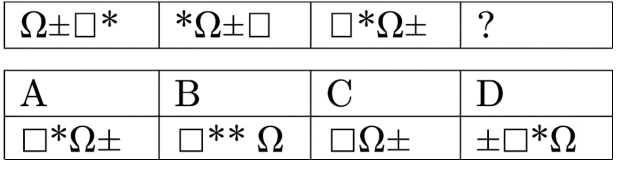
To determine the next figure in the series, we need to identify the pattern in the sequence of symbols and their arrangement.
Correct Option: C) □Ω±
After spending 85% of his salary, Alok saves Rs 1,200 per month. What is his monthly salary (in Rupees)?
This problem involves calculating a total amount (monthly salary) given a percentage of expenditure and the remaining savings. We will determine the percentage of salary saved and then use this percentage to find the total salary.
Understand the given information:
Calculate the percentage of salary saved:
If Alok spends 85% of his salary, the remaining percentage is saved. The total salary can be considered as 100%.
Relate the saved percentage to the saved amount:
We know that 15% of Alok's salary is equal to Rs 1,200.
Calculate the total monthly salary:
Let the monthly salary be \(S\). We can write the equation:
Thus, Alok's monthly salary is Rs 8,000.
A) 8,000 is the correct monthly salary.