This question asks about the fundamental reason why objects thrown upwards fall back to Earth. This phenomenon is governed by one of the most basic forces in physics: gravity. We need to identify the option that correctly describes this force.
D) There exists a force that pulls it down towards the Earth. This option correctly identifies that a force is responsible for pulling the stone back down. This force is specifically the gravitational force exerted by the Earth.
The question asks about the type of energy possessed by a car moving at a high speed. We need to recall the definitions of different forms of energy and forces to determine the correct answer.
Correct Option: D) Kinetic energy
The question asks for the year when English was officially made the medium of instruction in India by the British. This refers to a significant policy decision during British colonial rule.
A) 1835 is the correct answer. In this year, Macaulay's Minute on Indian Education was presented, and the English Education Act was passed, officially establishing English as the medium of instruction in India.
The problem presents a series with terms consisting of a number and a letter. We need to identify the pattern in both the numerical and alphabetical parts separately to find the next term.
The numbers in the series are 3, 9, 27.
The pattern for the numerical part is multiplication by 3. So, the next number will be \(27 \times 3 = 81\).
The letters in the series are E, G, I.
The pattern for the alphabetical part is an increase of 2 in the position of the letter in the alphabet (E to G is +2, G to I is +2). So, the next letter will be the letter that is 2 positions after I. I is the 9th letter, so the next letter will be the 11th letter, which is K.
Combining the next number (81) and the next letter (K), the next term in the series is 81K.
Correct Option: D) 81 K
Which of the following correctly corresponds to the relationship between
A) Woolen Sweater
B) Cotton
C) Wool
To determine the correct relationship among A) Woolen Sweater, B) Cotton, and C) Wool, we need to understand the material composition and usage of these items.
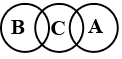
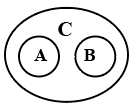
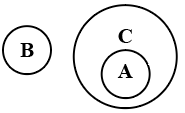
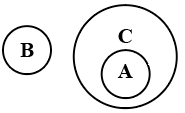
Based on this understanding, the diagram should show Woolen Sweater inside Wool, while Cotton is separate.
Correct Option: D) The diagram shows "A" inside "C" and "B" separate, which correctly represents the relationship.
The question asks to identify a substance commonly used as a fuel additive in cars that run on petrol. This is a general knowledge question related to alternative fuels and fuel additives used in the automotive industry.
Correct Option: A) Ethanol is a common biofuel additive blended with petrol to improve combustion and reduce emissions. Countries like India have programs to promote ethanol blending in petrol.
To find the equivalent resistance of resistors connected in parallel, we use a specific formula. For \(n\) resistors connected in parallel, the reciprocal of the equivalent resistance is the sum of the reciprocals of individual resistances. When identical resistors are connected in parallel, there's a simpler formula.
Correct Option: C) 2 Ω
The question asks to identify the constituent metals of solder, which is a common alloy. Recalling the composition of various important alloys is key to answering this question.
Correct Option: D) Pb and Sn
To find the percentage of loss, we first need to calculate the actual loss incurred by Pratyay. Loss is the difference between the cost price and the selling price. Once the loss amount is determined, the percentage of loss can be calculated by dividing the loss by the cost price and multiplying by 100.
The price at which Pratyay bought the set of cups is the Cost Price.
\[ \text{CP} = \text{Rs } 195 \]The price at which Pratyay sold the set of cups is the Selling Price.
\[ \text{SP} = \text{Rs } 171.6 \]Since the Selling Price is less than the Cost Price, there is a loss. The loss is calculated as:
\[ \text{Loss} = \text{CP} - \text{SP} \]\[ \text{Loss} = 195 - 171.6 \]\[ \text{Loss} = \text{Rs } 23.4 \]The percentage of loss is calculated using the formula:
\[ \text{Percentage of Loss} = \left( \frac{\text{Loss}}{\text{CP}} \right) \times 100 \]\[ \text{Percentage of Loss} = \left( \frac{23.4}{195} \right) \times 100 \]\[ \text{Percentage of Loss} = 0.12 \times 100 \]\[ \text{Percentage of Loss} = 12\% \]A) 12 is the correct answer. The calculated percentage of loss is 12%.
This problem involves work and time. We will first calculate the individual work rates of A and B. Then, we will consider the scenario where A leaves before completion and determine the total time taken and the duration for which A and B worked together.
A and B together complete the task in 15 days.
\[ (\text{A} + \text{B})\text{'s 1-day work} = \frac{1}{15} \]A alone completes the task in 18.75 days.
\[ \text{A's 1-day work} = \frac{1}{18.75} = \frac{1}{18 \frac{3}{4}} = \frac{1}{\frac{75}{4}} = \frac{4}{75} \]B's 1-day work is the difference between (A+B)'s 1-day work and A's 1-day work.
\[ \text{B's 1-day work} = (\text{A} + \text{B})\text{'s 1-day work} - \text{A's 1-day work} \]\[ \text{B's 1-day work} = \frac{1}{15} - \frac{4}{75} \]\[ \text{B's 1-day work} = \frac{5}{75} - \frac{4}{75} = \frac{1}{75} \]Let the total time taken to complete the work be \(T\) days.
A leaves 12.5 days before the completion of the work. This means B works for the entire \(T\) days, and A works for \((T - 12.5)\) days.
The total work done is 1.
\[ \text{Work done by A} + \text{Work done by B} = 1 \]\[ (\text{A's 1-day work} \times \text{Days A worked}) + (\text{B's 1-day work} \times \text{Days B worked}) = 1 \]\[ \left(\frac{4}{75} \times (T - 12.5)\right) + \left(\frac{1}{75} \times T\right) = 1 \]\[ \frac{4(T - 12.5)}{75} + \frac{T}{75} = 1 \]\[ 4(T - 12.5) + T = 75 \]\[ 4T - 50 + T = 75 \]\[ 5T - 50 = 75 \]\[ 5T = 75 + 50 \]\[ 5T = 125 \]\[ T = \frac{125}{5} \]\[ T = 25 \text{ days} \]A worked for \((T - 12.5)\) days.
\[ \text{Days A worked} = 25 - 12.5 = 12.5 \text{ days} \]Since A and B started working together, and A left after 12.5 days, they worked together for 12.5 days.
C) 12.5
A and B worked together for 12.5 days before A left. B completed the remaining work.