
Which of the fractions given below, when added to \( \frac{13}{5} \), gives 1?
-\( \frac{8}{15} \)
-\( \frac{7}{5} \)
-\( \frac{26}{10} \)
-\( \frac{48}{30} \)
The problem asks us to find a fraction that, when added to \( \frac{13}{5} \), results in 1. We can set up an equation to represent this and solve for the unknown fraction. Then, we will compare the result with the given options.
D) -\( \frac{48}{30} \)
This question tests the understanding of refraction, specifically how the speed and direction of light change when it passes from a denser medium to a rarer medium. Key concepts include Snell's Law and the relationship between refractive index, speed of light, and the bending of light.
C) speed up and bend away from the normal — As explained above, when light goes from a denser to a rarer medium, its speed increases, and it bends away from the normal according to Snell's Law.
The question asks to identify the actor who played the role of Alauddin Khilji in the movie 'Padmavat'. This is a general knowledge question related to Indian cinema, which often appears in competitive exams.
D) Ranveer Singh portrayed the character of Alauddin Khilji in the movie 'Padmavat'. His performance in this role was widely acclaimed and received several awards.
The question asks about the common characteristic of elements within the same group in the periodic table. We need to recall the organization principles of the periodic table, specifically what defines a 'group' of elements.
B) number of valence electrons. Elements in the same group of the periodic table have the same number of valence electrons. This is the fundamental reason why they exhibit similar chemical properties.
We need to find the lowest possible mark for one of the new students such that the overall average score for five students is at least 40. We will first calculate the total score of the initial three students. Then, we will determine the minimum total score required for all five students to achieve an average of at least 40. Finally, we will use the condition that one new student scores less than the other to find the lowest possible mark for that student.
Calculate the total score of the initial three students:
The mean score of three students is 38. So, their total score is:
Calculate the minimum total score required for five students:
For the overall average of five students to be at least 40, the minimum total score required is:
Calculate the minimum total score required from the two new students:
The sum of scores of the two new students must be at least:
Determine the lowest mark for the newcomer who scores less:
Let the scores of the two new students be \(x\) and \(y\). We know that \(x + y \ge 86\).
Also, one student scores less than the other. Let's assume \(x < y\).
To find the lowest possible mark for \(x\), we need to maximize \(y\). Since the test is out of 45, the maximum score any student can get is 45.
So, let \(y = 45\).
Then, \(x + 45 \ge 86\)
\[ x \ge 86 - 45 \]\[ x \ge 41 \]The lowest mark for \(x\) is 41. We must also check the condition \(x < y\), which is \(41 < 45\), which is true. Therefore, the lowest mark that can be obtained by the newcomer who scores less is 41.
Correct Option: C) 41
The problem involves calculating the amount of flour added to a recipe to change the sugar-to-flour ratio. We will first determine the initial quantities of sugar and flour in the recipe. Then, we will set up an equation based on the new ratio after adding an unknown amount of flour, keeping the sugar quantity constant.
Correct Option: C) 8.7 kg is the amount of flour Sunita added to change the ratio from 17:28 to 2:5.
To find the Least Common Multiple (LCM) of a set of numbers, we first express each number as a product of its prime factors. Then, we take the highest power of each prime factor that appears in any of the factorizations and multiply them together.
Multiply the highest powers of all unique prime factors:
\[ \text{LCM}(112, 72, 90) = 2^4 \times 3^2 \times 5^1 \times 7^1 \] \[ \text{LCM} = 16 \times 9 \times 5 \times 7 \] \[ \text{LCM} = 144 \times 35 \]To calculate \(144 \times 35\):
\[ 144 \times 30 = 4320 \] \[ 144 \times 5 = 720 \] \[ 4320 + 720 = 5040 \]So, the LCM is 5040.
C) 5040 is the correct LCM of 112, 72, and 90.
The pH scale measures the acidity or alkalinity of a solution. It is inversely related to the concentration of hydrogen ions (\(\text{H}^+\)) and directly related to the concentration of hydroxide ions (\(\text{OH}^-\)). Understanding this relationship is key to answering the question.
Definition of pH: The pH is defined as the negative logarithm (base 10) of the hydrogen ion concentration:
\[ \text{pH} = -\log_{10}[\text{H}^+] \]pH Scale Interpretation:
Relationship between \([\text{H}^+]\) and \([\text{OH}^-]\): In aqueous solutions, the product of the hydrogen ion concentration and the hydroxide ion concentration is a constant, known as the ion product of water (\(K_w\)), at a given temperature (typically \(1.0 \times 10^{-14}\) at 25°C):
\[ [\text{H}^+][\text{OH}^-] = K_w = 1.0 \times 10^{-14} \]Analyzing the pH change: As the pH value increases from 7 to 14, the solution becomes more basic or alkaline.
Impact on \([\text{H}^+]\): Since \(\text{pH} = -\log_{10}[\text{H}^+]\), an increase in pH means a decrease in \([\text{H}^+]\). For example, at pH 7, \([\text{H}^+] = 10^{-7} \text{ M}\), and at pH 14, \([\text{H}^+] = 10^{-14} \text{ M}\).
Impact on \([\text{OH}^-]\): Because \([\text{H}^+][\text{OH}^-] = K_w\) is constant, if \([\text{H}^+]\) decreases, then \([\text{OH}^-]\) must increase to maintain the constant product. For example, at pH 7, \([\text{OH}^-] = 10^{-7} \text{ M}\), and at pH 14, \([\text{OH}^-] = 10^0 \text{ M}\) or \(1 \text{ M}\).
A) an increase in the OH⁻ ion concentration: As the pH increases from 7 to 14, the solution becomes more alkaline. This means the concentration of hydroxide ions (\(\text{OH}^-\)) increases. This is consistent with the inverse relationship between \([\text{H}^+]\) and \([\text{OH}^-]\) and the definition of basicity.
Find the odd one out.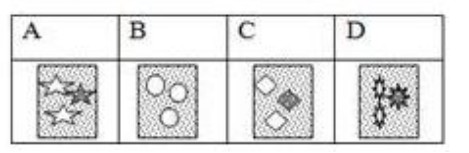
To find the odd one out, examine the patterns and shapes within each option. Look for differences in the number, type, or arrangement of elements.
Correct Option: B) Option B is the odd one out because it contains uniform circles, unlike the other options which have varied shapes.
How many right angled triangles are there in this figure?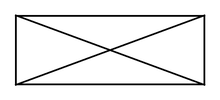
To determine the number of right-angled triangles in the given figure, we need to identify triangles that have one angle measuring 90 degrees. The figure is a rectangle divided by diagonals and additional lines.
Correct Option: A) 4