
Choose the one which does not belong to the group.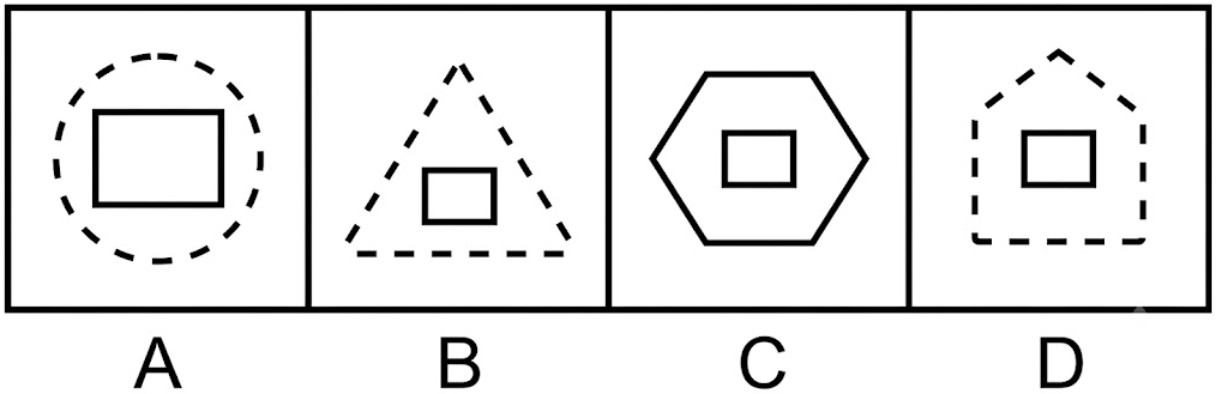
To solve this problem, we need to identify the pattern or rule that groups three of the options together, while the fourth one does not fit this pattern.
Correct Option: D) The pentagon in option D does not belong to the group of regular geometric shapes like circle, triangle, and hexagon.
To determine why covalently bonded molecules have low melting and boiling points, we need to understand the nature of the forces involved. Covalent bonds are strong intramolecular forces, but the forces between individual molecules (intermolecular forces) are what dictate physical properties like melting and boiling points.
Correct Option: D) Intermolecular forces are weak
The question asks to identify an element that was undiscovered during Mendeleev's time but later found a place in his periodic table. This requires knowledge of Mendeleev's predictions and the elements that filled those predicted gaps.
C) Ge — Germanium (Ge) was discovered in 1886 by Clemens Winkler. Its properties closely matched those predicted by Mendeleev for 'Eka-silicon'. Therefore, Germanium is one of the elements that filled a gap in Mendeleev's periodic table.
This problem involves calculating the principal amount (sum invested) given the simple interest, time period, and rate of interest. We will use the standard formula for simple interest.
The formula for simple interest is:
\[ \text{SI} = \frac{\text{P} \times \text{R} \times \text{T}}{100} \]Where:
To find the principal, we can rearrange the formula:
\[ \text{P} = \frac{\text{SI} \times 100}{\text{R} \times \text{T}} \]The sum invested was Rs. 800.
Correct Option: D) Rs. 800
The question asks about the specific Oscar category in which India-born Vikas Sathaye won an award. This requires knowledge of recent Oscar winners and their contributions, particularly those of Indian origin. We need to identify the correct achievement associated with Vikas Sathaye's Oscar.
D) Invention of an innovative movie camera — Vikas Sathaye, along with his team, was honored with a Scientific and Technical Oscar for the development of the Phantom Flex4K camera, which is an innovative high-speed, high-resolution movie camera.
The question asks to identify the specific structures that extend from the lower epidermal cells of Bryophytes. This requires knowledge of the basic morphology of Bryophytes.
C) Rhizoids — Rhizoids are the hair-like, root-like structures that extend from the lower epidermal cells of Bryophytes. Their primary functions are anchorage and absorption of water and nutrients.
Consider the given question and decide which of the following statements is sufficient to answer the question.
How much was the sale of the company ABC?
Statements:
1. The company ABC sold 75000 units of soaps each at Rs. 70/-
2. ABC has no other products in the production line.
1 alone is sufficient while 2 alone is not sufficient to answer the question.
Both 1 and 2 are sufficient to answer the question.
Neither 1 nor 2 is sufficient to answer the question.
2 alone is sufficient while 1 alone is not sufficient to answer the question.
The question asks to determine the total sale of company ABC. We need to evaluate if the given statements, individually or together, provide enough information to calculate the total sale.
B) Both 1 and 2 are sufficient to answer the question. This is correct because Statement 1 provides the sales figure for soaps, and Statement 2 confirms that soaps are the only product, thus allowing us to determine the total sales of the company.
Which of the option figures bears the closest resemblance to the question figure?
Question Figure:
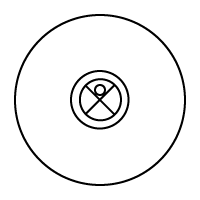
Option Figures:
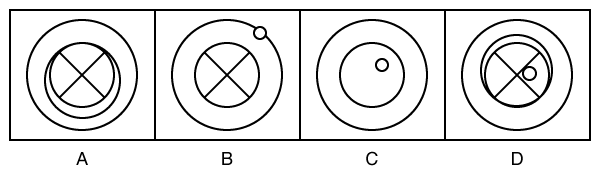
The task is to identify which option figure most closely resembles the given question figure. The question figure consists of a circle with a smaller circle inside, containing an 'X' pattern.
Correct Option: A) This option closely matches the structure and pattern of the question figure.
To solve this problem, we need to follow the order of operations, often remembered by the acronym BODMAS/PEMDAS. This stands for Brackets/Parentheses, Orders/Exponents, Division and Multiplication (from left to right), and Addition and Subtraction (from left to right). The term "of" in mathematics typically implies multiplication, especially when dealing with fractions or percentages, but in this context, it acts as a multiplication operator after evaluating the expression within the curly braces.
First, calculate the value inside the innermost parenthesis:
\[ (-18 \div -2) = 9 \]Next, substitute this value back into the curly braces and perform the division:
\[ \{27 \div 9\} = 3 \]Now, perform the multiplication indicated by "of" inside the square bracket:
\[ (-3) \text{ of } \{3\} = (-3) \times 3 = -9 \]Substitute this back into the square bracket and perform the addition:
\[ [-4 + (-9)] = [-4 - 9] = -13 \]Finally, perform the division outside the bracket:
\[ 91 \div [-13] = -7 \]Thus, the value of the expression is \(-7\).
B) The step-by-step calculation leads to \(-7\).
A car starting from rest moves with uniform acceleration of 1 ms-2 for 2 minutes. Find the speed acquired by the car.
This problem involves calculating the final speed of a car undergoing uniform acceleration. We will use the first equation of motion, which relates initial velocity, final velocity, acceleration, and time.
Since the acceleration is given in ms\(^{-2}\), we must convert the time from minutes to seconds.
\[ t = 2 \text{ minutes} \times 60 \text{ seconds/minute} = 120 \text{ seconds} \]The first equation of motion is given by:
\[ v = u + at \]where \(v\) is the final velocity, \(u\) is the initial velocity, \(a\) is the acceleration, and \(t\) is the time.Correct Option: C) 120 ms\(^{-1}\)