
The following bar graph shows information of the results in the national level entrance exam by the institute “ABC” for the last 5 years.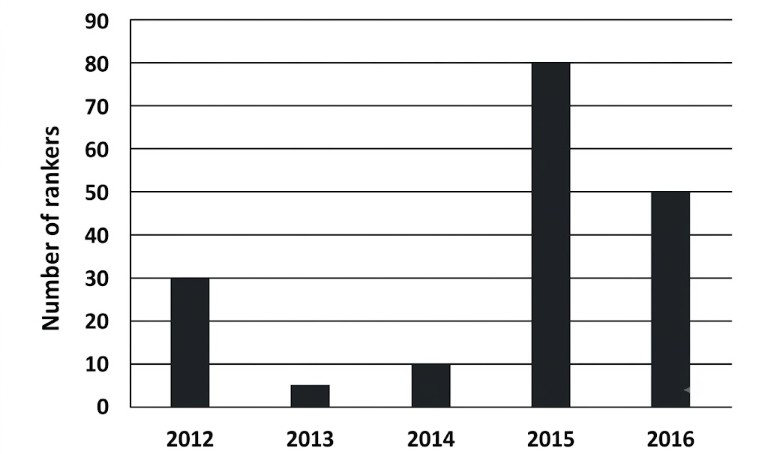
In which year institute ABC scored least number of ranks?
To determine the year in which institute ABC scored the least number of ranks, we need to analyze the bar graph provided. The height of each bar represents the number of rankers for each year.
From the graph:
Thus, the year 2013 has the shortest bar, indicating the least number of rankers.
Correct Option: C) 2013
Find the value of ‘A’ when the polynomial P(x) = x3 + 3x2 – 2Ax + 3, where ‘A’ is a constant, is divided by x2 + 1 has a remainder equal to – 5x:
To find the value of 'A', we will perform polynomial long division of \(P(x) = x^3 + 3x^2 - 2Ax + 3\) by \(x^2 + 1\) and then equate the obtained remainder to the given remainder, which is \(-5x\).
Set up the polynomial long division:
\[\begin{array}{c|cc cc} \multicolumn{2}{r}{x} & + & 3 \ \cline{2-5} x^2+1 & x^3 & +3x^2 & -2Ax & +3 \ \multicolumn{2}{r}{x^3} & & +x \ \cline{2-3} \multicolumn{2}{r}{0} & +3x^2 & -(2A+1)x & +3 \ \multicolumn{2}{r}{} & +3x^2 & & +3 \ \cline{3-5} \multicolumn{2}{r}{} & 0 & -(2A+1)x & +0 \ \end{array}\]From the long division, the remainder is \( -(2A+1)x \).
We are given that the remainder is \(-5x\).
Equate the obtained remainder to the given remainder:
\[ -(2A+1)x = -5x \]Divide both sides by \(x\) (assuming \(x \neq 0\)):
\[ -(2A+1) = -5 \]Multiply both sides by \(-1\):
\[ 2A+1 = 5 \]Subtract 1 from both sides:
\[ 2A = 5 - 1 \]\[ 2A = 4 \]Divide by 2:
\[ A = \frac{4}{2} \]\[ A = 2 \]B) 2 is the correct value for 'A'.
If in a triangle ∠B = 90° and ∠A = 30°, then 2sin2A – cos2A – tan2A =?
\( \frac{1}{6} \)
\( \frac{-1}{2} \)
1
\( \frac{-1}{3} \)
The problem asks us to evaluate the expression \(2\sin2A - \cos2A - \tan2A\) given that in a triangle, \(\angle B = 90^\circ\) and \(\angle A = 30^\circ\). First, we need to find the value of angle A, which is given as \(30^\circ\). Then we will substitute this value into the expression and use standard trigonometric identities and values to simplify it.
We are given \(\angle A = 30^\circ\).
The expression is \(2\sin2A - \cos2A - \tan2A\). Substitute \(A = 30^\circ\):
\[ 2\sin(2 \times 30^\circ) - \cos(2 \times 30^\circ) - \tan(2 \times 30^\circ) \]\[ = 2\sin(60^\circ) - \cos(60^\circ) - \tan(60^\circ) \]B) The simplified value of the expression is \(-\frac{1}{2}\).
The problem asks us to identify the term that does not follow the same pattern as the others, based on its position in the given series. We need to analyze the positional relationship between the elements in each group and compare them.
D) % / 5 is the term that does not belong to the group. In this term, the elements are at positions \(n\), \(n+3\), \(n+7\), which breaks the established pattern of \(n\), \(n+3\), \(n+6\).
We are given the total cost price of two books and the profit/loss percentages for each. The key information is that the selling prices of both books are the same. We will set up equations based on the cost price and selling price relationships for each book and then solve for the individual cost prices.
Let the cost price of the first book be \(C_1\) and the cost price of the second book be \(C_2\).
The total cost price is Rs. 1,200. So, we have the equation:
\[ C_1 + C_2 = 1200 \quad \text{(Equation 1)} \]The first book is sold at a profit of 20%. The selling price (\(S_1\)) for the first book is:
\[ S_1 = C_1 \left(1 + \frac{20}{100}\right) = C_1 \left(\frac{120}{100}\right) = 1.2 C_1 \]The second book is sold at a loss of 16%. The selling price (\(S_2\)) for the second book is:
\[ S_2 = C_2 \left(1 - \frac{16}{100}\right) = C_2 \left(\frac{84}{100}\right) = 0.84 C_2 \]We are given that the selling prices of both books are the same, i.e., \(S_1 = S_2\). Therefore,
\[ 1.2 C_1 = 0.84 C_2 \]We can simplify this equation to find a relationship between \(C_1\) and \(C_2\):
\[ \frac{C_1}{C_2} = \frac{0.84}{1.2} = \frac{84}{120} \]\[ \frac{C_1}{C_2} = \frac{7 \times 12}{10 \times 12} = \frac{7}{10} \]\[ 10 C_1 = 7 C_2 \quad \text{(Equation 2)} \]Now we have a system of two linear equations:
From Equation 2, express \(C_1\) in terms of \(C_2\):
\[ C_1 = \frac{7}{10} C_2 \]Substitute this into Equation 1:
\[ \frac{7}{10} C_2 + C_2 = 1200 \]\[ \frac{7 C_2 + 10 C_2}{10} = 1200 \]\[ \frac{17 C_2}{10} = 1200 \]\[ 17 C_2 = 12000 \]\[ C_2 = \frac{12000}{17} \]Calculate the approximate value of \(C_2\):
\[ C_2 \approx 705.88 \]Now find \(C_1\) using \(C_1 = 1200 - C_2\):
\[ C_1 = 1200 - \frac{12000}{17} = \frac{1200 \times 17 - 12000}{17} = \frac{20400 - 12000}{17} = \frac{8400}{17} \]Calculate the approximate value of \(C_1\):
\[ C_1 \approx 494.12 \]Rounding to the nearest tens or hundreds, \(C_1 \approx 490 - 500\) and \(C_2 \approx 700 - 710\). Comparing with the options, Rs. 500 and Rs. 700 are the closest approximate values.
B) Rs. 500 and Rs. 700. The calculated cost prices are approximately Rs. 494.12 and Rs. 705.88, which are best approximated by Rs. 500 and Rs. 700 respectively.
The question asks for the typical weight of the human brain in grams. This is a factual recall question related to human anatomy. We need to identify the correct range from the given options.
D) 1200 - 1400
The average weight of an adult human brain is typically between 1200 and 1400 grams (1.2 to 1.4 kg). This range is consistent with scientific and medical literature.
To identify the set of atomic numbers belonging to alkali metals, we need to recall the definition of alkali metals and their position in the periodic table. Alkali metals are elements in Group 1 of the periodic table (excluding hydrogen). They all have one valence electron and are highly reactive. The atomic numbers of these elements follow a specific pattern.
C) 37, 19, 3, 55
This option contains the atomic numbers for Rubidium (37), Potassium (19), Lithium (3), and Cesium (55), all of which are alkali metals.
We are looking for the largest number that leaves specific remainders when dividing two given numbers. This means the number we are looking for is a common divisor of the numbers obtained by subtracting the remainders from the original numbers. Therefore, we need to find the Highest Common Factor (HCF) of these modified numbers.
When the required number divides 105, it leaves a remainder of 9.
This means that \(105 - 9 = 96\) must be perfectly divisible by the required number.
When the required number divides 164, it leaves a remainder of 20.
This means that \(164 - 20 = 144\) must be perfectly divisible by the required number.
The required number is the largest number that divides both 96 and 144 exactly. This is the HCF (Highest Common Factor) of 96 and 144.
We can find the HCF using prime factorization or the division method.
Prime factorization of 96:
\[ 96 = 2 \times 48 = 2 \times 2 \times 24 = 2 \times 2 \times 2 \times 12 = 2 \times 2 \times 2 \times 2 \times 6 = 2 \times 2 \times 2 \times 2 \times 2 \times 3 = 2^5 \times 3^1 \]Prime factorization of 144:
\[ 144 = 12^2 = (2^2 \times 3)^2 = 2^4 \times 3^2 \]HCF: To find the HCF, we take the lowest power of the common prime factors.
\[ \text{HCF}(96, 144) = 2^{\min(5,4)} \times 3^{\min(1,2)} = 2^4 \times 3^1 = 16 \times 3 = 48 \]Both conditions are satisfied.
Correct Option: A) 48
The question asks about the field for which the Moorti Devi Award is given. This requires knowledge of prominent Indian literary and cultural awards.
A) Literature — The Moorti Devi Award is a prestigious literary award in India, presented by the Bharatiya Jnanpith, for works that uphold Indian cultural values.
The question asks about the birthplace of the famous Indian revolutionary, Chandra Shekhar Azad. This requires knowledge of Indian history, specifically the biographies of prominent freedom fighters.
Correct Option: D) Madhya Pradesh