
To convert a temperature from Celsius to Fahrenheit, a standard conversion formula is used. This formula relates the two temperature scales based on their respective freezing and boiling points of water.
This problem can be solved using the concept of work and time. We can determine the individual work rates of P and Q and then use these rates to find how long P alone would take to complete the task.
Calculate the combined work rate of P and Q:
If P and Q together can complete the task in 6 days, their combined work rate is \(\frac{1}{6}\) of the task per day.
Calculate the work rate of Q alone:
If Q alone can complete the task in 10 days, Q's individual work rate is \(\frac{1}{10}\) of the task per day.
Calculate the work rate of P alone:
The work rate of P alone can be found by subtracting Q's work rate from the combined work rate of P and Q.
Perform the subtraction:
To subtract the fractions, find a common denominator, which is 30.
Determine the number of days P alone takes:
If P's work rate is \(\frac{1}{15}\) of the task per day, then P alone can complete the task in 15 days.
Correct Option: B) 15 days
The question asks to identify the Bollywood actor who received the Kala Ratan Award in March 2017. This is a factual question related to awards and honors in the Indian film industry.
Correct Option: C) Anupam Kher received the Kala Ratan Award in March 2017 for his significant contributions to Indian cinema and art.
This problem involves a collision where two objects stick together after impact. This is a classic example of a perfectly inelastic collision. In such collisions, the total momentum of the system is conserved. We can use the principle of conservation of momentum to find the unknown mass of the car.
The total momentum before the collision must be equal to the total momentum after the collision.
\[ m_1 u_1 + m_2 u_2 = (m_1 + m_2) v \]Correct Option: B) 500 kg
The question asks to identify the individual who assumed the role of Managing Director of India Infrastructure Finance Company Ltd (IIFCL) in January 2018. This is a factual question related to appointments in public sector undertakings, which is common in competitive exams.
According to official announcements and news reports from January 2018, Pankaj Jain, an IAS officer, was appointed as the Managing Director of India Infrastructure Finance Company Ltd (IIFCL).
B) Pankaj Jain took charge as the Managing Director of India Infrastructure Finance Company Ltd (IIFCL) in January 2018. He is an IAS officer from the 1990 batch of the Assam-Meghalaya cadre.
Identify the figure that will replace the question mark in the given series:
Problem figure: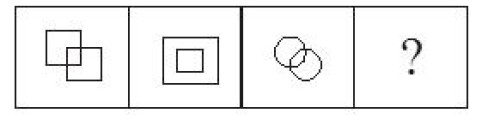
Answer figures: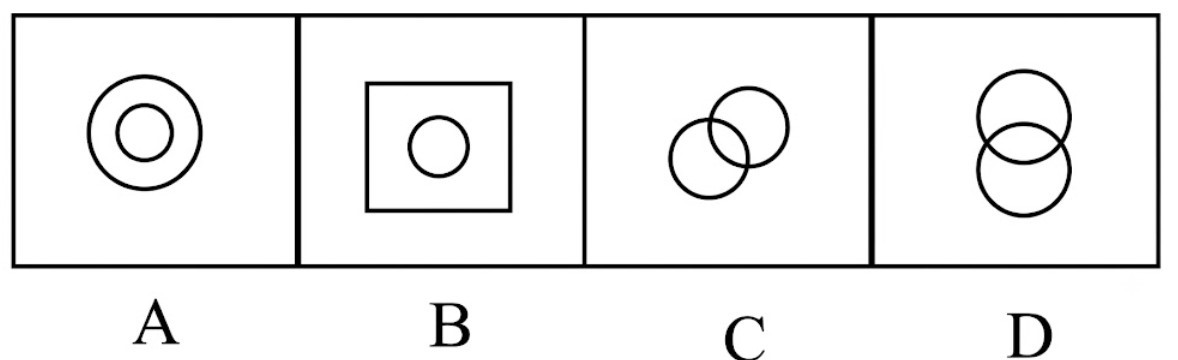
The problem involves identifying a pattern in a series of figures and selecting the correct figure to complete the sequence. The series shows a progression of shapes with specific arrangements.
Correct Option: B) Option B correctly follows the pattern by placing a circle inside a square, similar to the second figure's arrangement.
This question asks to identify which option is NOT a characteristic of dicotyledonous plants. To answer this, we need to recall the defining features of dicots and then check which of the given options contradicts these features.
Correct Option: D) Fibrous roots
The question asks to identify the Chief Minister of Delhi as of August 2018. This requires knowledge of current affairs and political leadership during that specific period.
As of August 2018, Arvind Kejriwal was serving as the Chief Minister of Delhi. He first took office in December 2013, resigned in February 2014, and then took office again in February 2015, continuing through August 2018 and beyond.
Correct Option: D) Arvind Kejriwal
What amount will Jatin get at the end of 3 years if he has invested ₹5,000 and the rate of interest is 4% for the first year, 3% for the second year and 2% for the third year?
This problem involves calculating the final amount after 3 years with varying rates of compound interest for each year. We need to calculate the amount at the end of each year, with the previous year's amount becoming the principal for the next year.
For the second year, \(A_1\) becomes the new principal.
\[ A_2 = A_1 \left(1 + \frac{R_2}{100}\right) \] \[ A_2 = 5200 \left(1 + \frac{3}{100}\right) \] \[ A_2 = 5200 \left(1 + 0.03\right) \] \[ A_2 = 5200 \times 1.03 \] \[ A_2 = \text{₹}5356 \]For the third year, \(A_2\) becomes the new principal.
\[ A_3 = A_2 \left(1 + \frac{R_3}{100}\right) \] \[ A_3 = 5356 \left(1 + \frac{2}{100}\right) \] \[ A_3 = 5356 \left(1 + 0.02\right) \] \[ A_3 = 5356 \times 1.02 \] \[ A_3 = \text{₹}5463.12 \]Correct Option: C) 5,463.12
An electric washing machine of 750 W is used for 4 hours per day. The energy consumed by the machine in one day will be ___
To calculate the energy consumed by an electrical appliance, we use the formula: Energy = Power × Time. The energy consumed is typically measured in "units," where 1 unit is equal to 1 kilowatt-hour (kWh).
Since 1 kW = 1000 W, we divide the power in Watts by 1000 to get Kilowatts.
\[ P_{\text{kW}} = \frac{750 \text{ W}}{1000} = 0.75 \text{ kW} \]Use the formula Energy = Power × Time.
\[ \text{Energy} = P_{\text{kW}} \times T \]\[ \text{Energy} = 0.75 \text{ kW} \times 4 \text{ hours} \]\[ \text{Energy} = 3 \text{ kWh} \]As 1 unit = 1 kWh, the energy consumed is 3 units.
Correct Option: B) 3 units