
Find the odd one out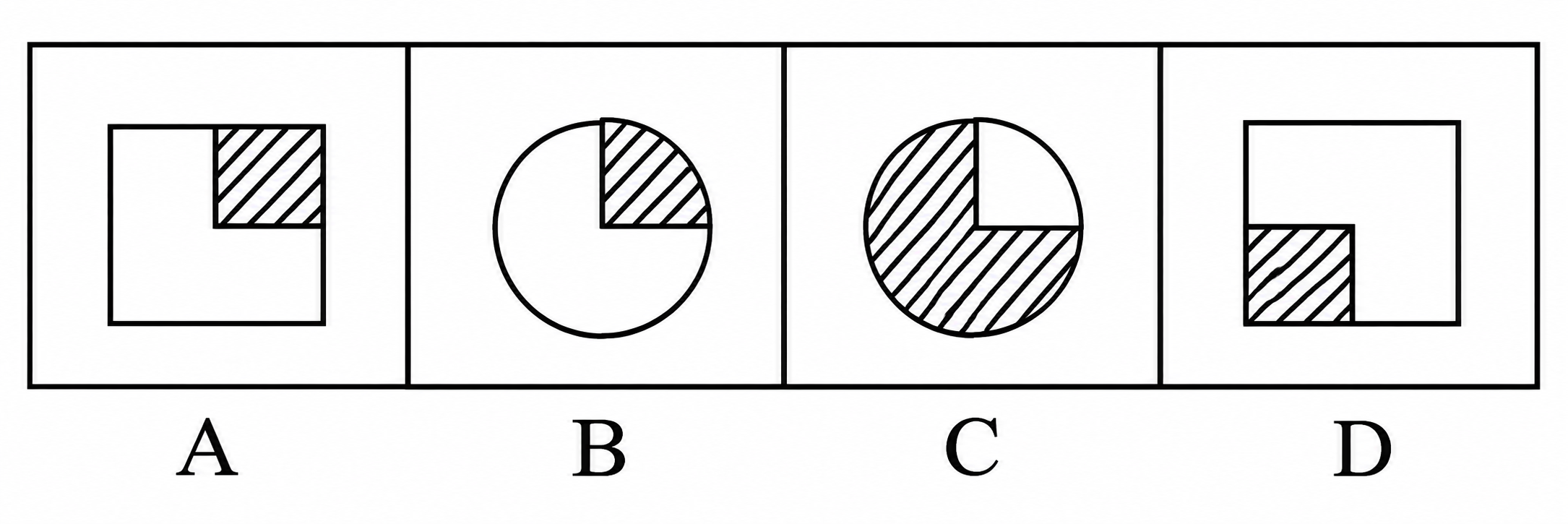
To find the odd one out, we need to identify the pattern or common characteristic among the options and determine which option deviates from this pattern.
Correct Option: B) Option B is the odd one out because it is the only option with a circular shape, whereas the others are squares.
The problem presents a numerical analogy where we need to find the relationship between the first pair of numbers and apply the same relationship to the third number to find the missing fourth number. We will analyze the given pair (35 : 7) to deduce the rule and then apply it to 125.
Correct Option: B) 25. The relationship is that the second number is obtained by dividing the first number by 5. Applying this rule to 125, we get \(125 \div 5 = 25\).
This problem involves the concept of work and time, specifically related to pipes filling a cistern. We can solve it by calculating the rate at which each pipe fills the cistern. The rate is typically expressed as the fraction of the cistern filled per unit of time (e.g., per hour).
Determine the filling rate of Pipe A:
Pipe A can fill the cistern in 14 hours. This means that in 1 hour, Pipe A fills \(\frac{1}{14}\) of the cistern.
Determine the combined filling rate of Pipe A and Pipe B:
Together, Pipe A and Pipe B can fill the cistern in 12 hours. This means that in 1 hour, they together fill \(\frac{1}{12}\) of the cistern.
Calculate the filling rate of Pipe B alone:
Let the filling rate of Pipe B be \(\frac{1}{x}\) of the cistern per hour, where \(x\) is the time Pipe B takes to fill the cistern alone. The combined rate is the sum of individual rates:
Solve for \(x\):
Subtract the rate of Pipe A from the combined rate to find the rate of Pipe B:
Determine the time taken by Pipe B:
From \[\frac{1}{x} = \frac{1}{84}\], we get \(x = 84\) hours.
Correct Option: D) 84
A tank can be filled by a pipe P in 32 minutes and by pipe Q in 36 minutes. When it is full, it can be emptied by a pipe R in 20 minutes. If all the three pipes are opened simultaneously, half of the tank will be filled in ____.
55\( \frac{3}{5} \) minutes
55\( \frac{3}{13} \) minutes
55\( \frac{5}{13} \) minutes
55\( \frac{2}{5} \) minutes
This problem involves calculating the combined work rate of multiple pipes (two filling pipes and one emptying pipe) and then determining the time required to fill a specific fraction of the tank. We will calculate the individual rates, combine them to find the net filling rate, and then use this rate to find the time to fill half the tank.
Calculate the filling rate of pipe P:
Pipe P can fill the tank in 32 minutes. So, in one minute, it fills:
\[ \text{Rate of P} = \frac{1}{32} \text{ of the tank} \]Calculate the filling rate of pipe Q:
Pipe Q can fill the tank in 36 minutes. So, in one minute, it fills:
\[ \text{Rate of Q} = \frac{1}{36} \text{ of the tank} \]Calculate the emptying rate of pipe R:
Pipe R can empty the tank in 20 minutes. So, in one minute, it empties:
\[ \text{Rate of R} = \frac{1}{20} \text{ of the tank} \]Calculate the net filling rate when all three pipes are open:
When all three pipes are open, pipes P and Q fill the tank, and pipe R empties it. The net rate will be the sum of filling rates minus the emptying rate:
\[ \text{Net Rate} = \text{Rate of P} + \text{Rate of Q} - \text{Rate of R} \] \[ \text{Net Rate} = \frac{1}{32} + \frac{1}{36} - \frac{1}{20} \]To add/subtract these fractions, find the Least Common Multiple (LCM) of 32, 36, and 20.
Calculate the time to fill half of the tank:
The net rate is \(\frac{13}{1440}\) of the tank per minute. We need to fill half of the tank, which is \(\frac{1}{2}\) of the tank.
Time taken \[= \frac{\text{Volume to be filled}}{\text{Net Rate}}\]
\[ \text{Time} = \frac{1/2}{13/1440} \] \[ \text{Time} = \frac{1}{2} \times \frac{1440}{13} \] \[ \text{Time} = \frac{720}{13} \text{ minutes} \]Convert the improper fraction to a mixed number:
Divide 720 by 13:
\[ 720 \div 13 = 55 \text{ with a remainder of } 5 \]So, the time is \(55\frac{5}{13}\) minutes.
Correct Option: C) 55\( \frac{5}{13} \) minutes
This question asks us to identify implicit assumptions in a given statement. An assumption is something taken for granted or accepted as true without proof. When someone asks a question or makes a request, certain conditions must be true for that question or request to be logical and meaningful.
Correct Option: B) Both I and II are implicit
This question tests knowledge about the chemical reactivity of alkali metals, specifically sodium, and appropriate storage methods to prevent hazardous reactions.
Correct Option: A) kerosene
The question asks to identify the endocrine gland commonly known as the 'master gland'. This requires knowledge of the functions and common names of major endocrine glands in the human body.
A) pituitary: The pituitary gland is a small gland located at the base of the brain. It produces and releases several hormones that control the activity of other endocrine glands, including the thyroid gland, adrenal glands, ovaries, and testes. This crucial role in regulating the entire endocrine system earns it the nickname 'master gland'.
The problem presents a coding pattern where each letter in a word is transformed into a combination of a letter and a number. We need to decipher this pattern and then apply it to the word "HENCE".
The word is COCK, and its code is D4P6D4L2.
Observe the letter part of the code:
The rule for the letter part is: Each letter is replaced by the next letter in the English alphabet.
Observe the number part of the code:
The rule for the number part is: The numerical position of the letter in the alphabet is taken, and if it's a two-digit number, its digits are summed up. Then, 1 is added to this result. If it's a single-digit number, 1 is added directly.
Let's re-verify the number rule carefully:
This rule seems consistent.
HENCE becomes I9F6O5D4F6.
Correct Option: B) I9F6O5D4F6
The question asks for the correct hierarchical order of animal classification. This is a fundamental concept in biology, specifically taxonomy, which deals with the classification, description, identification, and naming of living organisms. The classification system follows a specific hierarchy, moving from broader categories to more specific ones.
Correct Option: D) Phylum, Class, Order, Family, Genus, Species
The problem asks us to decode a word based on a given coding pattern. We need to analyze the transformation from "BIRBAL" to "RIBLAB" to identify the rule and then apply the same rule to "DIESEL".
This pattern can be visualized by grouping letters in pairs and swapping them, except for the middle letters if the word length is odd, or by a specific permutation.
Let's number the letters of BIRBAL (1 2 3 4 5 6):
B(1) I(2) R(3) B(4) A(5) L(6)
And the coded word RIBLAB:
R(3) I(2) B(4) L(6) A(5) B(1)
The permutation is: \(1 \rightarrow 6\), \(2 \rightarrow 2\), \(3 \rightarrow 1\), \(4 \rightarrow 3\), \(5 \rightarrow 5\), \(6 \rightarrow 4\).
Alternatively, consider it as swapping pairs of letters from the ends towards the center, while keeping the middle letters in place if they are not part of a swap.
Let's re-examine the pattern by splitting the word into two halves: BIR and BAL.
BIRBAL
B I R | B A L
The coded word is RIBLAB.
Notice that the first three letters 'BIR' become 'RIB' (R and B are swapped, I stays).
The next three letters 'BAL' become 'LAB' (L and B are swapped, A stays).
So, the pattern is: swap the 1st and 3rd letters, keep the 2nd letter. Apply this to both halves of the word.
B) EIDLES is the correct code for DIESEL based on the identified pattern.