
How many squares are present in the following figure?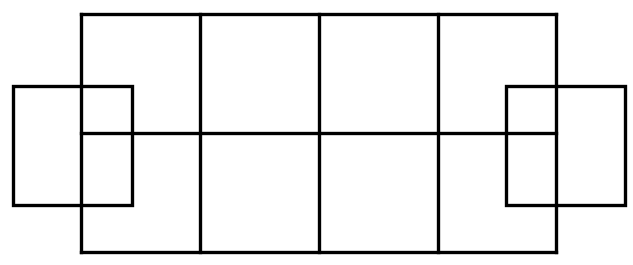
To find the total number of squares in the given figure, we need to count all possible squares of different sizes.
However, upon closer inspection, there is one additional square formed by the entire grid, making the total 17 squares.
Correct Option: D) 17
The problem provides the power of a lens and asks for its type and focal length. We need to recall the relationship between power and focal length, and how the sign of power (or focal length) determines the type of lens.
Correct Option: B) Concave, –0.40 m
The question asks to identify which of the given fairs (melas) has been recognized by UNESCO as Intangible Cultural Heritage. This requires knowledge of UNESCO's listings related to Indian cultural practices.
A) Kumbh Mela
The Kumbh Mela was inscribed on UNESCO's Representative List of the Intangible Cultural Heritage of Humanity in December 2017. It is a major pilgrimage and festival in Hinduism, celebrated periodically at four different locations in India (Haridwar, Prayagraj, Nashik, and Ujjain). The inscription recognizes its significance as a peaceful congregation of pilgrims, its rich traditions, rituals, and its role in preserving spiritual knowledge and social harmony.
To determine the block an element belongs to, we need to identify its atomic number and then write its electronic configuration. The block is determined by the subshell in which the last electron enters.
Correct Option: C) f
Cerium (Ce) with atomic number 58 is the first element in the Lanthanide series. Lanthanides are characterized by the filling of the 4f subshell and are therefore classified as f-block elements.
An object of mass 20 kg is moving with a uniform velocity of 5 m s-1. What is the kinetic energy possessed by it?
To find the kinetic energy of an object, we use the formula for kinetic energy, which depends on the object's mass and velocity. We will substitute the given values into this formula and calculate the result.
The kinetic energy (\(KE\)) of an object is given by the formula:
\[ KE = \frac{1}{2} m v^2 \]Substitute \(m = 20 \text{ kg}\) and \(v = 5 \text{ m s}^{-1}\) into the kinetic energy formula:
\[ KE = \frac{1}{2} \times (20 \text{ kg}) \times (5 \text{ m s}^{-1})^2 \]The kinetic energy possessed by the object is 250 Joules.
D) 250 J is the correct answer, as calculated using the kinetic energy formula.
The question asks to identify the scientist who predicted the existence of undiscovered elements based on gaps in their periodic table. This requires knowledge of the contributions of various scientists to the development of the periodic table.
Correct Option: A) Mendeleev is credited with predicting the existence of several elements and their properties based on the gaps in his periodic table. His predictions were later confirmed with the discovery of these elements, which solidified the acceptance of his periodic law.
To determine which elements have filled outermost shells, we need to recall the concept of electron configuration and the octet rule (or duet rule for the first shell). Elements with filled outermost shells are chemically stable and are known as noble gases. We will examine the electron configuration of each element mentioned in the options.
Correct Option: D) Helium (He), Neon (Ne), Argon (Ar) are all noble gases, meaning they have completely filled outermost electron shells (He has 2 electrons, Ne and Ar have 8 electrons in their respective outermost shells).
To solve this problem, we need to track the changes in the amount of money Seema has. We will start with the initial amount, add any money she receives, and subtract any money she spends or loses. This is a straightforward arithmetic problem involving addition and subtraction.
Therefore, ₹ 23 was left with Seema.
C) 23 is the correct answer, as calculated by tracking all transactions.
Find the odd one out: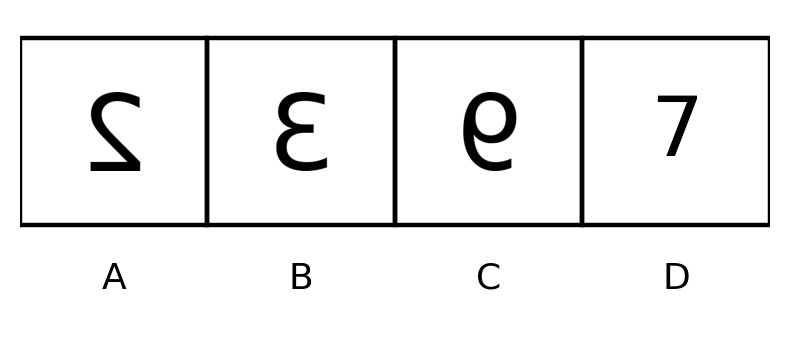
The task is to identify the odd one out among the given symbols. Each symbol is either a letter or a number, and we need to determine the pattern or property that makes one of them different from the others.
The key observation is that Options A, B, and C are mirror images of their respective characters, whereas Option D is not a mirror image but a regular numeral.
Correct Option: D) The number 7 is not a mirror image, unlike the others.
The question asks for the year Qutb-ud-din Aibak became the first Sultan of Delhi. This requires knowledge of the early history of the Delhi Sultanate and the Mamluk dynasty.
Correct Option: A) 1206 AD is the correct year when Qutb-ud-din Aibak became the first Sultan of Delhi, marking the beginning of the Delhi Sultanate.