
If the side of an equilateral triangle is equal to the edge of a square, then the ratio of the height of the triangle to the edge of the square is:
\(\sqrt{3}:2\)
\(\sqrt{2}:\sqrt[4]{3}\)
\(\sqrt{3}:\sqrt[4]{2}\)
\(\sqrt[4]{3}:2\)
To find the ratio of the height of an equilateral triangle to the edge of a square, we first need to express the height of the equilateral triangle in terms of its side. Then, we will use the given condition that the side of the equilateral triangle is equal to the edge of the square to establish the desired ratio.
Define the side length: Let the side of the equilateral triangle be \(a\). Since all sides of an equilateral triangle are equal, each side is \(a\).
Calculate the height of the equilateral triangle: In an equilateral triangle, the altitude (height) bisects the base and forms two 30-60-90 right-angled triangles. Let \(h\) be the height of the equilateral triangle. Using the Pythagorean theorem, or the standard formula for the height of an equilateral triangle:
\[ h = \frac{\sqrt{3}}{2} a \]Define the edge of the square: Let the edge of the square be \(s\).
Apply the given condition: The problem states that the side of the equilateral triangle is equal to the edge of the square. Therefore,
\[ a = s \]Substitute and find the ratio: Substitute \(a = s\) into the formula for the height of the triangle:
\[ h = \frac{\sqrt{3}}{2} s \]We need to find the ratio of the height of the triangle to the edge of the square, which is \(h:s\).
\[ \frac{h}{s} = \frac{\frac{\sqrt{3}}{2} s}{s} = \frac{\sqrt{3}}{2} \]So, the ratio is \(\sqrt{3}:2\).
A) \(\sqrt{3}:2\) is the correct ratio derived from the calculations.
If PINE is written as SLQH, then how will you write ATE?
The problem is a coding-decoding question. We need to identify the pattern or rule by which "PINE" is transformed into "SLQH" and then apply the same rule to transform "ATE".
Let's write down the letters and their corresponding positions in the English alphabet:
Observe the difference in alphabetical positions for each letter:
The pattern is that each letter is shifted forward by 3 positions in the alphabet.
Now, we apply the same "+3" rule to each letter of "ATE":
Combining the transformed letters, ATE becomes DWH.
A) DWH is the correct transformation based on the identified pattern.
The following pie diagram shows the information about Non-Performing Assets (NPA) processed by the various banks of India until December 2017. If the total NPA under all the banks is 3 lakh crore, which bank contains more NPA compared to the other banks?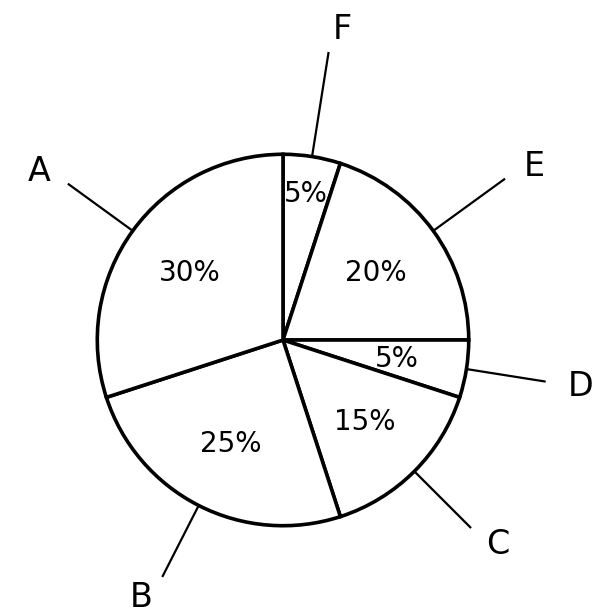
The pie chart illustrates the percentage of Non-Performing Assets (NPA) managed by different banks. To determine which bank has the highest NPA, we need to identify the bank with the largest percentage.
Correct Option: C) Bank A
The question asks us to find a word that shares the same relationship with "Talk" as "Cold" shares with "Hot". This is an analogy question, and we need to identify the type of relationship between the first pair of words and then apply the same relationship to the third word to find the fourth.
Correct Option: B) Silence — "Hot" is the antonym of "Cold". Similarly, "Talk" is the antonym of "Silence".
The question asks to identify the committee formed by the Union government to study the existing framework for virtual currencies. This is a factual question related to government committees and their mandates.
B) Dinesh Sharma Committee — The committee constituted by the Union government to examine the existing framework with regard to virtual currencies was headed by Subhash Chandra Garg, then Secretary, Department of Economic Affairs. However, it is also widely known and referred to in the context of Dinesh Sharma, who was a key member. The committee's report, submitted in 2019, recommended a ban on private cryptocurrencies and proposed a framework for an official digital currency.
To calculate the distance covered by the train, we need to use the fundamental formula relating speed, distance, and time. First, ensure that all units are consistent. The speed is given in km/hr, and the time is given in minutes. We will convert the time into hours to match the speed unit, and then apply the formula: \(\text{Distance} = \text{Speed} \times \text{Time}\).
Since the speed is in kilometers per hour, we need to convert the time from minutes to hours. There are 60 minutes in 1 hour.
\[ \text{Time in hours} = \frac{15 \text{ minutes}}{60 \text{ minutes/hour}} = \frac{15}{60} \text{ hours} = \frac{1}{4} \text{ hours} = 0.25 \text{ hours} \]The formula for distance is:
\[ \text{Distance} = \text{Speed} \times \text{Time} \]Substitute the given speed and the converted time into the formula:
\[ \text{Distance} = 144 \text{ km/hr} \times 0.25 \text{ hours} \] \[ \text{Distance} = 144 \times \frac{1}{4} \text{ km} \] \[ \text{Distance} = 36 \text{ km} \]Correct Option: D) 36 km
This question asks us to evaluate the strength of two arguments regarding whether Indian citizens should pay taxes to the government. A strong argument is one that is logical, universally accepted, and directly relevant to the core issue, without being based on personal opinions or impractical ideals.
C) Only argument I is strong. Argument I highlights the essential role of taxes in funding government operations and public services, which is a universally accepted and practical necessity for any functioning country. It is a strong, logical, and valid reason.
The question asks for the definition of sublimation. We need to recall the different phase transitions of matter and identify the one that corresponds to sublimation.
Correct Option: C) It is the process of conversion of a solid into vapour.
Pipes A and C can fill an empty cistern in 7 and 10.5 hours, respectively, while Pipe B can drain the filled cistern in 5.25 hours. If the three pipes are turned on together when the cistern is empty, how many hours will it take for the cistern to be \( \frac{2}{3} \) full?
This problem involves calculating the combined work rate of pipes filling and draining a cistern. We will determine the individual rates of each pipe, then find their net combined rate. Finally, we will use this net rate to calculate the time required to fill a specific fraction of the cistern.
The calculations show that it will take 14 hours for the cistern to be \( \frac{2}{3} \) full.
Find the odd one out: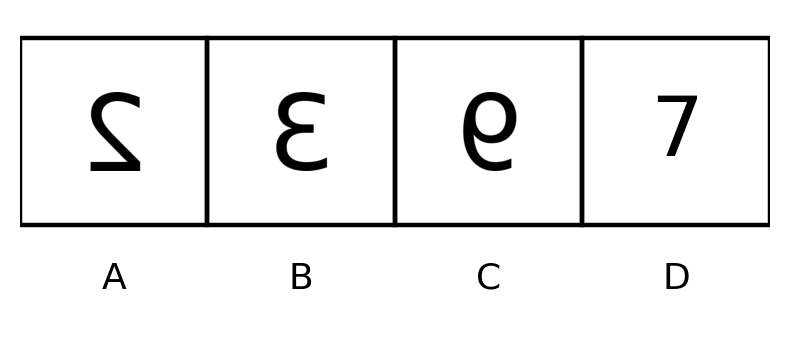
The task is to identify the element that does not belong with the others based on a specific pattern or characteristic.
Therefore, option C is the odd one out as it does not follow the mirror image pattern.
Correct Option: C) 6