
The question asks to identify the name of an online campaign launched by the Union Ministry of Women and Child Development aimed at ending gender bias against women. This requires knowledge of specific government initiatives.
Correct Option: A) I am That Woman
The Union Ministry of Women and Child Development launched the online campaign "I am That Woman" in 2017. The campaign aimed to celebrate women who have positively impacted the lives of other women, thereby challenging gender stereotypes and promoting gender equality.
\( \frac{2}{3} \) part of the goods was sold at a profit of 6% and the remaining part at a loss of 3%. If the total profit is Rs 540, then what was the total cost of the article?
We need to find the total cost of the article. We are given that a fraction of the goods was sold at a profit and the remaining at a loss. The total profit is also given. We can set up an equation for the total profit based on the cost price and the given percentages to solve for the total cost.
Let the total cost of the article be \(C\).
The first part of the goods sold is \( \frac{2}{3} \) of the total. Its cost price is \( \frac{2}{3} C \).
This part was sold at a profit of 6%. The profit from this part is:
\[ \text{Profit}_1 = \frac{2}{3} C \times \frac{6}{100} = \frac{12}{300} C = \frac{1}{25} C \]The remaining part of the goods is \[1 - \frac{2}{3} = \frac{1}{3}\] of the total. Its cost price is \( \frac{1}{3} C \).
This part was sold at a loss of 3%. The loss from this part is:
\[ \text{Loss}_2 = \frac{1}{3} C \times \frac{3}{100} = \frac{3}{300} C = \frac{1}{100} C \]The total profit is the profit from the first part minus the loss from the second part (since loss is a negative profit):
\[ \text{Total Profit} = \text{Profit}_1 - \text{Loss}_2 \]We are given that the total profit is Rs 540. So, we can set up the equation:
\[ 540 = \frac{1}{25} C - \frac{1}{100} C \]To solve for \(C\), find a common denominator for the fractions:
\[ 540 = \frac{4}{100} C - \frac{1}{100} C \]\[ 540 = \frac{3}{100} C \]Now, isolate \(C\):
\[ C = 540 \times \frac{100}{3} \]\[ C = 180 \times 100 \]\[ C = 18000 \]Therefore, the total cost of the article was Rs 18,000.
B) Rs 18,000
The question asks for the year in which the "Swachh Bharat Abhiyan" initiative was launched by the Government of India. This requires knowledge of key government initiatives and their launch dates.
Correct Option: A) 2014
The Swachh Bharat Abhiyan was indeed launched in 2014, making this the correct answer.
To find the compound interest, we can calculate the amount accumulated after 2 years using the compound interest formula, and then subtract the principal amount from it. Alternatively, we can calculate the interest for each year separately and add them up.
The formula for the amount (\(A\)) after \(n\) years compounded annually is:
\[ A = P \left(1 + \frac{R}{100}\right)^n \]Substitute the given values:
\[ A = 2000 \left(1 + \frac{3}{100}\right)^2 \] \[ A = 2000 \left(1 + 0.03\right)^2 \] \[ A = 2000 \left(1.03\right)^2 \] \[ A = 2000 \times 1.0609 \] \[ A = 2121.80 \]Now, calculate the Compound Interest (CI):
\[ \text{CI} = A - P \] \[ \text{CI} = 2121.80 - 2000 \] \[ \text{CI} = 121.80 \]For the 1st year:
\[ \text{Interest for 1st year} = \frac{P \times R \times T}{100} \] \[ \text{Interest for 1st year} = \frac{2000 \times 3 \times 1}{100} = 60 \]Amount at the end of 1st year = \(P + \text{Interest for 1st year} = 2000 + 60 = 2060\)
For the 2nd year:
The principal for the 2nd year will be the amount at the end of the 1st year.
\[ \text{Interest for 2nd year} = \frac{2060 \times 3 \times 1}{100} \] \[ \text{Interest for 2nd year} = \frac{6180}{100} = 61.80 \]Total Compound Interest = Interest for 1st year + Interest for 2nd year
\[ \text{Total CI} = 60 + 61.80 = 121.80 \]Correct Option: D) Rs 121.80
This problem involves calculating the combined work rate of multiple taps, some filling and some emptying a tank. We will determine the individual filling/emptying rates per hour and then combine them to find the net rate. Finally, we will use the net rate to find the total time required to fill the tank.
Tap A can fill the tank in 5 hours. So, in 1 hour, Tap A fills \(\frac{1}{5}\) of the tank.
\[ \text{Rate of A} = \frac{1}{5} \text{ tank/hour} \]Tap B can fill the tank in 15 hours. So, in 1 hour, Tap B fills \(\frac{1}{15}\) of the tank.
\[ \text{Rate of B} = \frac{1}{15} \text{ tank/hour} \]Tap C can empty the tank in 5 hours. So, in 1 hour, Tap C empties \(\frac{1}{5}\) of the tank. Since it's emptying, its contribution is negative.
\[ \text{Rate of C} = -\frac{1}{5} \text{ tank/hour} \]The net rate will be the sum of the filling rates minus the emptying rate.
\[ \text{Combined Rate} = \text{Rate of A} + \text{Rate of B} + \text{Rate of C} \]\[ \text{Combined Rate} = \frac{1}{5} + \frac{1}{15} - \frac{1}{5} \]\[ \text{Combined Rate} = \frac{1}{15} \text{ tank/hour} \]If the combined rate is \(\frac{1}{15}\) of the tank per hour, it means that in 1 hour, \(\frac{1}{15}\) of the tank is filled. Therefore, to fill the entire tank (1 unit), it will take the reciprocal of this rate.
\[ \text{Time} = \frac{1}{\text{Combined Rate}} \]\[ \text{Time} = \frac{1}{\frac{1}{15}} \]\[ \text{Time} = 15 \text{ hours} \]B) 15 hours — When all three taps are opened, the net filling rate is \(1/15\) of the tank per hour, meaning it will take 15 hours to fill the tank completely.
The question asks to identify the dynasty that ruled the region around Madurai and achieved supremacy in the thirteenth century. This requires knowledge of the major South Indian dynasties and their periods of dominance.
Correct Option: D) The Pandyas were one of the three ancient crowns of Tamilakam (along with the Cholas and Cheras). Madurai was their capital. They experienced a resurgence in the 13th century, becoming the dominant power in South India. Their rule extended over a vast region, and they were known for their maritime trade and cultural patronage.

Choose the correct option given below from the alternatives that fit the (?) in the blank space: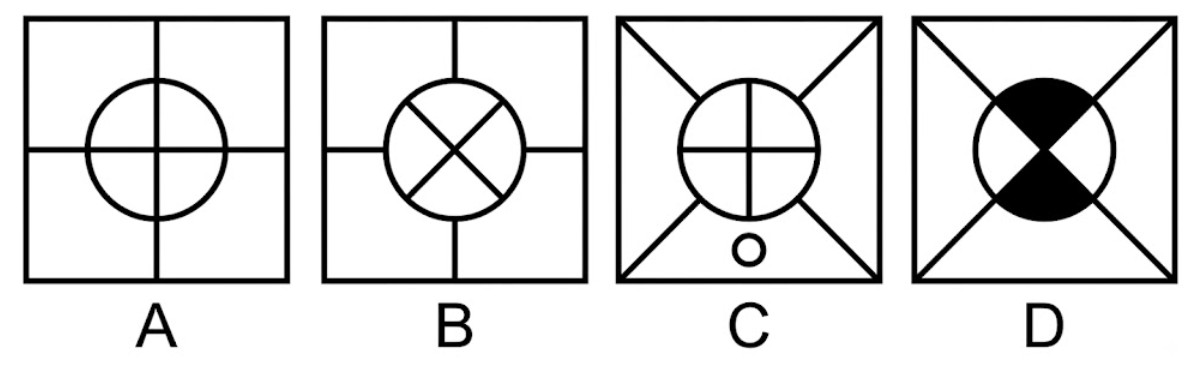
The problem involves identifying a pattern in a sequence of diagrams and selecting the option that logically completes the sequence.
Correct Option: C) The option with a circle and intersecting lines, matching the pattern of combining shapes.
To solve this problem, we first need to calculate the initial number of clerks and other employees. Then, we will calculate the new number of clerks after the reduction and the new total number of employees. Finally, we will express the new number of clerks as a percentage of the new total number of employees.
Calculate the initial number of clerks:
Total employees = \(6400\)
Fraction of clerks = \(\frac{1}{4}\)
Initial number of clerks = \(\frac{1}{4} \times 6400 = 1600\)
Calculate the initial number of other employees:
Initial number of other employees = Total employees - Initial number of clerks
Initial number of other employees = \(6400 - 1600 = 4800\)
Calculate the reduction in clerk employees:
Clerk employees to be reduced by one-fourth.
Reduction in clerks = \(\frac{1}{4} \times 1600 = 400\)
Calculate the new number of clerks:
New number of clerks = Initial number of clerks - Reduction in clerks
New number of clerks = \(1600 - 400 = 1200\)
Calculate the new total number of employees:
The reduction only applies to clerks, so the number of other employees remains the same.
New total number of employees = New number of clerks + Number of other employees
New total number of employees = \(1200 + 4800 = 6000\)
Calculate the percentage of clerks in the remaining total employees:
\[\text{Percentage of clerks} = \frac{\text{New number of clerks}}{\text{New total number of employees}} \times 100\] \[\text{Percentage of clerks} = \frac{1200}{6000} \times 100\] \[\text{Percentage of clerks} = \frac{1}{5} \times 100\] \[\text{Percentage of clerks} = 20\%\]Correct Option: C) 20
The pie graph shows the expenditure of a publishing body in Karnataka. If the total expenditure is Rs. 50,000, then the expenditure on transportation is: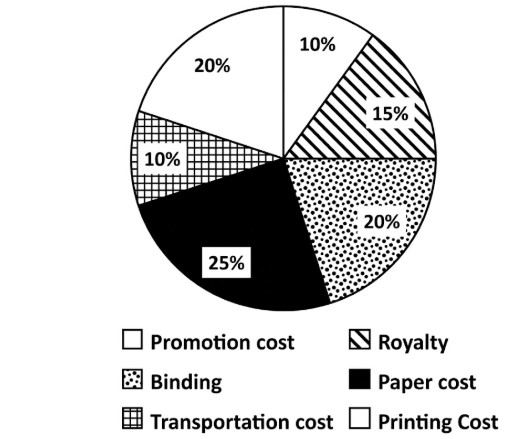
The pie chart represents the expenditure distribution of a publishing body. Each segment of the pie chart corresponds to a specific type of expenditure, with percentages indicating the proportion of the total expenditure. We need to calculate the expenditure on transportation.
The formula to calculate the expenditure on transportation is:
Transportation Expenditure = (Percentage for Transportation / 100) × Total Expenditure
Substitute the values:
\[ \text{Transportation Expenditure} = \left( \frac{10}{100} \right) \times 50,000 = 5,000 \text{ Rs} \]Therefore, the expenditure on transportation is Rs. 5,000.
Correct Option: A) Rs 5,000
Select the odd one out: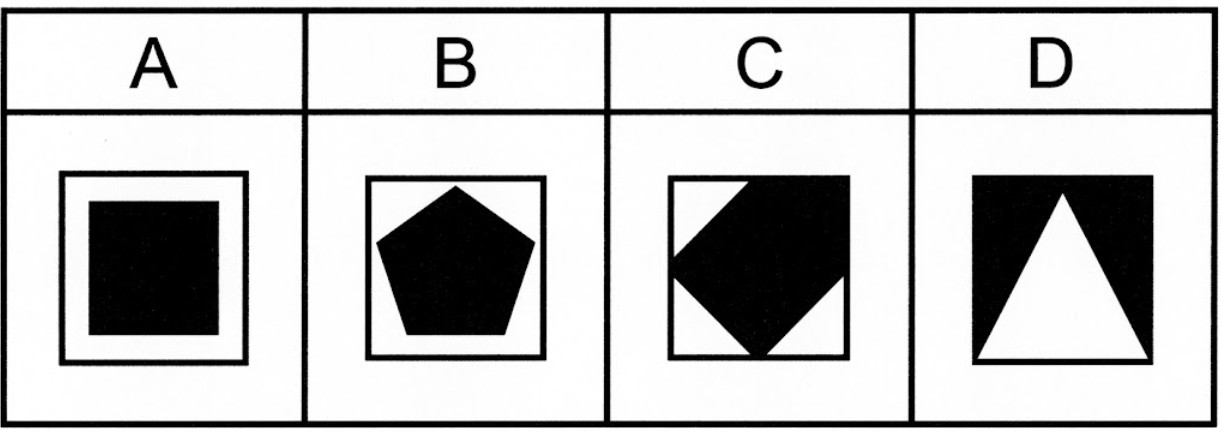
To determine the odd one out, we need to analyze the shapes within each option and identify the one that does not fit the pattern followed by the others.
Correct Option: D) The triangle in option D is not filled, unlike the other shapes.