
The following pie chart shows the total sales made by different mobile companies in the year 2017.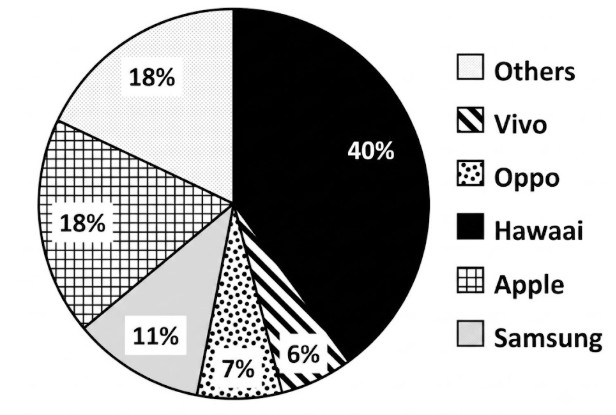
What is the share of the segment corresponding to the sales of 'Others'?
To find the share of the segment corresponding to the sales of 'Others', we need to calculate the angle of the pie chart section that represents 40% of the total sales.
\[ \text{Angle} = \frac{\text{Percentage}}{100} \times 360 \]
\[ \text{Angle} = \frac{40}{100} \times 360 = 144\degree \]
Thus, the angle corresponding to the 'Others' segment is 144 degrees.
Correct Option: D) 144°
The question asks to identify the state for which Oscar-winning composer A.R. Rahman serves as the official brand ambassador. This is a factual question related to current affairs and general knowledge about brand endorsements by prominent personalities.
Correct Option: C) Sikkim is the correct answer. A.R. Rahman was appointed as the brand ambassador of Sikkim in 2018 to promote the state's tourism and culture.
What do the following have in common?
A. A fast-moving pebble can injure a person or break the glass of the window.
B. Energy of a moving vehicle.
C. Fast-moving wind can damage many homes
D. Wind can move the blades of a windmill.
Kinetic energy
Very high speed
Gravitational pull
Frictional force
The question describes several scenarios involving moving objects or phenomena and asks what they have in common. We need to identify the fundamental physical concept that explains the ability of these moving entities to cause effects or perform work.
A) Kinetic energy
Kinetic energy is the energy an object possesses due to its motion. All the given examples (a fast-moving pebble, a moving vehicle, fast-moving wind) demonstrate the effects or presence of kinetic energy. This energy allows them to do work, such as breaking glass, causing damage, or rotating windmill blades.
The question asks to identify the permanent tissue responsible for providing elasticity to plants. We need to recall the characteristics and functions of the different types of permanent plant tissues listed in the options.
D) Collenchyma — Collenchyma is a simple permanent tissue composed of living cells with unevenly thickened primary cell walls, particularly at the corners. This thickening provides flexible support and elasticity to plant organs like young stems, petioles, and leaf veins, allowing them to bend without snapping.
The problem asks us to find a number that, when added to 2.06, results in 3.1. This can be set up as a simple algebraic equation where the unknown number is represented by a variable. We then solve for this variable.
C) 1.04 is the correct answer because when 1.04 is added to 2.06, the sum is 3.1.
Nalini, Tanvi and Rashi share a cake. Nalini ate \( \frac{1}{12} \)th of it, Tanvi ate \( \frac{1}{3} \)th of it and Rashi ate the rest of the cake. What was Rashi's share of the cake?
\( \frac{13}{5} \)th
\( \frac{5}{6} \)th
\( \frac{3}{4} \) th
\( \frac{7}{12} \)th
To find Rashi's share of the cake, we first need to determine the total portion of the cake eaten by Nalini and Tanvi. Once we have this sum, we subtract it from the total cake (represented as 1) to find the remaining portion, which is Rashi's share.
Correct Option: D) \( \frac{7}{12} \)th
The question asks which type of energy increases with speed. We need to recall the definitions and formulas for different forms of energy and identify which one is directly dependent on an object's speed or velocity.
C) Kinetic energy — As explained, kinetic energy is directly proportional to the square of the speed of an object. Therefore, as speed increases, kinetic energy increases.
First, we need to determine the focal length of the concave mirror using the information about the Sun's rays. Since the Sun is at an infinite distance, its rays are parallel and converge at the principal focus of the mirror. Once the focal length is known, we can use the mirror formula to find the image distance for the candle placed at a given object distance.
When parallel rays from the Sun (object at infinity) fall on a concave mirror, they converge at its principal focus. The problem states that the rays converge at a point 5 cm away on the principal axis. Therefore, the focal length of the concave mirror is 5 cm.
For a concave mirror, the focal length is taken as negative by convention.
\[ f = -5 \text{ cm} \]A 3 cm long candle is placed on the principal axis at a distance of 10 cm from the mirror. For a real object placed in front of a mirror, the object distance is taken as negative.
\[ u = -10 \text{ cm} \]The mirror formula is given by:
\[ \frac{1}{f} = \frac{1}{v} + \frac{1}{u} \]Substitute the values of \(f\) and \(u\):
\[ \frac{1}{-5} = \frac{1}{v} + \frac{1}{-10} \] \[ -\frac{1}{5} = \frac{1}{v} - \frac{1}{10} \]Rearrange the equation to solve for \(\frac{1}{v}\):
\[ \frac{1}{v} = -\frac{1}{5} + \frac{1}{10} \]Find a common denominator:
\[ \frac{1}{v} = -\frac{2}{10} + \frac{1}{10} \] \[ \frac{1}{v} = -\frac{1}{10} \]Therefore, the image distance \(v\) is:
\[ v = -10 \text{ cm} \]The negative sign for \(v\) indicates that the image is formed on the same side as the object (in front of the mirror) and is real. The image of the candle will be formed 10 cm away from the mirror.
Correct Option: C) 10 cm
Select the option which is related to figure C in the same way as figure B is related to figure A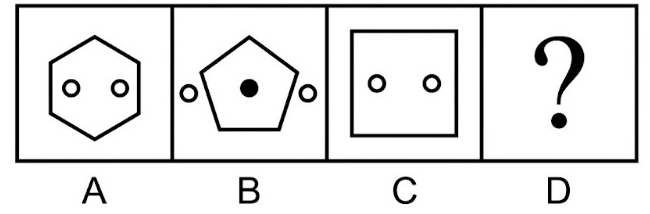
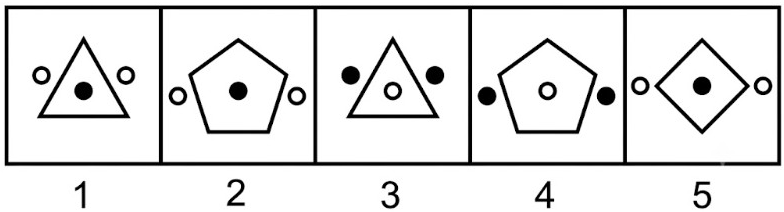
To solve this problem, we need to identify the relationship between figures A and B, and apply the same relationship to figure C to find the correct option from the given choices.
Correct Option: D) The transformation from square to diamond and the circle arrangement matches the pattern from hexagon to pentagon.
Silica is soluble in:
The question asks about the solubility of silica (silicon dioxide, \(\text{SiO}_2\)) in various acids. Silica is known for its chemical inertness, but it reacts specifically with certain strong reagents. We need to identify which of the given acids can dissolve silica.
Correct Option: D) HF — Hydrofluoric acid (\(\text{HF}\)) is unique among common acids in its ability to dissolve silica (\(\text{SiO}_2\)). It reacts with silica to form silicon tetrafluoride (\(\text{SiF}_4\)) and water, or hexafluorosilicic acid (\(\text{H}_2\text{SiF}_6\)) in excess \(\text{HF}\).