
The problem asks us to identify the implicit assumptions from a given statement. An assumption is something taken for granted or accepted as true without proof. We need to analyze the statement and determine what underlying beliefs or facts must be true for the statement to make sense.
C) Both I and II are implicit. As analyzed, the statement implies that plastic persists (non-decomposable) and that this persistence leads to negative consequences for the environment (affects ecological balance).
The question asks for the term that describes the point where all rays converge. This is a fundamental definition in optics, specifically related to lenses and mirrors.
D) focus — The focus (or focal point) is the specific point where parallel light rays converge after reflecting off a concave mirror or passing through a convex lens. Similarly, for a convex mirror or concave lens, it is the point from which parallel rays appear to diverge.
This is a blood relation question. We need to establish the relationships between the individuals mentioned in the problem statement. We can use a family tree or symbolic representation to map out the relationships and then deduce how V is related to E.
Correct Option: C) Brother-in-law
Select the option that can replace the question mark (?) in the following series.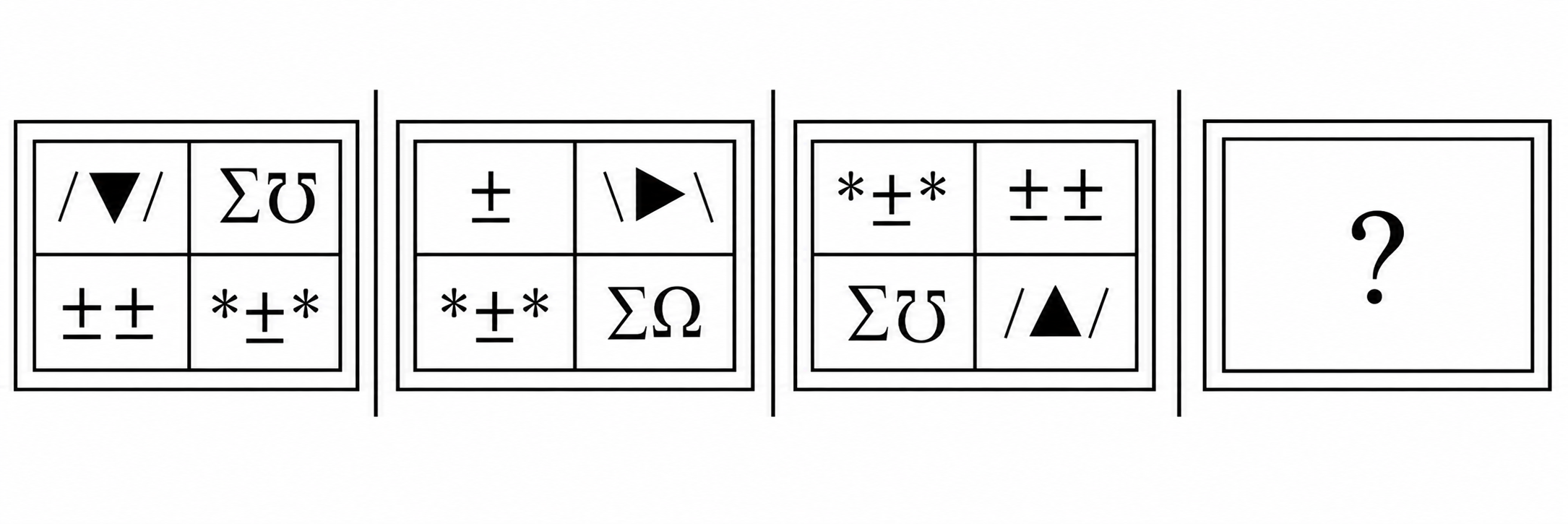
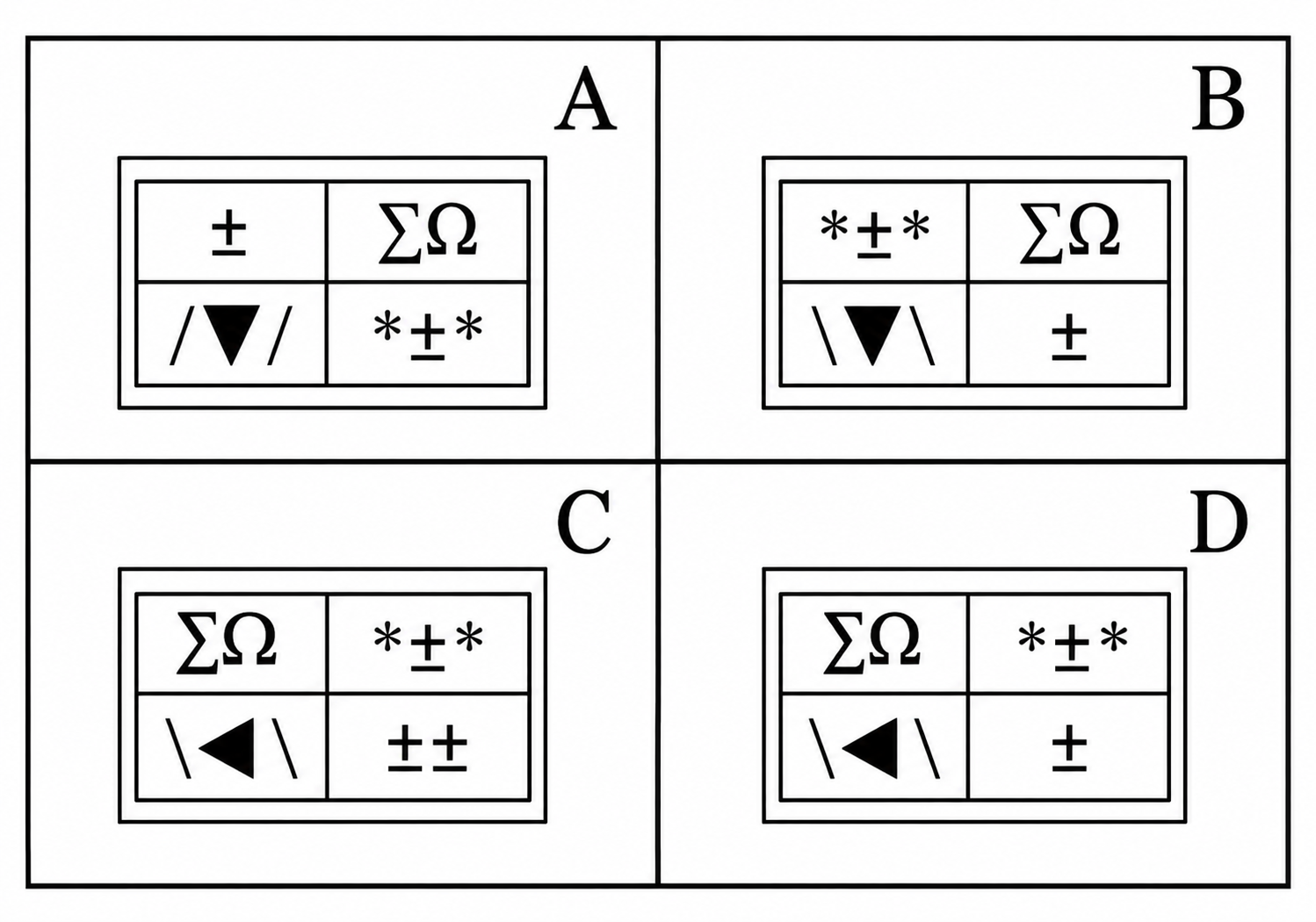
To solve this problem, we need to identify the pattern or rule governing the arrangement of symbols in the given series of diagrams. This involves observing the sequence and rotation of symbols across the diagrams.
By following these transformations, Option B matches the pattern observed in the series.
Correct Option: B) The symbols are arranged in a manner that follows the transformation rule from the previous diagrams.
The problem states that the polynomial \(4x^2 + kx + 5\) is divisible by \(x + 1\). This means that if we substitute \(x = -1\) into the polynomial, the result should be zero (Remainder Theorem). This will allow us to find the value of \(k\). Once \(k\) is known, we can substitute it back into the polynomial and then factorize the quadratic expression to find its other factor.
Given that \(P(x) = 4x^2 + kx + 5\) is divisible by \(x + 1\), by the Remainder Theorem, \(P(-1)\) must be equal to 0.
\[ P(-1) = 4(-1)^2 + k(-1) + 5 = 0 \]\[ 4(1) - k + 5 = 0 \]\[ 4 - k + 5 = 0 \]\[ 9 - k = 0 \]\[ k = 9 \]Now that we have \(k = 9\), the polynomial becomes:
\[ 4x^2 + 9x + 5 \]We need to find two numbers that multiply to \(4 \times 5 = 20\) and add up to \(9\). These numbers are \(4\) and \(5\).
Rewrite the middle term:
\[ 4x^2 + 4x + 5x + 5 \]Since the polynomial is \((4x + 5)(x + 1)\) and it is already given to be divisible by \(x + 1\), the other factor by which it is divisible is \(4x + 5\).
A) 4x + 5 is the other factor of the polynomial \(4x^2 + 9x + 5\).
This is a work and time problem. We will calculate the individual work rates of Garima and her sister. Then, we will set up an equation based on the given conditions where Garima's sister leaves 9 days before completion, and solve for the total number of days.
A) 49 is the correct answer. The total number of days taken to complete the work is 49 days.
To determine which element has the greatest electron affinity, we need to understand the trend of electron affinity across the periodic table, especially for halogens. Electron affinity generally increases across a period and decreases down a group. However, there is an exception for the second-period elements due to their small size and high electron density.
Correct Option: B) Cl
Which of the answer figures is formed from the shapes given in the problem figure?
Problem figure: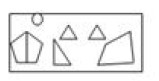
Answer figures: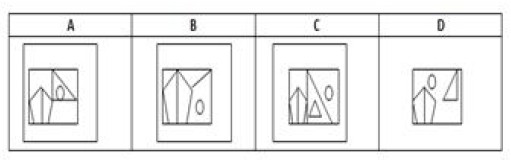
The problem requires identifying which of the answer figures can be formed using the shapes provided in the problem figure. Each shape in the problem figure must be used exactly once to form the correct answer figure.
Correct Option: C) The figure uses all the given shapes correctly.
The question asks to identify the Finance Minister of the Mughal Empire during Emperor Akbar's reign from the given options. This requires knowledge of prominent figures in Akbar's court and their respective roles.
D) Raja Todar Mal — Raja Todar Mal was a prominent administrator and one of the 'Navratnas' in Emperor Akbar's court. He is renowned for his significant reforms in the revenue system of the Mughal Empire. He introduced the 'Zabti' system, also known as the 'Bandobast' system or 'Todar Mal's Bandobast', which involved a systematic survey of land, classification of land according to its fertility, and a fixed revenue assessment based on the average produce of the last ten years. This made him the Finance Minister (Diwan-i-Ashraf) of the Mughal Empire during Akbar's reign.
You are given a question and two statements. Identify which of the statements is/are sufficient to answer the question.
Question:
Nayan has 4 caps of 3 different colours. How many blue caps does he have?
Statements:
1. Nayan has 2 white caps.
2. The number of blue caps he has is the same as that of beige caps.
Statement 1 alone is sufficient.
Statements 1 and 2 together are sufficient.
Neither 1 nor 2 is sufficient.
Statement 2 alone is sufficient.