
The question asks to identify the scientist associated with the theory of evolution. We need to recall the major contributions of the scientists listed in the options to determine the correct association.
Correct Option: B) Charles Darwin is credited with developing the theory of evolution by natural selection, which explains how species change over time through a process of adaptation to their environment.
The question asks for the definition of e-Governance. We need to identify the core characteristic that distinguishes e-Governance from traditional governance.
Correct Option: C) Technology driven governance
e-Governance refers to the application of Information and Communication Technology (ICT) for delivering government services, exchanging information, communication transactions, and integrating various stand-alone systems and services. It aims to improve efficiency, transparency, and accountability in governance.
Valency is the combining capacity of an element. It is determined by the number of electrons an atom needs to gain, lose, or share to achieve a stable outer electron shell (usually 8 electrons, known as an octet, or 2 for the first shell, known as a duplet).
Correct Option: D) 1
To find the square root of 10201, we can use either the long division method or estimation based on the last digit and the number of digits. Since the number ends in 1, its square root must end in either 1 or 9. Also, we can estimate the range by considering perfect squares of numbers like 100.
Therefore, the square root of 10201 is 101.
Correct Option: C) 101
If x + y = 1, then x3 + y3 + 3xy - 1 =?
The problem requires us to simplify the expression \(x^3 + y^3 + 3xy - 1\) given the condition \(x + y = 1\). We can use the algebraic identity for the sum of cubes, \(a^3 + b^3 = (a+b)(a^2 - ab + b^2)\), or the identity for the cube of a sum, \((a+b)^3 = a^3 + b^3 + 3ab(a+b)\).
We are given the condition:
\[ x + y = 1 \]We need to find the value of the expression:
\[ x^3 + y^3 + 3xy - 1 \]Recall the algebraic identity for the cube of a sum:
\[ (a+b)^3 = a^3 + b^3 + 3ab(a+b) \]Substitute \(a=x\) and \(b=y\) into the identity:
\[ (x+y)^3 = x^3 + y^3 + 3xy(x+y) \]From the given condition, we know that \(x+y = 1\). Substitute this into the identity:
\[ (1)^3 = x^3 + y^3 + 3xy(1) \]\[ 1 = x^3 + y^3 + 3xy \]Rearrange the equation to match the expression we need to evaluate:
\[ x^3 + y^3 + 3xy - 1 = 0 \]Thus, the value of the given expression is 0.
A) The value of the expression \(x^3 + y^3 + 3xy - 1\) is \(0\), as derived from the algebraic identity \((x+y)^3 = x^3 + y^3 + 3xy(x+y)\) and the given condition \(x+y=1\).
In an alloy of German silver the ratio of copper to zinc was 19 : 6 while that of nickel to zinc was 7 : 4. The ratio of copper to zinc to nickel in the alloy was:
38 : 12 : 21
133 : 42 : 24
19 : 44 : 4
21 : 12 : 38
To find the combined ratio of copper to zinc to nickel, we need to make the common element, zinc, have the same proportional value in both given ratios. We will find the least common multiple (LCM) of the zinc values in the individual ratios and then adjust the ratios accordingly.
Identify the given ratios:
Rewrite the second ratio to match the order of the first (C:Z:N):
Find a common value for zinc (Z):
Adjust the first ratio \(C : Z = 19 : 6\) to make Z = 12:
Adjust the second ratio \(Z : N = 4 : 7\) to make Z = 12:
Combine the adjusted ratios:
A) 38 : 12 : 21 is the correct ratio of copper to zinc to nickel.
This is a syllogism question. We need to analyze the given statements and determine which of the conclusions logically follow. We can use Venn diagrams or logical deduction to evaluate each conclusion.
D) Neither 1 nor 2 follows.
As determined in the step-by-step analysis, both conclusions contradict or are not supported by the given statements.
Relative density is a dimensionless quantity that compares the density of a substance to the density of a reference substance, usually water. Since it is a ratio of two similar quantities (densities), their units cancel out, resulting in a unitless value.
Correct Option: C) Relative density has no unit
Group the following figures into three classes based on their identical properties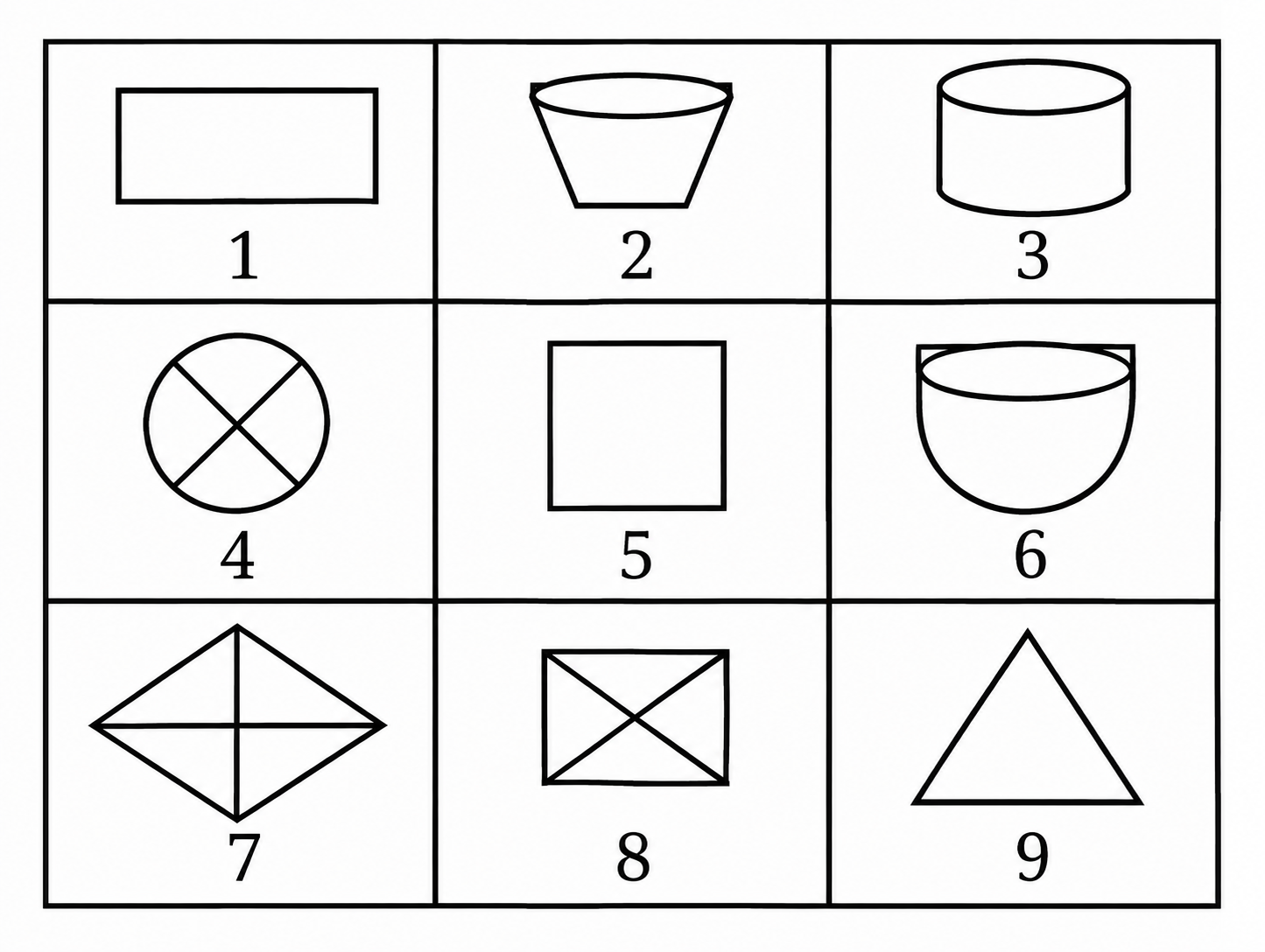
1,3,9; 2,4,6; 5,7,8
1,5,9; 2,4,6; 3,5,7
1,2,5; 3,6,7; 4,8,9;
1,5,9; 2,3,6; 4,5,7;
To solve this problem, we need to group the figures based on their identical properties. The figures can be categorized by their shapes and structural characteristics.
Correct Option: C) 1,2,5; 3,6,7; 4,8,9;
The question asks to identify the incorrect statement about non-metals. We need to evaluate each option based on the general properties of non-metals.
B) Non-metals form cations. This statement is incorrect because non-metals typically gain electrons to form anions, not lose electrons to form cations. Cations are characteristic of metals.